Completed the source map for LP2 pages 27–32 and extended it through page 33 to inspect the transition. No new plaintext. The useful result is a more precise boundary map, not a newly discovered symbol.
The tree the user flagged is archive 49.jpg, corresponding to LP2 page 32. All page numbers below use LP2 numbering. Original JPEGs match the pinned source manifest; images were not restored or redrawn.
What the layout actually shows
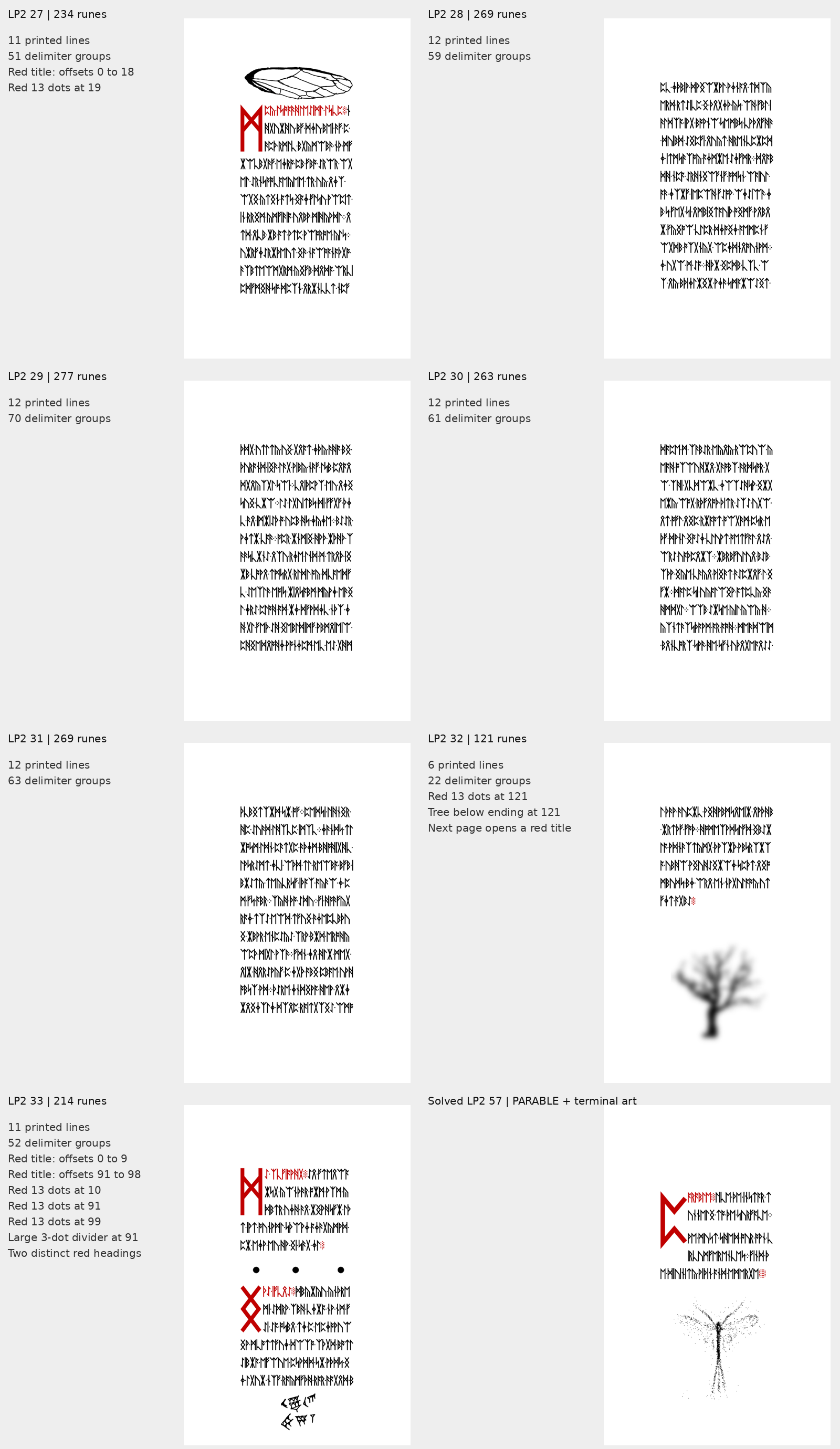
| Page | Runes | Printed lines | Small delimiter groups | Visible structure |
|---|---|---|---|---|
| 27 | 234 | 11 | 51 | Wing-like outline; enlarged red initial; 19-rune red heading; black body text |
| 28 | 269 | 12 | 59 | Black text, continuing from previous page |
| 29 | 277 | 12 | 70 | Black text |
| 30 | 263 | 12 | 61 | Black text, continuing from previous page |
| 31 | 269 | 12 | 63 | Black text |
| 32 | 121 | 6 | 22 | Black text; red 13-dot ending; blurred tree below |
| 33 | 214 | 11 | 52 | Two red headings and text blocks, separated by three large black dots; cuneiform-style signs below |
Headings and body text can share a printed line. Enlarged initials extend down multiple lines, but count as one rune in the transcription.
Pages 27–32 contain 1,433 runes, not the entire 1,524-rune section used in our earlier calculations. The remaining 91 runes occupy the upper block on page 33. That block has its own 10-rune red heading. A three-dot divider follows it; the lower block then starts with an eight-rune red heading.
The earlier section size is correct under the master transcription's $ grouping. What needed correction was our shorthand description of pages 27–32 as the entire section. That grouping is an analytical convention, not proof that all its passages share one cipher state.
The observed sequence is therefore:
- Red heading and extended passage beginning on page 27.
- Red passage ending and tree on page 32.
- A separately headed, 91-rune block on page 33.
- Three large black dots, followed by another red heading and passage.
The tree may accompany the preceding passage. Calling it the section's closing symbol or an instruction to traverse branches would go beyond this evidence.
A fuller punctuation record
The map preserves 378 small delimiter groups across these seven pages, plus the large three-dot divider as a separate event:
| Color and shape | Groups |
|---|---|
| Black single square | 348 |
| Black four-square diamond | 21 |
| Red single square | 4 |
| Red 13-square cluster | 5 |
The single squares correspond to the transcription's hyphens. Both the black four-square marks and red 13-square marks correspond to its periods. Thus a period retains a boundary while losing a visible distinction. No additional missing delimiter was found in the selected text regions.
Each small group has a measured bounding box, constituent component boxes, color, dot count, printed line and rune offset. Counts, ordering and dot classes match the transcription on every mapped line. The alignment remains unchanged under three paired black/red pixel thresholds. This is a segmentation check, not three independent discoveries or a statistical significance test.
Offsets inherit the existing rune transcription. This was not an independent OCR pass or a full re-transcription of every rune. Heading roles, illustration selections and the large divider alignment are manual annotations, explicitly distinguished from measured components.
Continuity matters
Three page seams have no intervening word delimiter in the source convention:
| Seam | Last fragment + first fragment | Joined rune count |
|---|---|---|
| 27 → 28 | ᚾᛈᚠ + ᛈᚳ |
5 |
| 29 → 30 | ᚷᚻᛗ + ᛞᚪᛈᛖ |
7 |
| 31 → 32 | ᛠᛗᚩ + ᛚ |
4 |
These are transcription-level word continuations, not deciphered words. They support retaining continuous reading across those page breaks. They do not prove whether an encryption counter resets at a page boundary.
The repeated six-rune phrase remains at page 27 offset 28, nine runes after the red heading terminator at offset 19. The map supplies no new reason to assign it a particular plaintext.
Compare with solved pages
The established LP2 page 56 reading has a red heading, AN END, followed by a red 13-dot mark at offset 5. The same design also closes its prose at offset 85. Page 57 has PARABLE, followed by a red 13-dot mark at offset 7; its final mark has 23 dots, with an illustration beneath. These source images and counts were previously audited in Session 20.
This comparison supports a document-role interpretation: red typography identifies headings, and red clusters can terminate different kinds of text block. A picture beneath completed text has a solved-page precedent. None of these features by itself establishes a numerical key, reset, or new reading direction.
The tree's blur still prevents a reliable branch graph. Session 18's fixed source-pixel views remain the relevant inversion and negative-space result; this session does not claim a recovered ancient glyph.
Decision and next test
The map does not yield a distinctive cipher instruction, so it does not justify reopening arithmetic searches. The most useful next target is the short, separately headed block immediately after the tree, considered in its structural role before guessing its words.
A bounded next comparison would map the transitions following other illustrated passages and check whether a short red-headed block recurs before a large divider. Record the selection rule before examining those transitions. A match would support a recurring layout template; it would still need independent evidence before being interpreted as an instruction or cipher reset. This broader comparison has not yet been run.
No new-to-community discovery is claimed. The gain is an auditable distinction between page boundaries, headed passages, and the master transcription's larger sections.
Reproduce and inspect
- Pixel extraction and alignment script
- Full page, line, block, delimiter and seam map
- Annotated source-page overview
- Pinned JPEG source manifest
- Previous event ledger
Run python -B page_structure_audit.py with NumPy, SciPy, Pillow and the companion notebook files. Source checksums, threshold settings and limitations are in the output. The script performs no cipher search.