Date: 19 September 2026.
Result: a more precise punctuation map, but no verified glyph or new plaintext. Two red 10-dot marks bracket the complete five-item list from Session 17. Other red multi-dot marks inspected in this local page range have 13 dots. Brightness inversion, reflection and fixed threshold views of the blurred tree do not establish a specific rune, ancient sign or hidden message.
Open the interactive image viewer to compare original source pixels with inversion, mirroring, rotation and four fixed thresholds. It includes the tree, the text above it, punctuation samples, and full LP2 pages 32–39.
1. Which page is the tree?
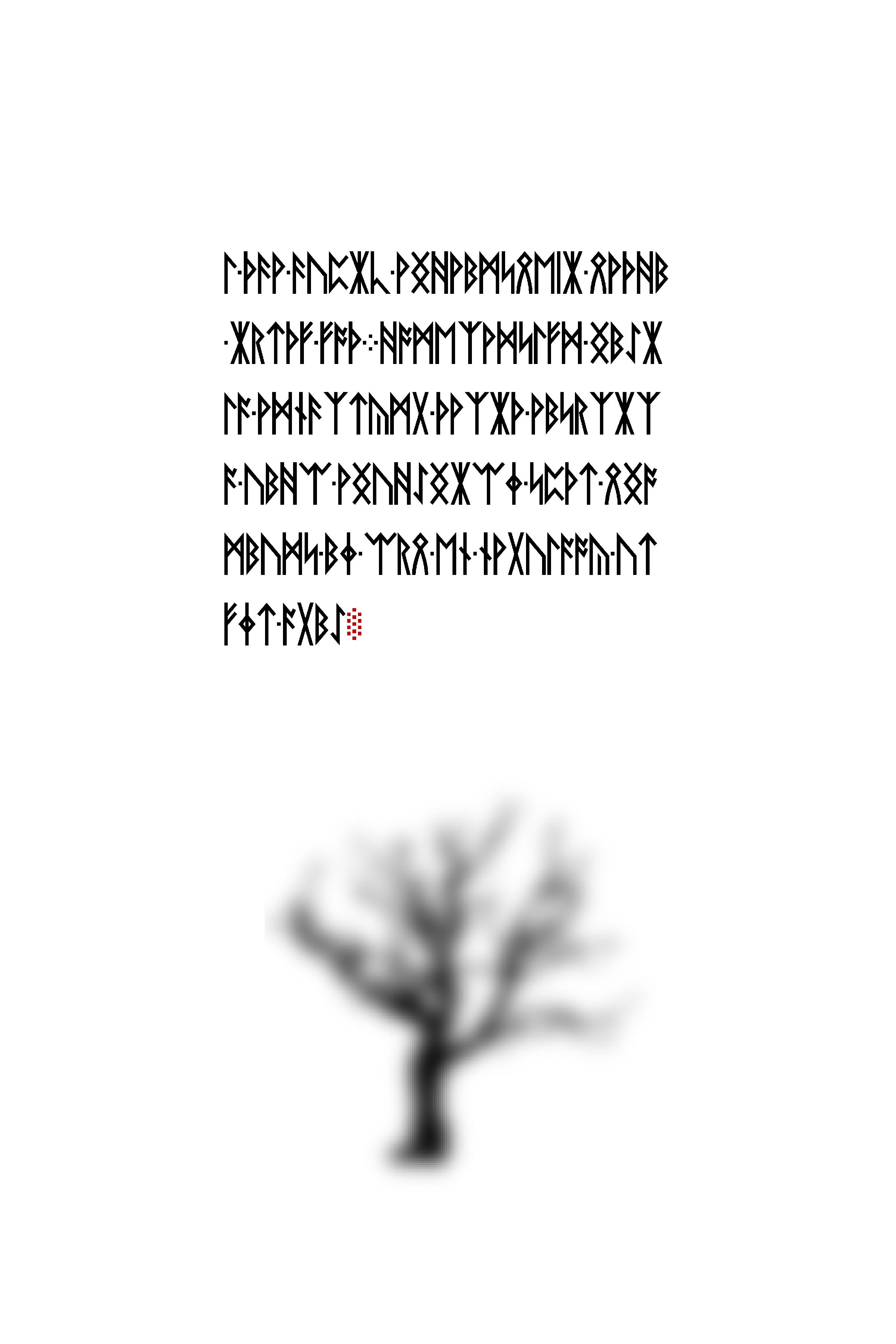
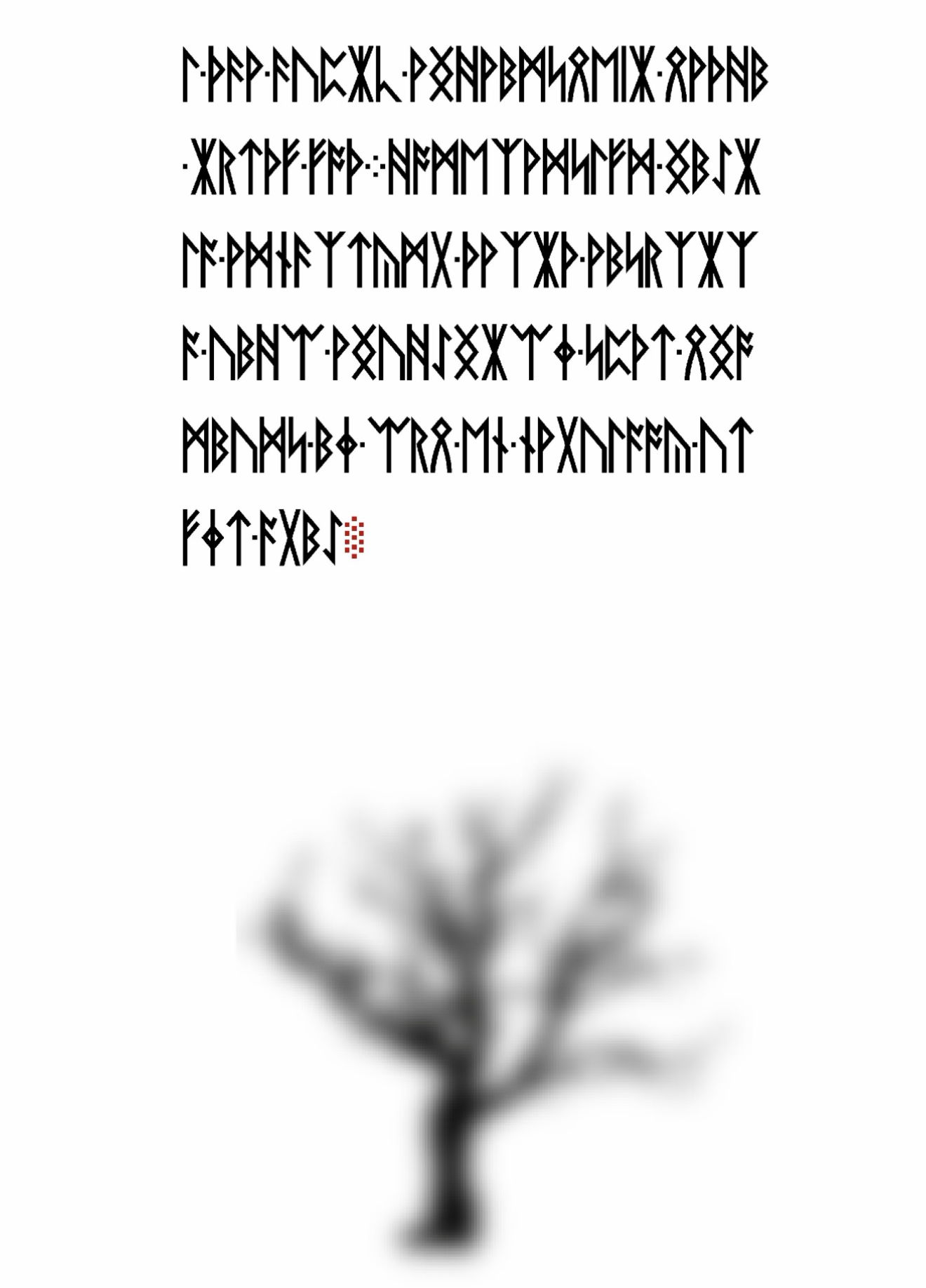
The user's attached image matches 49.jpg in the combined archive, which corresponds to LP2 page 32. This is a numbering difference, not a different tree. The archived original is 2400 × 3600 pixels; the supplied screenshot is 1320 × 1836 and has a different crop. The tree is blurred in the archived original, while the runic text above it is sharp. We have not established the illustration's earlier source or why it was blurred.
The community's LP2 page-32 entry identifies the same page. Its LP2 overview groups pages 27–32 as “Wing & Tree.” That illustration-based grouping is not a substitute for exact textual boundaries: our active cuneiform section begins 91 runes into the following page, LP2 33.
The original 49.jpg, the unaltered user upload, and their SHA-256 hashes are retained. The archive image was already collected in Session 9; this is a more specific analysis of an existing lead.
2. Two distinguishable red punctuation forms
The audit covers LP2 pages 32–39: the tree page plus the seven-page block examined in Sessions 16–17. It counts red multi-dot punctuation, excluding red runes, single word-separator dots and the Arabic list labels.
| LP2 page | Rune offset within that page | Dots | Plain transcription at that boundary | Visible context |
|---|---|---|---|---|
| 32 | 121 | 13 | .& |
End of text above the tree |
| 33 | 10 | 13 | . |
After the first red opening text |
| 33 | 91 | 13 | .&$ |
End of the upper text block, before the new section |
| 33 | 99 | 13 | . |
After the second red opening text |
| 36 | 99 | 10 | . |
Immediately before numbered item 1 |
| 38 | 186 | 10 | . |
After item 5's second sentence, before subsequent prose |
| 39 | 119 | 13 | .& |
End of the upper text block |
| 39 | 122 | 13 | . |
After the lower block's red opening text |
| 39 | 240 | 13 | .&$ |
End of the marked section |
LP2 pages 34, 35 and 37 have no detected red multi-dot marks. Page 37 does contain red Arabic list labels, excluded from this count. All offsets count runes only, from zero. The character & is the transcription's paragraph marker and $ its section marker.
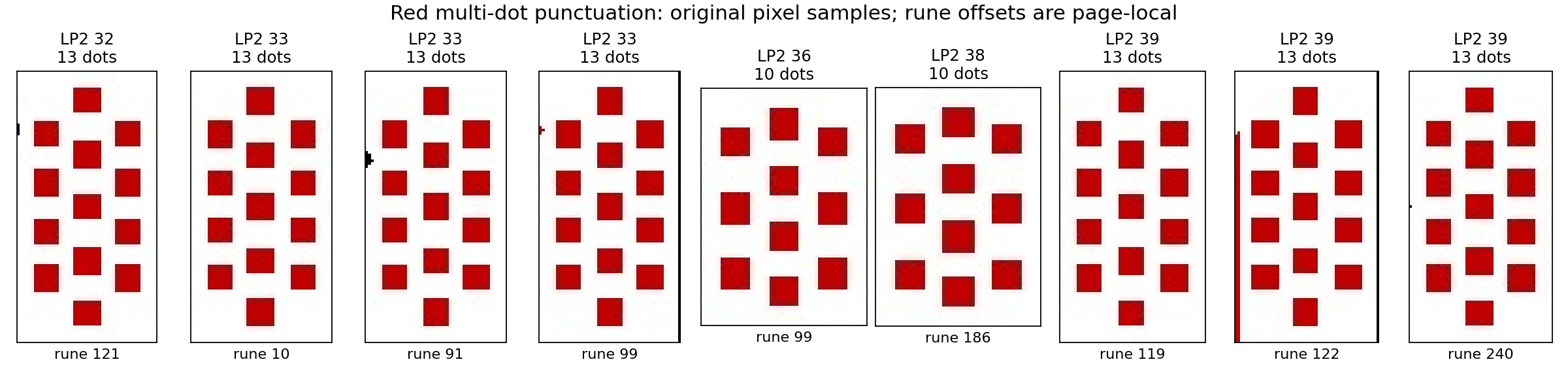
The 13-dot form has columns of 4, 5 and 4 squares; the 10-dot form has 3, 4 and 3. This is a shape and count distinction, not a claim that the dots should be read as the numbers 13 and 10 in a cipher.
The count uses red-channel dominance, connected pixel components and spatial grouping. It agrees at three red-dominance thresholds, 40, 65 and 90, on the 0–255 channel scale. The source-pixel samples above were also inspected visually. Component bounds and all three threshold checks are preserved in the results. This is a limited local audit, not a claim to have discovered previously unknown punctuation across Liber Primus.
3. What this changes about the numbered list
The two 10-dot marks fall at offsets 754 and 1307 in the active 1,589-rune section. Between them are exactly 553 runes and 122 words, matching Session 17's full five-item extraction, including item 5's second sentence. The numeral motif on page 38 falls inside this span and inside item 4.
This strengthens the interpretation that the shorter red marks delimit the whole list. It still does not prove their grammatical meaning or their role in encryption.
There is also an important limit to the transcription criticism: every red multi-dot position in this audit is already represented by a full stop. The lost information is color and mark type, not the existence of every boundary. Session 2's clause-reset tests therefore already reset at these positions, together with other full stops. Paragraph-only resets did not distinguish all of them, and no earlier test in our record selected reset points specifically by the visible 10-dot versus 13-dot form.
Within the active section, the red marks after its start are at offsets 8, 754, 1307, 1468, 1471 and 1589. The transcription has 19 full stops in that section. A rule that resets only at red marks is therefore different from a rule that resets at every full stop. A rule that treats the 10-dot marks as an opening/closing pair is a further, still untested, possibility.
We did not change the historical transcription or rerun a large arithmetic search in this session. The source decisions are now explicit enough to support a targeted next experiment.
4. Inversion, reflection and white space
For this analysis, brightness inversion means replacing each displayed intensity with its complement: 255 − intensity. Reflection means reversing left and right; 180-degree rotation turns the page upside down. These are distinct operations. None reconstructs missing detail from a blurred image.
The tree measurement uses a fixed original-image rectangle: x = 640–1769, y = 2020–3199. The text comparison uses x = 585–1809, y = 650–1749. Coordinates are zero-based. Grayscale uses a fixed rounded RGB luminance formula, documented in the script; no learned restoration, tracing, inpainting or manually completed branches were used.
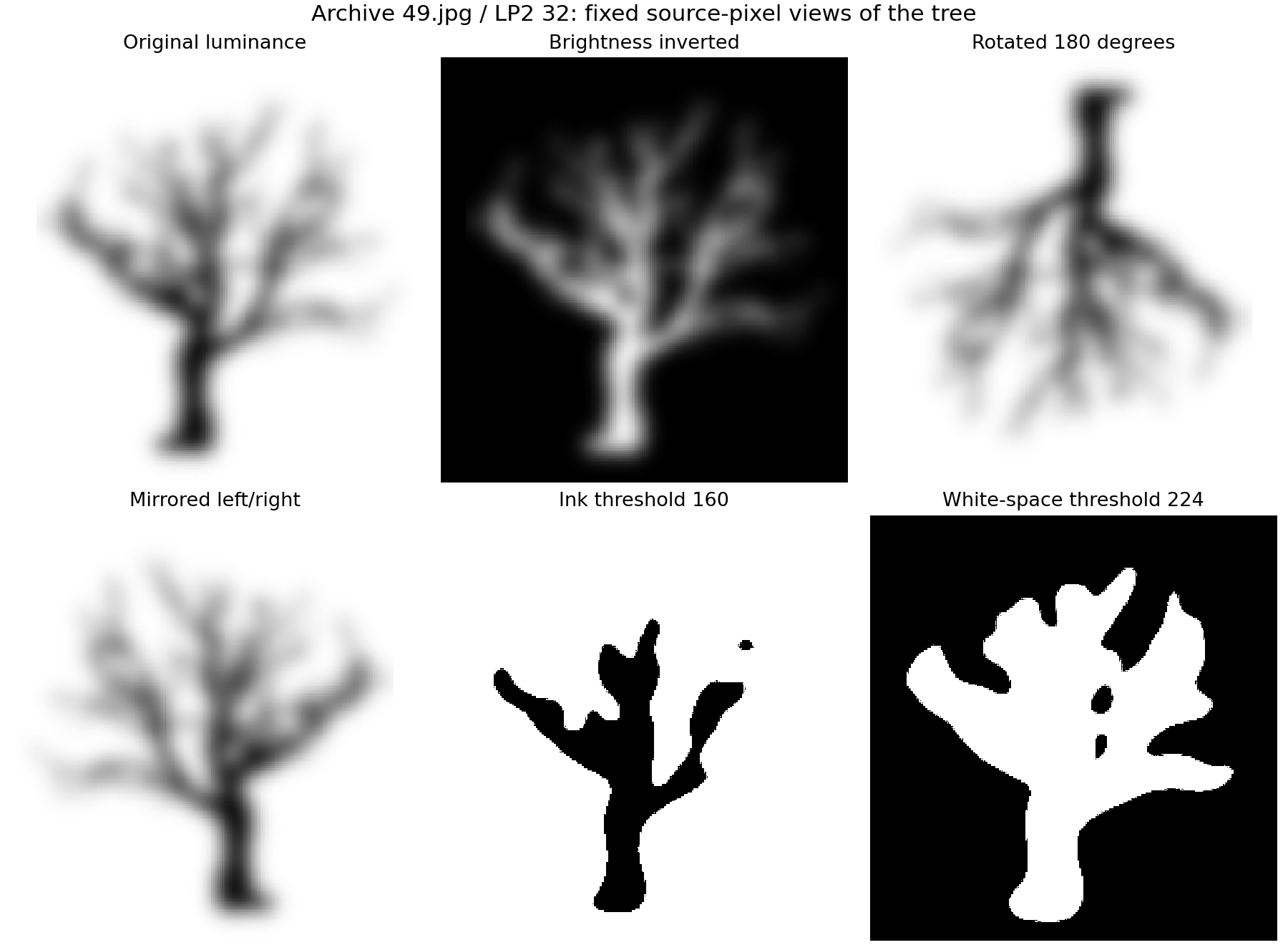
The whole tree, the major gaps between its branches, and the text's inter-line and inter-glyph spaces were inspected in the displayed views. No coherent second sign sequence or reproducible identification of a particular glyph was found. The tree retains a broad branching silhouette under inversion or mirroring. That silhouette alone does not select a rune or an ancient script.
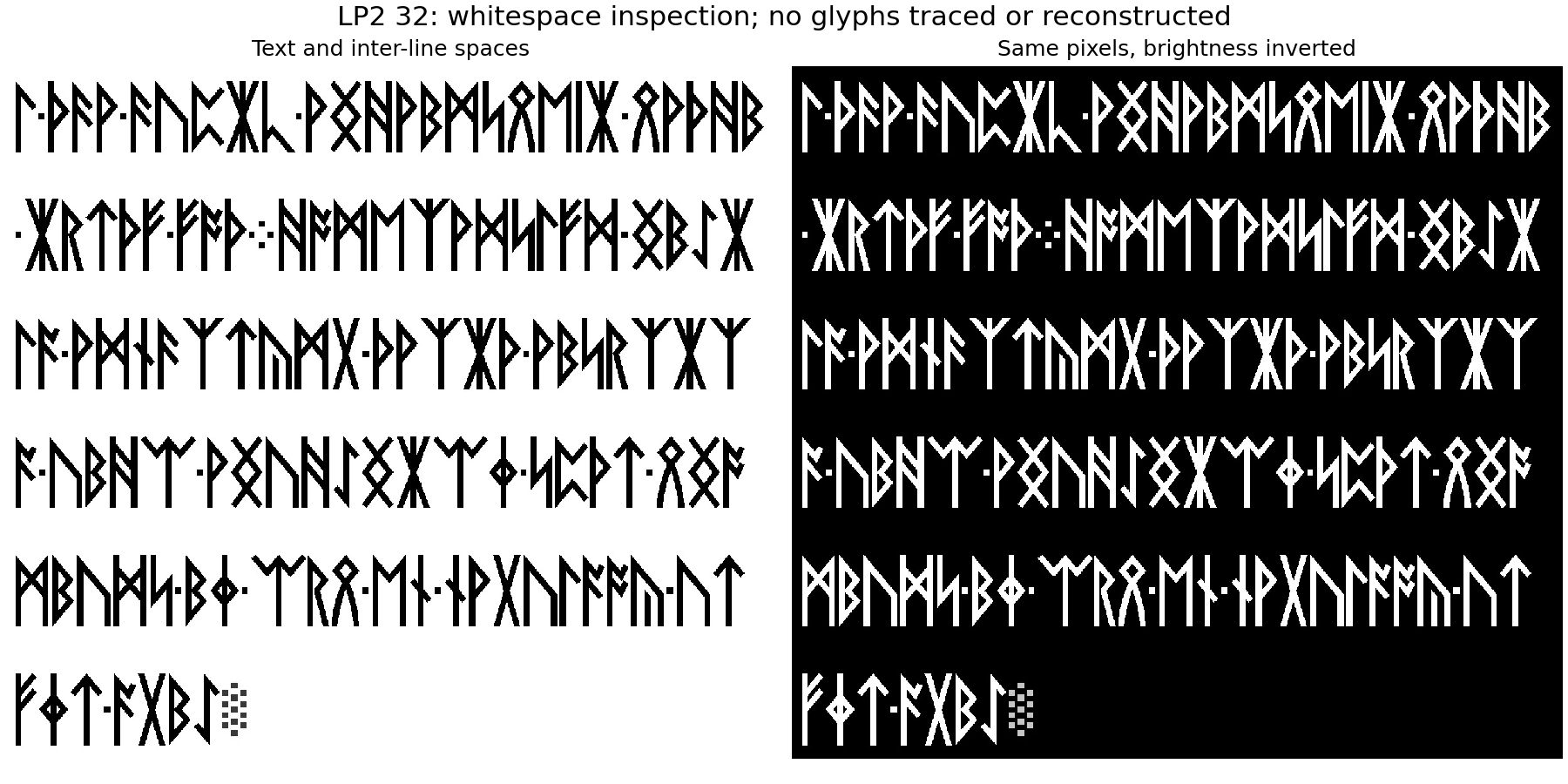
Inversion makes the background dark and the strokes light; it does not automatically isolate a hidden negative-space symbol. The spaces between these text lines remain predominantly horizontal bands in the inspected view. Small angular spaces inside or between rune strokes are expected from the source lettering and are not independently decoded signs.
Does the tree's geometry survive thresholding?
Four brightness thresholds were fixed: 128, 160, 192 and 224. Pixels at or below a threshold count as ink. Eight-connected ink and four-connected white background are measured at native resolution. Components smaller than 25 pixels are excluded from the large-component count but remain in the full results.
| Threshold | Ink components of at least 25 pixels | Largest fully enclosed white component, pixels |
|---|---|---|
| 128 | 3 | 35 |
| 160 | 2 | 10 |
| 192 | 2 | 29 |
| 224 | 1 | 3,573 |
These are connected regions, not branch-tip counts. The changing counts show that faint regions join the main silhouette as the threshold admits more of the blur. At 224, formerly open gaps can close into larger white pockets. At lower thresholds, those substantial enclosed pockets are absent. This does not support treating a particular threshold's outline as a recovered original drawing.
The measurement does not rule out a symbol made from open white channels, an image-level instruction, or a different steganographic method. No exhaustive comparison against historical glyph collections was performed. The negative result is limited to the specified views and measurements.
5. How to pursue the tree without forcing a match
| Hypothesis | What would make it useful | Current standing |
|---|---|---|
| An illustration with thematic meaning | A specific source illustration, distinctive attributes or surrounding plaintext | Plausible category; no source or specific mythology identified |
| A branching read-order instruction | Stable nodes and endpoints, a defined traversal, and a predicted extraction that works elsewhere | No reliable graph or traversal established |
| A hidden negative-space glyph | A specified shape that survives modest processing changes and matches an independently chosen reference | No reproducible identification in this pass |
| An instruction to blur or change viewing scale | A fixed transformation that reveals independently verifiable information | The blur is observed; that instruction has not been established |
World-tree or sacred-tree interpretations can remain thematic hypotheses. The picture alone supplies no distinctive evidence tying it to a particular religion or civilization. Likewise, a broad resemblance to a forked rune is insufficient to identify a character, key or reading direction.
The community marginalia overview also leaves the illustrations' function unresolved. Our result neither authenticates a mythological interpretation nor rules out an eventual visual clue.
Decision
The strongest new constraint in our record is two matching 10-dot marks around the whole list. Next, compare a small, fixed set of rules that treat those two marks as block delimiters with rules that reset at all red marks. Keep black full-stop resets as a baseline, and require any candidate to work beyond the text used to choose its parameters.
The tree and whitespace views remain available for inspection, but no new glyph, translation or cipher solution is claimed.
Reproduction and viewer
- Interactive original/transformed image viewer
- Analysis script: Python, NumPy, Pillow, SciPy and Matplotlib; uses local originals only.
- Measurements, hashes, component bounds and thresholds
- Punctuation samples
- Tree comparison
- Text whitespace comparison
The viewer transforms native source pixels before the browser scales the canvas for display. The downloadable comparison sheets are labeled scientific plots, not restored source images. Four pixel fixtures check the viewer's inversion, grayscale, threshold boundary and preservation of input data. The original archive files remain unchanged.