Is the name itself a clue?
Yes: 3301 had a demonstrated function in the original puzzle. Why the authors originally chose that exact number remains unestablished.
Where the name came from
The opening image in January 2012 was signed 3301. Cicada imagery subsequently appeared on the puzzle website and physical posters. The same early archive records the combined name in the group's PGP key identity. The name joins a numerical signature and an insect emblem; it is not an anagram solution we have recovered. 2012 archive
In the telephone clue, participants were explicitly instructed to multiply three primes associated with the original image. One was 3301. The other two were the image dimensions, 509 and 503:
3301 × 509 × 503 = 845145127
The resulting number supplied the historical website address. This is direct evidence that 3301 was functional puzzle material. It does not explain why that prime was chosen over all others. The original telephone recording is preserved in the archived walkthrough; no historical phone number or domain was contacted in this investigation.
The strongest number-play lead: 3301 and 1033
Reversing the decimal digits gives 1033, also prime. This is more grounded than an arbitrary rearrangement because both numbers already appear in the puzzle material examined in Session 9.
Update from Session 16: there are four visible copies, on pages 33, 35, 38 and 39. The earlier two-page comparison was incomplete. All four have the same visible orientation. The fifteen bounded reading-order settings found no coherent plaintext in the inspected excerpts.
The repeated inscription reads, under the conventional two-place integer interpretation:
| Sexagesimal groups | Calculation | Decimal value |
|---|---|---|
| 17, 13 | 17 × 60 + 13 | 1033 |
| 55, 1 | 55 × 60 + 1 | 3301 |
Historical sexagesimal notation can leave scale ambiguous. These integer readings fit the Cicada context; they do not identify the language of the encrypted prose. Our earlier bounded repeating-key tests using these numbers produced no verified plaintext.
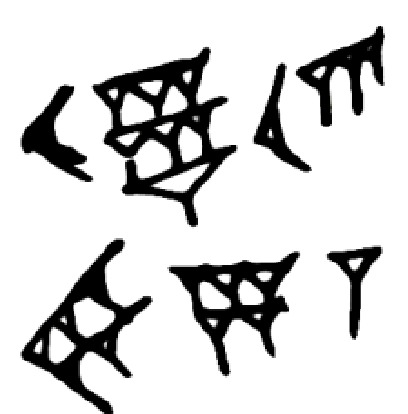
Research crop retained from the earlier source-image audit. See Session 9 and its provenance for the reading and limits.
What about anagrams?
An exact anagram of CICADA must preserve two Cs, two As, one I and one D. That gives 180 distinct letter arrangements. We have not identified an evidence-backed alternative word or phrase. This is not an exhaustive multilingual dictionary search. Expanding it as an acronym would allow even more unconstrained choices.
I also checked all nine distinct four-digit rearrangements of 3301 that do not begin with zero:
| Prime | Composite |
|---|---|
| 1033, 1303, 3301 | 1330, 3013, 3031, 3103, 3130, 3310 |
Only 1033 has the direct reversal relationship and supporting occurrence established in our existing material. Primality alone does not make 1303 a new clue.
These numerical facts were computed directly by trial division through the integer square root. The check is preserved as name_checks.py.
Why a cicada?
Two interpretations fit, at different evidence levels:
Emergence and transformation. The solved text explicitly compares inward development with emergence, and its final parable returns to shedding constraints. This is a strong connection between the emblem and the text, although it does not prove the original naming decision. Solved welcome passage
Prime-number cycles. Periodical cicadas of the genus Magicicada have 13- or 17-year life cycles. Both are prime. That makes a plausible thematic connection to 3301 and the puzzle's explicit interest in primes. This biology does not apply to every cicada species, and it is not an authenticated explanation from the puzzle's authors. University of Connecticut
What this changes
The name is a useful lead because the number demonstrably participates in the puzzle and the insect imagery connects to solved text. The 3301 ↔ 1033 reversal is the most specific name-based direction supported here. A successful follow-up would need a page feature that selects reversal as an operation, identifies what to reverse, and predicts readable output. We should not assume that every appearance of 3301 demands the same operation.
This page records a naming and arithmetic audit, not a new decryption session. No verified new plaintext resulted.