20 September 2026. No stable successor preference established by these models; no new plaintext. Three learned descriptions of which rune follows another failed to beat an equal-probability baseline on separate sections. The immediate-repeat shortage remains the clearer structural constraint.
Question and dataset
Session 25 found that the repeat shortage is concentrated at immediate neighbors and continues across words. This session asks a different question: once the next rune differs from the current rune, are some successors predictably preferred?
The dataset remains the eight substantial unsolved sections: 12,947 runes and 12,939 adjacent pairs, without crossing section boundaries. The separate nine-rune segment is excluded.
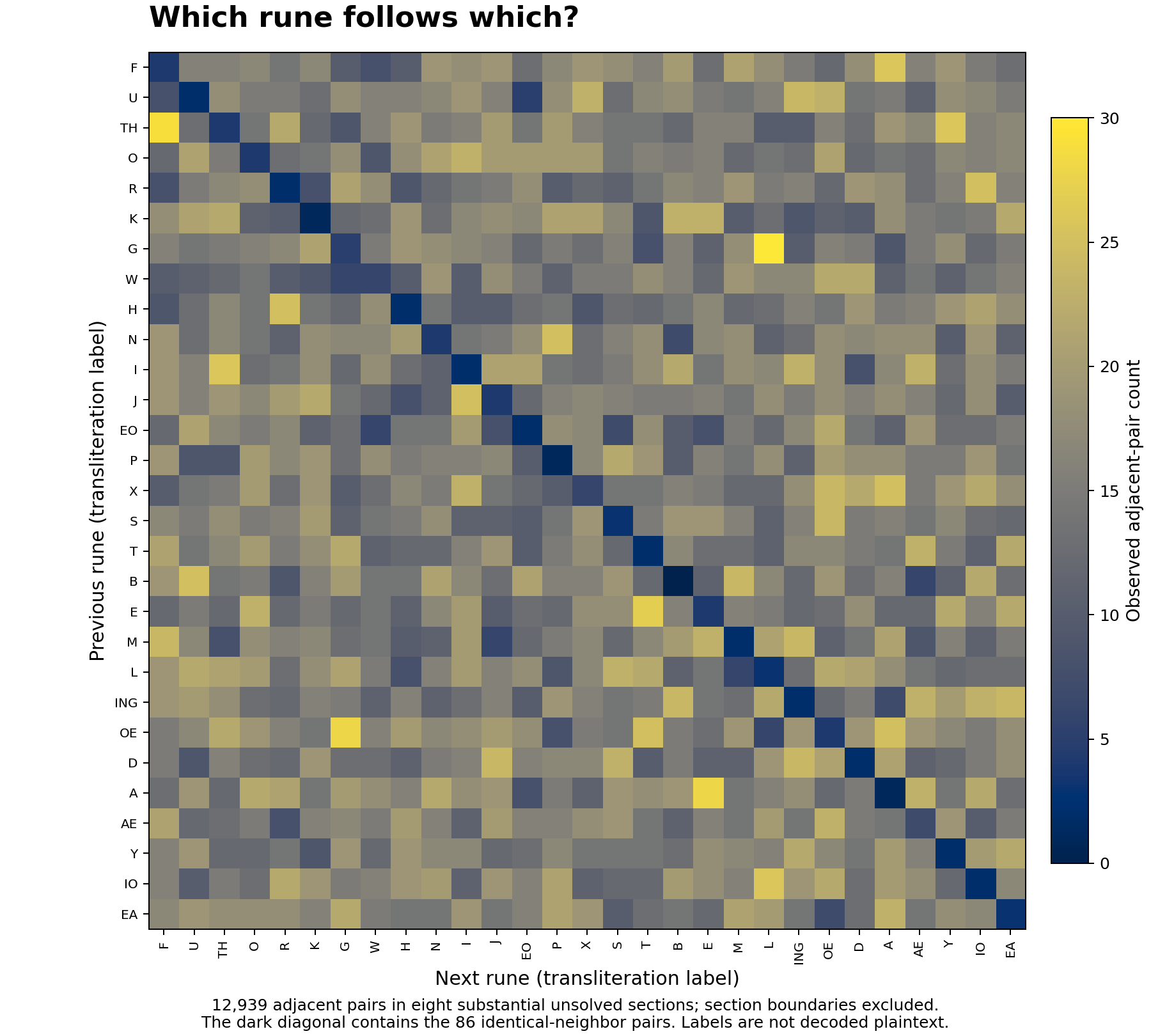
The map includes the diagonal so the already-known repeat shortage remains visible. For fitting and prediction, all 86 identical-neighbor pairs are excluded. This prevents a model from earning credit simply by rediscovering the shortage. The prediction task is conditional on the next symbol being different, not a complete model of the cipher stream.
Fixed models and evaluation
Fit on sections 0, 1, 2 and 4, then evaluate unchanged on sections 5, 6, 7 and 8. That supplies 5,464 training transitions and 7,389 evaluation transitions after removing the diagonal.
| Model | What it learns |
|---|---|
| Uniform reference | Nothing: each of the 28 different successors has probability 1/28. |
| Destination frequency | Whether some runes are generally more frequent as successors, regardless of the preceding rune. |
| Modular step | Preferences for (next − previous) mod 29 in the standard rune order. |
| Full transition table | A separate successor distribution for each preceding rune. |
Destination and modular-step counts receive a fixed 0.5 pseudocount per category. The full table receives fixed shrinkage toward the uniform reference, with concentration 280 per row. These settings were not tuned against evaluation results.
All sections were examined in earlier work. This is a retrospective prediction check, not historically untouched evidence. No English translation, key, alphabet permutation or plaintext was fitted.
Result: extra preferences did not improve prediction
The score below is total log-probability gain, measured in bits, relative to the uniform reference. Positive would mean better prediction; negative means worse. This is not a count of plaintext bits recovered.
| Learned model | Gain on other sections | Gain per transition |
|---|---|---|
| Destination frequency | −40.20 bits | −0.00544 |
| Modular step | −35.82 bits | −0.00485 |
| Full transition table | −115.74 bits | −0.01566 |
The uniform reference wins among these four fixed models. Individual differences are small per transition, but there is no positive predictive gain to justify promoting one of the learned rules.
For example, the P-label followed by the O-label was the largest training-selected excess relative to its row's uniform expectation. It appeared 16 times versus about 7.1 expected in training, but only four times versus about 8.8 expected in evaluation. These labels identify runes, not decoded letters. The ten training-selected pairs are retained in the results; none was selected using evaluation counts.
This is why a bright square in a transition chart is not, by itself, a clue. Looking across hundreds of squares naturally supplies conspicuous candidates, and the candidates need to predict other text.
Keep sequence structure, change rune identities
To test whether the actual rune labels align unusually well with the learned preferences, we made 999 comparisons in which each evaluation section received its own random one-to-one relabeling.
This preserves that section's length, all equality and repetition patterns, and its entire transition structure up to relabeling. It changes which named runes occupy those patterns. Exact named-rune frequencies are therefore not preserved.
| Learned model | Relabeled comparisons scoring at least as well as the real labels |
|---|---|
| Destination frequency | 709 of 999 |
| Modular step | 478 of 999 |
| Full transition table | 292 of 999 |
The actual alignment is not exceptional in these comparisons. The corresponding one-sided simulation comparisons are 0.710, 0.479 and 0.293; a three-model Bonferroni adjustment gives 1.000, 1.000 and 0.879. These are conditional comparisons under a relabeling scheme, not probabilities that a cipher hypothesis is true.
Could preferences be local to each section?
A separate fixed check fitted each section's first 60% and scored its remaining 40%, using the same models and smoothing. The one adjacent pair crossing each split was omitted. Parameters for a section never used its continuation.
Across those continuations, total gains were:
- Destination frequency: −94.83 bits.
- Modular step: −84.06 bits.
- Full transition table: −37.91 bits.
Thus these models did not improve prediction in aggregate even when allowed to learn separately inside each section. Per-section results are retained; this aggregate finding does not assert that every individual model loses on every individual section. Short samples and conservative shrinkage can miss weak or changing patterns.
Checks with constructed data
The same shared-section procedure was applied to synthetic sequences with matching section lengths and a low repeat rate:
| Constructed source | Relevant model | Evaluation gain |
|---|---|---|
| Uniform choice among different successors | Full transition table | −125.88 bits |
| A deliberately favored +1 modular step | Modular-step model | +2,531.72 bits |
| A fixed favored successor in a randomly permuted 29-rune cycle | Full transition table | +2,073.80 bits |
The deliberately strong preferences were detected. The unstructured control lost prediction quality when extra parameters were learned. These examples check useful behavior of the procedure; they do not measure its weakest detectable signal or prove that all real mechanisms would be detected.
Interpretation and next discriminator
The evidence does not support a simple, stable list of preferred next runes or modular steps under the tested fits. It does not prove randomness, eliminate all first-order models, or establish that the cipher remembers only one rune. A changing key, a different mapping between sections, longer context, or a positional rule could conceal such preferences.
The strongest retained constraint is still: immediate repeats are unusually scarce, but ordinary successor identities have not supplied a reusable prediction. That suggests treating repeat suppression and any underlying encryption as potentially separate questions. It does not establish a two-layer cipher.
A useful next check would inspect whether the rare actual doubles occur in a shared local context, such as a particular kind of word or delimiter position. That could distinguish occasional exceptions from an ordinary low-probability transition. It should be fixed in advance and compared with a model that already preserves the low repeat rate. Another unrestricted key search is not justified by the present result.
Reproduce
- Prediction and relabeling code, Python with NumPy.
- Full matrices, scores, per-section checks and controls.
- Count-map code, Python with NumPy and matplotlib.
- Standalone count map.
- Previous distance/boundary investigation.
Seed 3301026; 999 relabelings. The source hash is retained. Counts use the existing master transcription and previous provenance checks, not a new transcription or authentication of every page.