20 September 2026. No concentration established in the tested layout contexts; no new plaintext. The 86 immediate-repeat events do not show a clear preference for word endings, punctuation, line boundaries, word lengths or section quarters after accounting for opportunities and the declared set of comparisons.
Fixed question and comparison
This pass inventories every immediate repeated pair in the eight substantial unsolved sections. It retains the previous scope: 12,939 eligible adjacent positions and 86 repeated pairs. Section boundaries and the separate nine-rune segment are excluded.
Twenty-one binary features were fixed before viewing results:
- Six mutually exclusive word-position categories.
- Six word-length categories, including a separate across-word category.
- Punctuation in the rune gap before, between or after the pair.
- Transcribed line or page boundaries between the pair.
- Four approximately equal quarters of each section.
Features from different groups overlap. Some duplicate the same set of positions, such as a two-rune word and the length-two category. The correction described below preserves those dependencies rather than counting them as independent evidence.
The comparison keeps each section's actual number of repeats fixed and places that many events uniformly among its eligible positions, without replacement. It therefore incorporates the already-known repeat shortage instead of comparing these exceptions with an ordinary 1-in-29 repetition rate. There were 9,999 random placements, seed 3301027.
This is a model of repeat-event locations, not a shuffle or decryption of the rune text. It assumes positions within a section are exchangeable under the no-layout-association hypothesis. It does not preserve rune-specific diagonal counts or rule out dependence on longer symbol context.
Word positions
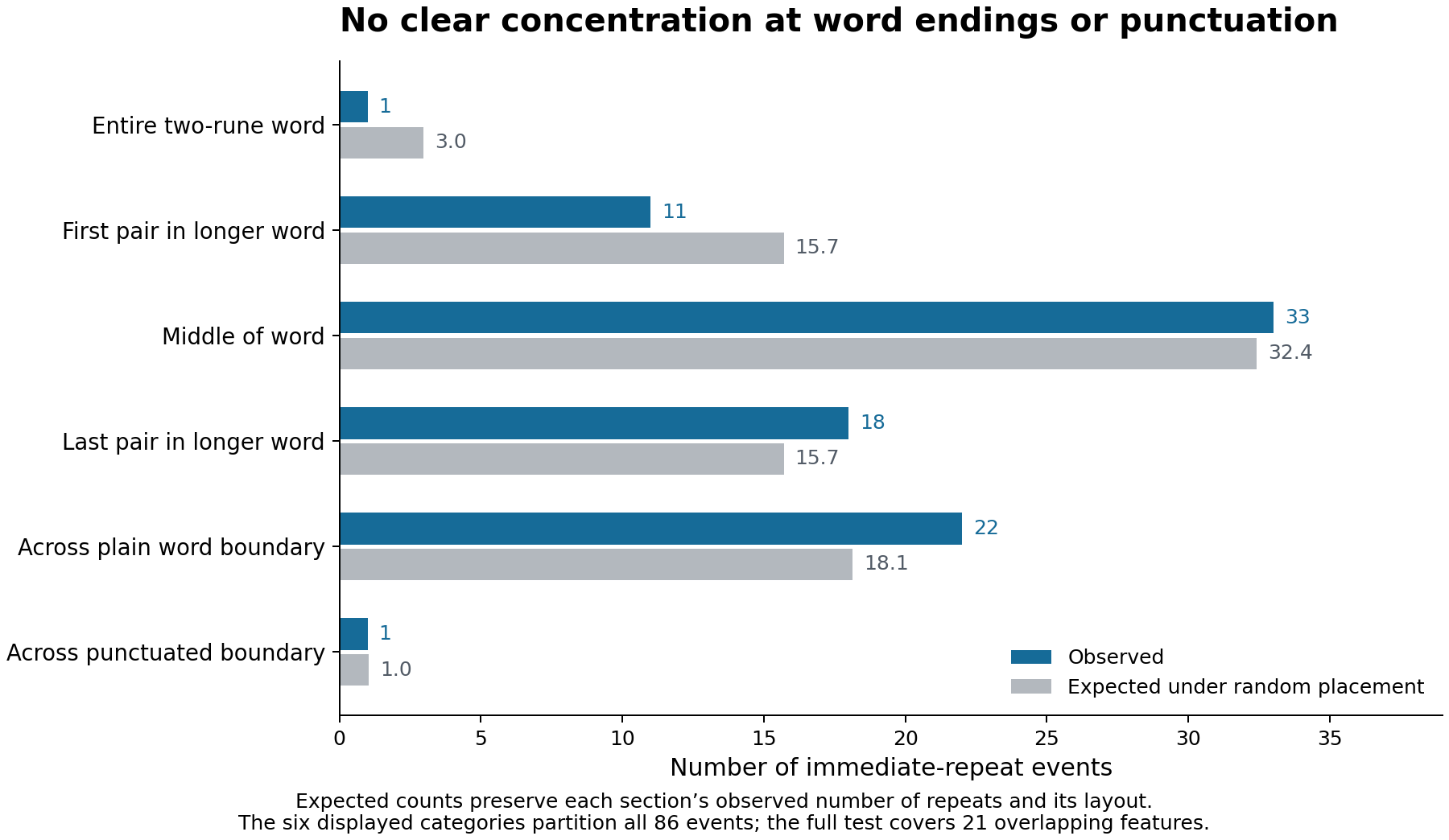
| Position | Observed repeats | Eligible positions | Expected repeats |
|---|---|---|---|
| Entire two-rune word | 1 | 449 | 2.99 |
| First pair in a word of at least three runes | 11 | 2,362 | 15.70 |
| Middle of a word | 33 | 4,877 | 32.41 |
| Last pair in a word of at least three runes | 18 | 2,362 | 15.70 |
| Across a plain word boundary | 22 | 2,730 | 18.15 |
| Across a punctuated word boundary | 1 | 159 | 1.05 |
The middle of a word contains the most repeats because it supplies the most eligible positions. Word endings have somewhat more repeats than beginnings, but these differences are not exceptional in the conditional comparison. The table's six rows account for all 86 events.
Punctuation, layout and lengths
| Context | Observed | Expected |
|---|---|---|
| Punctuation in the gap before the pair | 2 | 1.05 |
| Punctuation between its runes | 1 | 1.05 |
| Punctuation in the gap after the pair | 1 | 1.10 |
| Pair crosses a transcribed line boundary | 4 | 3.89 |
| Pair crosses a page boundary | 0 | 0.32 |
Zero repeats at page boundaries is not strong evidence of a reset rule: there are only 48 eligible page-crossing positions in this scope, and the expected count is already below one.
Within words, the observed counts by length are 1, 10, 12, 21 and 19 for lengths 2, 3, 4, 5–7 and 8+. Their corresponding expectations are approximately 2.99, 9.58, 10.16, 25.60 and 18.49. None supplies a supported concentration.
Section-quarter counts are 25, 28, 19 and 14, compared with about 21.5 expected in each. The final-quarter deficit is the largest standardized deviation among the 21 declared features. Its unadjusted two-sided comparison is 0.0782. Accounting for the maximum deviation across the entire feature family gives 0.6614. This is a comparison under the stated placement model, not a 66% probability that the cipher is random.
What punctuation means in this analysis
The flags detect the transcription characters ., ,, & and §. “Plain boundary” means none of those characters occurs in the relevant gap; it does not assert that the original image has a particular dot color or layout.
Adjacency means adjacency in the rune-only stream. Non-runic content can intervene. In particular, one gap before a repeated pair at the start of LP2 page 51 spans the preceding numerical material. The raw gap is retained in the inventory; its punctuation flag does not imply that every punctuation mark in that gap is physically close to the pair.
Red color, dot counts and distances measured in image pixels were not tested. Those require separate image annotations. This limitation matters when interpreting a hypothetical punctuation-triggered exception.
Two image spot-checks
Two selected events were checked visually against the retained page images:
- LP2 page 35, zero-based rune offsets 195–196: the only whole two-rune repeated word, TH–TH. It is visible on the ninth text line of archive image 52, between word separators.
- LP2 page 34, offsets 210–211: A followed by A across the transcribed clause delimiter. It is visible on the tenth text line of archive image 51.
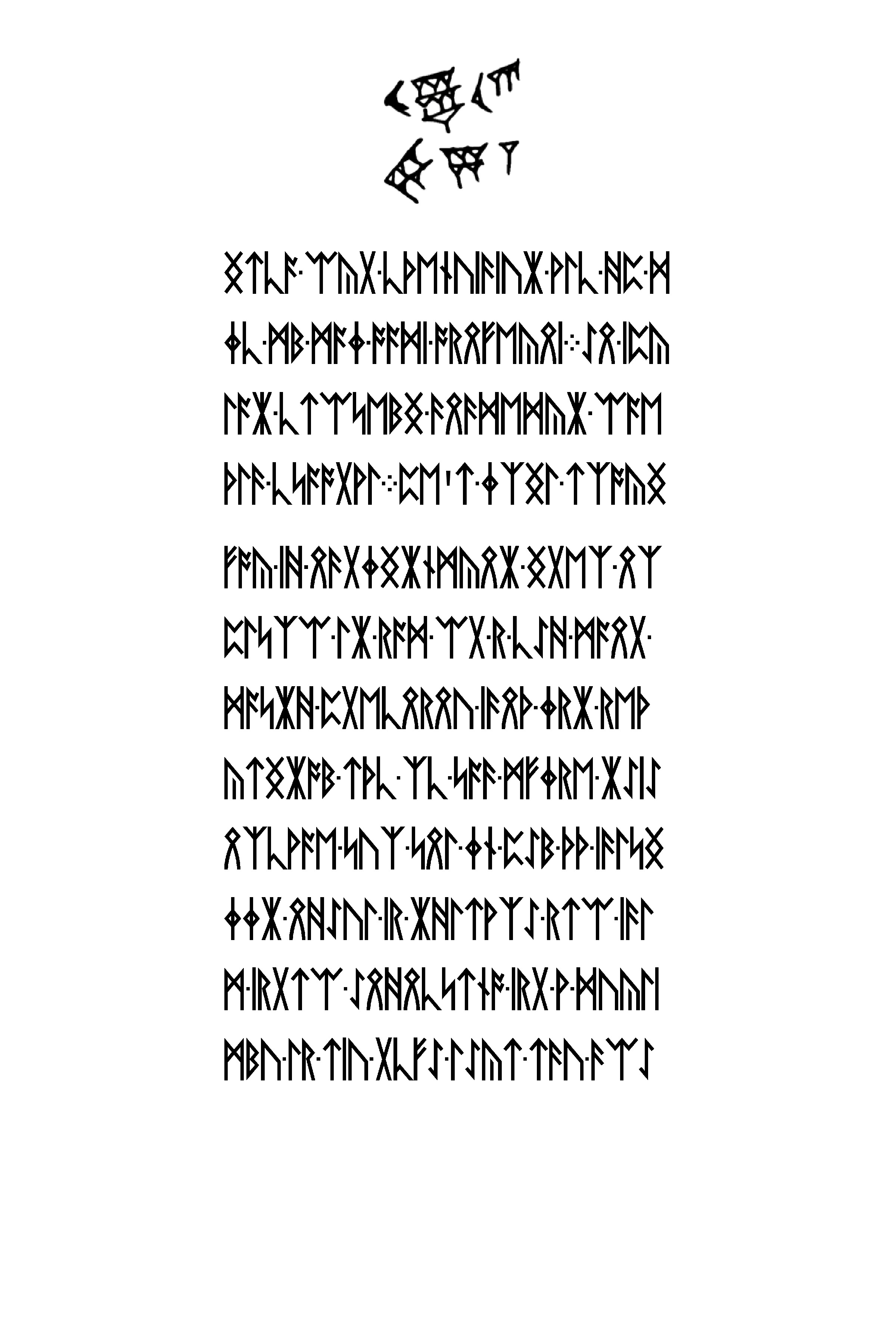
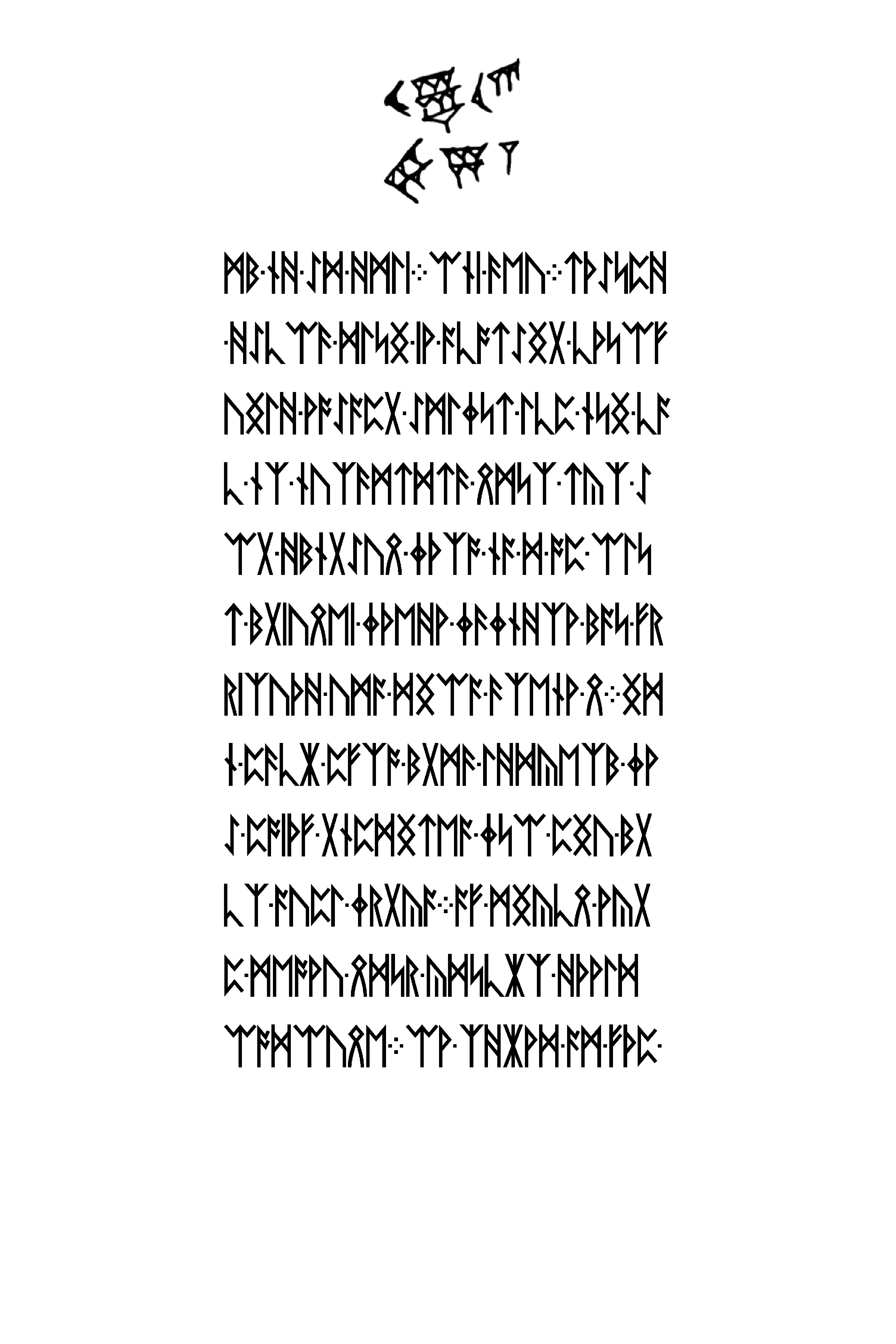
These checks support the transcription at those locations. They do not verify every one of the 86 events, authenticate the images' origin, or decode the rune labels. Image fingerprints and locations are retained in the spot-check record.
Statistical scope and conclusion
For every feature, the expected count and variance were computed from the fixed section totals using the conditional hypergeometric model. The largest absolute standardized deviation across all 21 features supplied the family-wide comparison. No feature is promoted as a detected exception marker.
This analysis is retrospective and does not correct for every idea explored across the whole research project. Counts around punctuation and page boundaries are small, so weak or specialized effects could be missed. Lack of detection does not prove that layout is irrelevant.
What we can say is narrower: these 86 events do not require a word-ending or punctuation exception to explain their measured locations. The current evidence remains compatible with occasional repeats spread through the text under a generally low-repeat process. That is a statistical description, not a cipher identification.
The event inventory now makes further source checking concrete. Before assigning meanings to individual doubles or treating them as special plaintext letters, their original-image context should be verified. An unrestricted search for exception rules would risk fitting these 86 events rather than explaining them.
Reproduce and inspect
- Analysis code, Python with NumPy.
- All 21 measurements and the complete 86-event inventory.
- Plot code, Python with NumPy and matplotlib.
- Standalone comparison plot.
- Two image checks and hashes.
- Previous transition-prediction check.
The inventory records the rune identity, section offset, LP2 page and page offset for both runes, word lengths and positions, neighboring transcription gaps, and a short rune context. Page and rune offsets are zero-based. The retained master transcription's hash is included.