20 September 2026. No new plaintext or identified cipher. The measured shortage is concentrated at immediate neighbors, continues across word boundaries, and affects both pairing phases. That narrows some simple explanations without selecting a unique mechanism.
What is new in this pass
Session 4 measured the repeat deficit and tested linear feedback. Session 5 confirmed the community chart, used pair-preserving comparisons, and tested several changing-alphabet and previous-symbol-exclusion decoders. Those experiments were not rerun here.
This pass fixes three diagnostic questions before inspecting results:
- Does the shortage continue at distances 2 through 12?
- Does it disappear at word boundaries?
- Is it confined to one of two alternating pair positions?
The dataset is the eight substantial unsolved sections, containing 12,947 runes. The separate nine-rune segment is excluded. Section boundaries are not crossed. Delimiters do not occupy rune positions. A distance of two means one intervening rune.
1. Immediate neighbors are the main anomaly
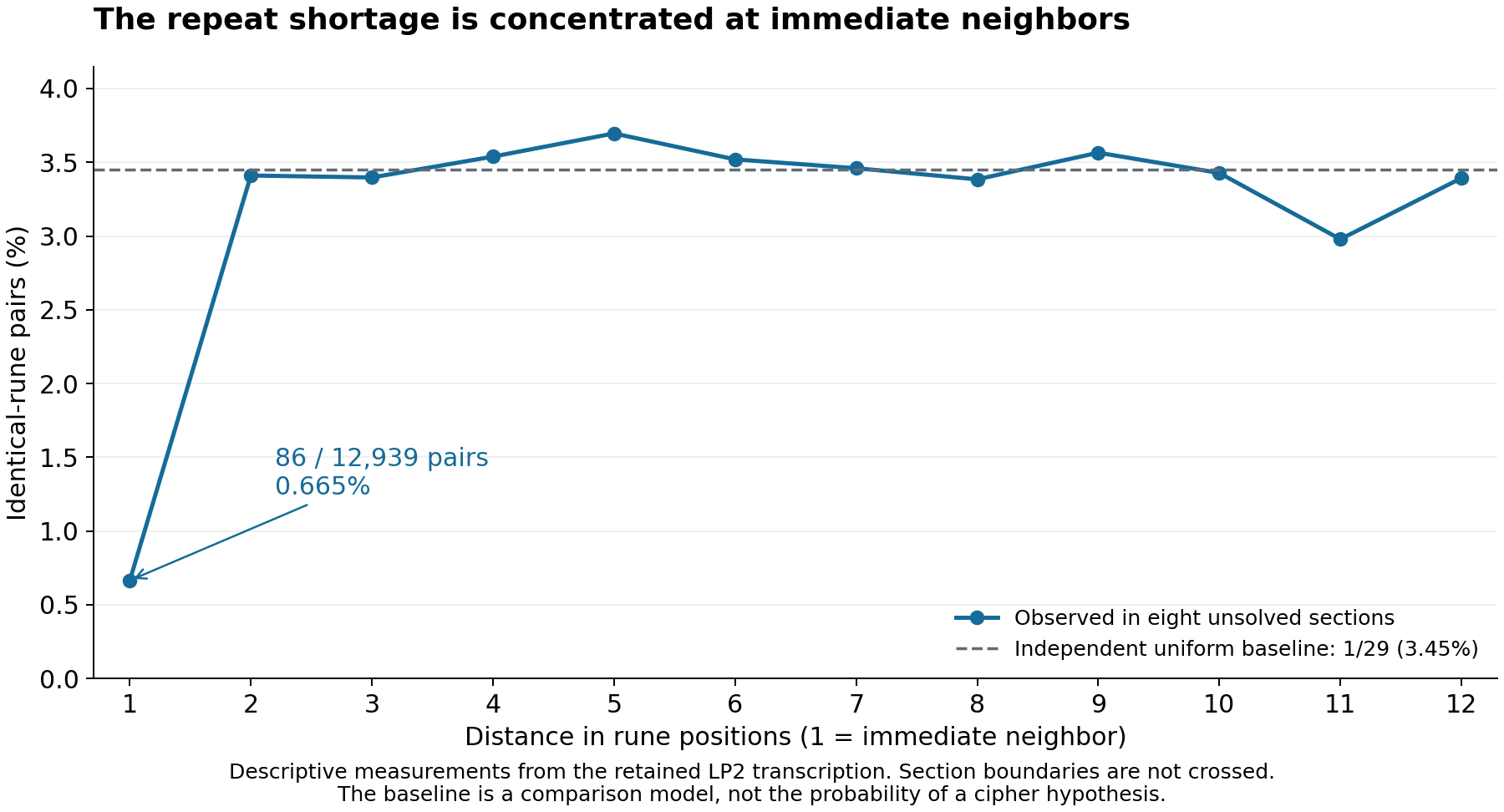
| Rune distance | Identical pairs | Eligible pairs | Rate |
|---|---|---|---|
| 1 | 86 | 12,939 | 0.665% |
| 2 | 441 | 12,931 | 3.410% |
| 3 | 439 | 12,923 | 3.397% |
| 4 | 457 | 12,915 | 3.539% |
| 5 | 477 | 12,907 | 3.696% |
| 6 | 454 | 12,899 | 3.520% |
| 7 | 446 | 12,891 | 3.460% |
| 8 | 436 | 12,883 | 3.384% |
| 9 | 459 | 12,875 | 3.565% |
| 10 | 441 | 12,867 | 3.427% |
| 11 | 383 | 12,859 | 2.978% |
| 12 | 436 | 12,851 | 3.393% |
Independent uniform draws from 29 runes give 3.448% equality at any distance. That is a deliberately simple reference, not a claim that the ciphertext should be independent or exactly uniform. Earlier inventory-preserving comparisons provide stronger evidence for the adjacent-pair deficit.
Distance 11 is lower than nearby distances, but this pass does not turn that single dip into an 11-rune period claim. In the evaluation sections below it lies near the lower edge of the descriptive simulation band. The overall shape is a sharp distance-one drop, not uniformly low repetition throughout a recent-symbol window.
A strict rule forbidding reuse of either of the last two runes is incompatible with the observed distance-two repetitions unless it adds exceptions. A softer recent-window rule is not excluded.
2. Word boundaries do not restore the ordinary rate
| Position of adjacent pair | Identical pairs | Eligible pairs | Rate |
|---|---|---|---|
| Within a word | 63 | 10,050 | 0.627% |
| Across a word boundary | 23 | 2,889 | 0.796% |
These reproduce the earlier scoped counts. They are consistent with suppression carrying through word boundaries. A model in which every new word starts with an independent uniform rune instead predicts about 99.6 equal boundary pairs, rather than 23.
That comparison weighs against that specific reset model. It does not rule out all word-based ciphers: nonuniform starts, correlated keys or extra constraints could change the prediction. The observed across-word rate is somewhat higher than the within-word rate; no claim of exact equality is made.
3. Neither pairing phase is an ordinary-rate channel
Phase is the zero-based position of the left rune in each adjacent pair. Both possible alignments of fixed pairs are covered by comparing phases zero and one.
| Counter starts at | Phase 0 repeats / pairs | Phase 1 repeats / pairs |
|---|---|---|
| Section start | 44 / 6,471 (0.680%) | 42 / 6,468 (0.649%) |
| Page start | 35 / 6,484 (0.540%) | 51 / 6,455 (0.790%) |
Page counters retain the actual offset when a marked section begins partway through a page; they do not silently restart at the section boundary.
A simple model that suppresses equal runes only inside each encoded pair, leaving independent uniform behavior between pairs, should restore roughly a 3.45% rate in one phase. Neither alignment shows that behavior. This weighs against that restricted pair-only explanation, not every digraph cipher or possible layered system.
All 29 runes occur at both odd and even positions under both counter conventions. Strict alternation between two disjoint symbol sets is therefore excluded for these conventions. Overlapping or changing sets remain possible.
4. Occasional repeats are not just an F exception
The 86 doubles involve 28 of the 29 rune identities. Only four are F–F, leaving 82 non-F doubles. A claim that all observed equal neighbors are literal F–F exceptions does not fit the transcription. This does not exclude more complicated selective-F behavior as part of another cipher.
For context, the five retained known LP1 plaintext groups contain 47 equal-neighbor pairs among 1,958 eligible positions, about 2.40%. A fixed one-to-one substitution preserves equality, so it would preserve that rate on those particular plaintexts. This is a limited reference sample, not proof that every possible English plaintext must have the same rate.
5. A deliberately small model comparison
We fitted just one number on sections 0, 1, 2 and 4: the probability of repeating the previous rune, 29 / 5,493 = 0.528%. The illustrative generator:
- Starts each section with a uniform random rune.
- Repeats the previous rune with the fitted probability.
- Otherwise selects uniformly among the other 28 runes.
- Does not restart at words or pages.
This is a statistical description, not an encryption algorithm. It has no plaintext, key or reversible decoder.
We generated 999 samples with the lengths and boundary positions of sections 5, 6, 7 and 8. Those sections were not used to fit this run's probability, but they have been examined before, so this is retrospective validation rather than untouched evidence.
The toy process reproduces the broad shape: very few adjacent repeats, followed by rates near 1/29 at longer distances. Every evaluated distance from 2 through 12 falls inside its individual central 95% simulation interval.
It also has limitations worth recording: the evaluation text contains 57 adjacent repeats, compared with a model mean of about 39.5 and an individual interval of 28–53. Across-word repeats are 17, compared with a mean of 8.9 and interval of 3–15. The fitted rate therefore underpredicts these observed counts. Those bands treat the training estimate as exact and omit its uncertainty; they do not establish different rules between sections.
A descriptive simultaneous check over all 12 distances puts the observed maximum standardized discrepancy below the simulated 95th-percentile threshold. That is not a formal probability that the model is correct, and it does not erase the count differences above. The process also does not explain the established repeated six-rune phrase, which remained unusual under the stricter pair-preserving comparisons in Session 5.
What this narrows
| Proposed explanation | What this pass says |
|---|---|
| Suppression tied mainly to the preceding rune, continuing across words | Compatible with the main shape; still many possible mechanisms |
| Avoid every recently used rune over a multi-rune window | Strict versions conflict with many distance-two repeats; soft versions remain open |
| Independent uniform restart at every word | Predicts substantially too many boundary repeats |
| Suppression only within fixed pairs, with independent uniform pair boundaries | Both phases remain too repeat-poor for this restricted model |
| Strict disjoint alphabets alternating by position | All 29 symbols occur in both positions |
| Every observed double is F–F | 82 of 86 doubles are non-F |
The useful working constraint is now more precise: a candidate mechanism should suppress equality mainly at distance one, carry that behavior across word boundaries, permit occasional repeats of nearly every rune, and still account for the repeated six-rune phrase. Meeting these constraints would only justify testing a decoder. Coherent plaintext and unchanged continuation behavior would still be required.
No new brute-force key search was justified by this diagnostic alone. Arbitrary nonlinear rules or unknown alphabet permutations remain too flexible to infer from one statistic. The next structural discriminator should examine the full transition table and its context, rather than treating this one-step toy process as the answer.
Reproduce and inspect
- Analysis code, Python with NumPy.
- Counts, per-section measurements and simulation results.
- Plot code, Python with matplotlib.
- Standalone plot.
RNG seed 3301025; 999 simulations. The result records the master transcription hash. Checks verify the toy model's lag-one identity and independent-uniform limiting case. The analysis relies on the retained transcription and previous archive/image checks; it does not newly authenticate or transcribe every original page. No discovery priority is claimed for these diagnostics.