No unusual local change in rune frequencies was found at the five red headings inside our existing sections. The largest observed change is ordinary under the fixed comparison. A constructed strong change is detected. This is not evidence that every heading shares one cipher state, and no plaintext was recovered.
What this adds to the earlier tests
Session 27 tested where the rare immediate repeats occur relative to transcription punctuation and layout. It did not distinguish red typography. Session 19 tried specified arithmetic counter rules at audited red marks in one section. Those are different questions from the present one.
Here we ask whether visually identified openings reveal a change in rune composition that our larger transcription-based sections concealed. We do not select a key, reset rule, plaintext label or numerical stream.
The relevant boundaries
The source review identifies 13 red introductory spans with enlarged initials in the unsolved pages. Eight begin at the starts of existing substantial sections. Five occur inside them:
| LP2 page | Heading rune span on page | Heading length | Offset within old section |
|---|---|---|---|
| 3 | 119–121 | 3 | 119 |
| 6 | 71–81 | 11 | 812 |
| 33 | 0–9 | 10 | 1,433 |
| 39 | 119–121 | 3 | 1,468 |
| 54 | 0–8 | 9 | 3,008 |
Offsets are zero-based. Page 33 is the short passage immediately after the tree. The nine-rune number-square label is a separate existing section without an enlarged initial and is not one of these openings.
There is a useful distinction within the broader inventory: on pages 8 and 40, the red opening words end at an ordinary single-square word separator and continue into black text. Their colored spans contain 12 and 8 runes, respectively. They should not automatically be treated as separately titled passages ending at the first full stop. The five internal headings tested here all have red multi-dot terminators.
Color spans were aligned manually to the retained transcription and checked against the original images. The result file records all 13 spans, source-image hashes and role limitations. This is not independent OCR or a full rune re-transcription.
Fixed comparison
The plan was saved and hashed before calculating local frequency results.
For each of the five internal headings:
- Take the 64 runes immediately before the heading.
- Omit the heading itself.
- Take the 64 body runes immediately after it.
- Compare the two 29-symbol count tables using the likelihood-ratio statistic G. Larger values mean a larger composition difference.
The primary result is the largest G across all five boundaries. Taking the same maximum in every comparison trial accounts for selecting the most conspicuous of the five. We do not promote individual unadjusted results.
Reference cuts come from ordinary word starts in the same old section. Each omits a gap equal to the corresponding heading length. Both flanks must stay inside that section, avoid other annotated red openings and avoid crossing gaps containing non-runic letters or digits. This excludes windows that bridge number labels or the long encoded alphanumeric block. Trials with overlapping comparison windows inside a section are rejected.
The five candidate pools contain 169, 166, 294, 186 and 642 eligible cuts. We retain 4,999 jointly valid trials from 7,043 proposals, using fixed seed 3301057. The source rune order is preserved; the boundary locations move.
This is a descriptive random-placement reference in the observed text. Word-start matching does not match paragraph syntax or semantic roles. Its tail probability is not the probability that a cipher hypothesis is true.
Result
| Boundary | Observed G | Median G among its eligible reference cuts |
|---|---|---|
| Page 3, lower heading | 28.96 | 31.19 |
| Page 6, lower heading | 27.36 | 30.99 |
| Page 33, passage after tree | 17.30 | 31.51 |
| Page 39, lower heading | 38.84 | 32.84 |
| Page 54, opening heading | 24.60 | 31.00 |
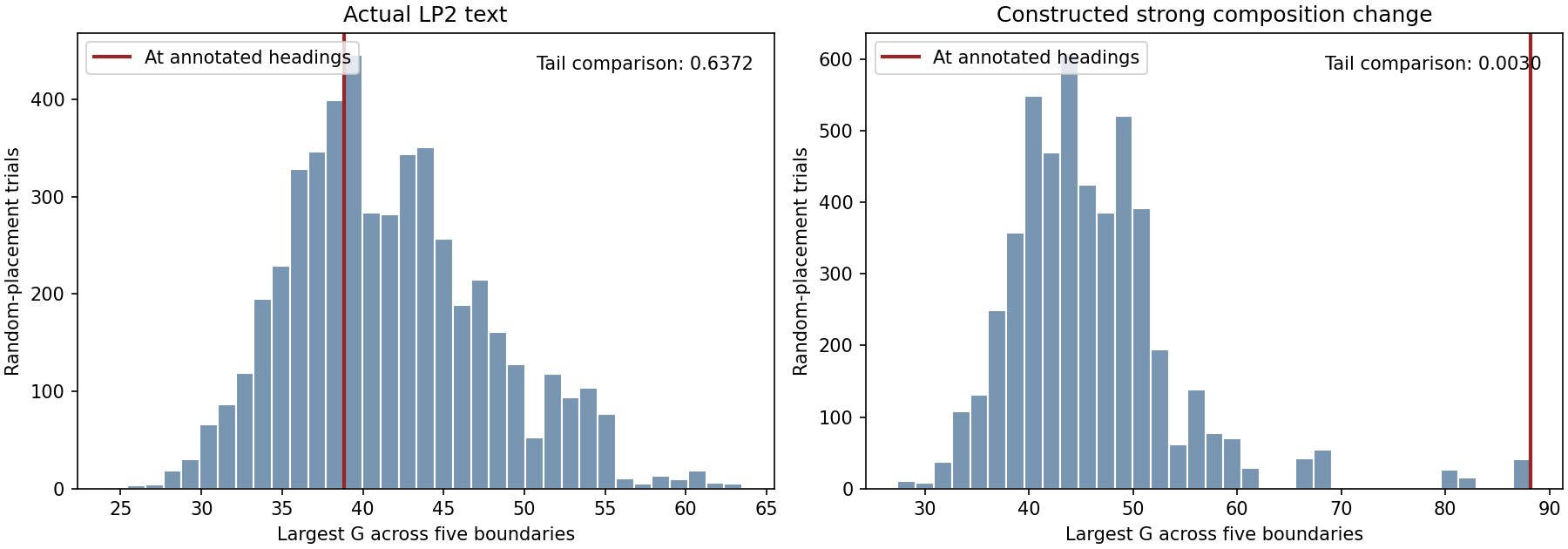
The observed maximum is 38.84. The random-placement maximum has a median of 40.77 and a 95th percentile of 53.41. In 3,185 of the 4,999 trials, the maximum is at least as large as the observed one. The plus-one Monte Carlo comparison is 0.6372.
Thus the largest of these five local differences is not unusually large under the stated reference. The tree-adjacent boundary has the smallest G in this group, but that was not the selected test direction and is not promoted as a separate finding.
Does the test detect a change when one is planted?
The fixed control starts with an independent uniform 29-symbol background. In each selected left flank, rune F receives probability 30%; in each right flank, rune I receives probability 30%. The other symbols share the remaining probability. It uses the same boundaries, window lengths, eligibility rules and joint reference placements.
This intentionally strong change produces a maximum G of 88.23, with a tail comparison of 0.0030. Two mathematical checks also confirm that identical count tables give G = 0 and completely disjoint constant-symbol samples give the expected maximum.
The control establishes sensitivity to this constructed composition change. It is not a power guarantee for subtle effects, a cipher-recovery demonstration or evidence that real key changes must look like this control.
What follows from this
We have no statistical reason from this test to assign a new cipher state at the five additional headings. The typography remains useful for representing passages, but it has not supplied a processing instruction.
The limit is essential: a change of key or cipher state can leave rune frequencies nearly identical. This test would miss that. Conversely, an observed composition shift could reflect plaintext subject matter rather than encryption. Five retrospective boundaries and one flank size do not resolve every possible boundary effect.
Decision: do not expand this into another reset-key search or change the window size to chase a result. Retain the visual map and this bounded negative result. No new verified solution or new-to-community discovery is claimed.
Reproduce and inspect
- Fixed comparison plan
- Audit and comparison script
- All visual spans, candidate cuts, rune counts, reference draws and results
- Standalone comparison figure
Run python -B heading_change_audit.py with NumPy, Pillow, matplotlib and the companion source files. The retained transcription and image hashes are verified. The script performs no cipher search.