Result: a real counting correction, but no new plaintext. Our historical parser split three apostrophe suffixes into separate words. The source images and transcription both distinguish those apostrophes from ordinary separating dots. Joining them for lexical word analysis reduces the claimed inventory from 29 distinct one-rune words to 28. The “all 29” statement in Session 41 was wrong under this corrected grouping.
The two latest word-based comparisons were recalculated. Their broad negative conclusions survive. The source transcription itself has not been altered.
What was inspected
The targeted visual audit covers:
- All 16 historical one-rune tokens in section 8, the section that previously appeared to contain 14 distinct ones.
- The other two apostrophe suffixes, on LP2 pages 4 and 21.
- Additional context for a line-end token, a line-start token and the paragraph transition from page 53 to page 54.
That is 18 target locations across 12 retained source images, with 21 exact-pixel crops including context. Of the old corpus-wide list of 86 locations, the remaining 68 were not newly image-audited in this session. The corrected corpus-wide totals below are transcription-derived; this is not a claim that all 83 surviving tokens have now been visually verified.
Every source JPEG matches its SHA-256 in the retained archive manifest. Crops preserve source pixels: no generated imagery, resampling, sharpening or symbol reconstruction is used. Hash agreement verifies the retained copy, not Cicada authorship or a digital signature.
Three apostrophes caused three false lexical boundaries
Pages and rune offsets are zero-based. Labels are conventional rune labels, not translations.
| LP2 page | Image | Suffix offset | Visible sequence | Historical split | Corrected lexical grouping |
|---|---|---|---|---|---|
| 4 | 21.jpg | 164 | M X I ' W | 3 runes + 1 rune | One 4-rune word |
| 21 | 38.jpg | 36 | AE O ' Y | 2 runes + 1 rune | One 3-rune word |
| 41 | 58.jpg | 218 | X L J ' K | 3 runes + 1 rune | One 4-rune word |
All three images show the raised apostrophe rather than a normal single dot between the stem and suffix. The master transcription already represents the mark with an apostrophe. The error was treating every non-rune character as a word boundary in our lexical interpretation.
The K suffix on page 41 was the only alleged one-rune K word. Removing that split is what changes the distinct-symbol total from 29 to 28.

The line above contains X L J ' K near its middle. The raised mark before K differs visibly from the square separating dots surrounding complete groups.
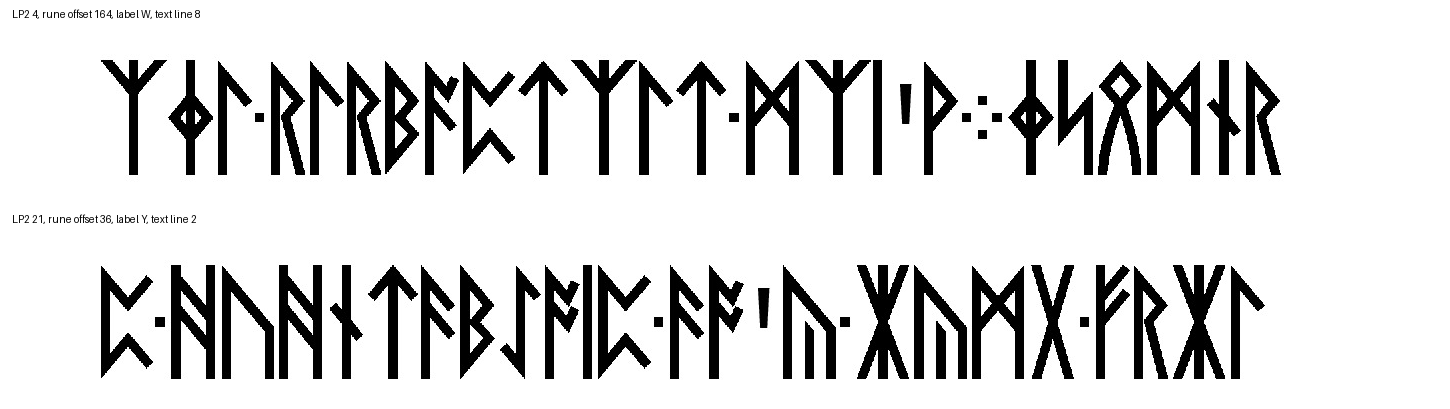
Joining apostrophe suffixes is the lexical convention adopted for current word analysis. It does not prove what these groups mean, or that an apostrophe cannot reset the cipher. The earlier punctuation-split calculations remain valid as tests of that explicitly different segmentation; their description as complete lexical words needed correction.
The remaining section-8 tokens
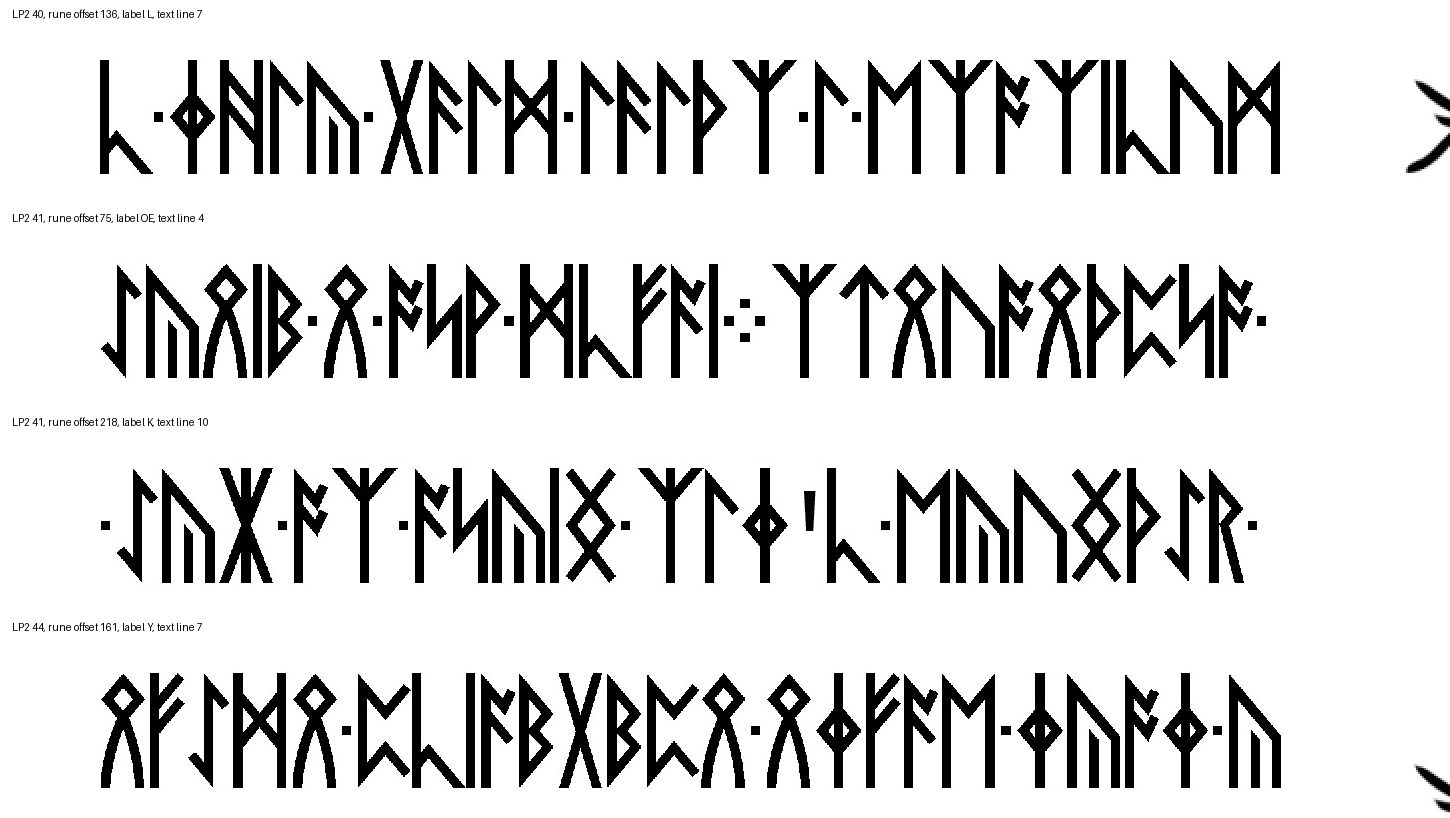
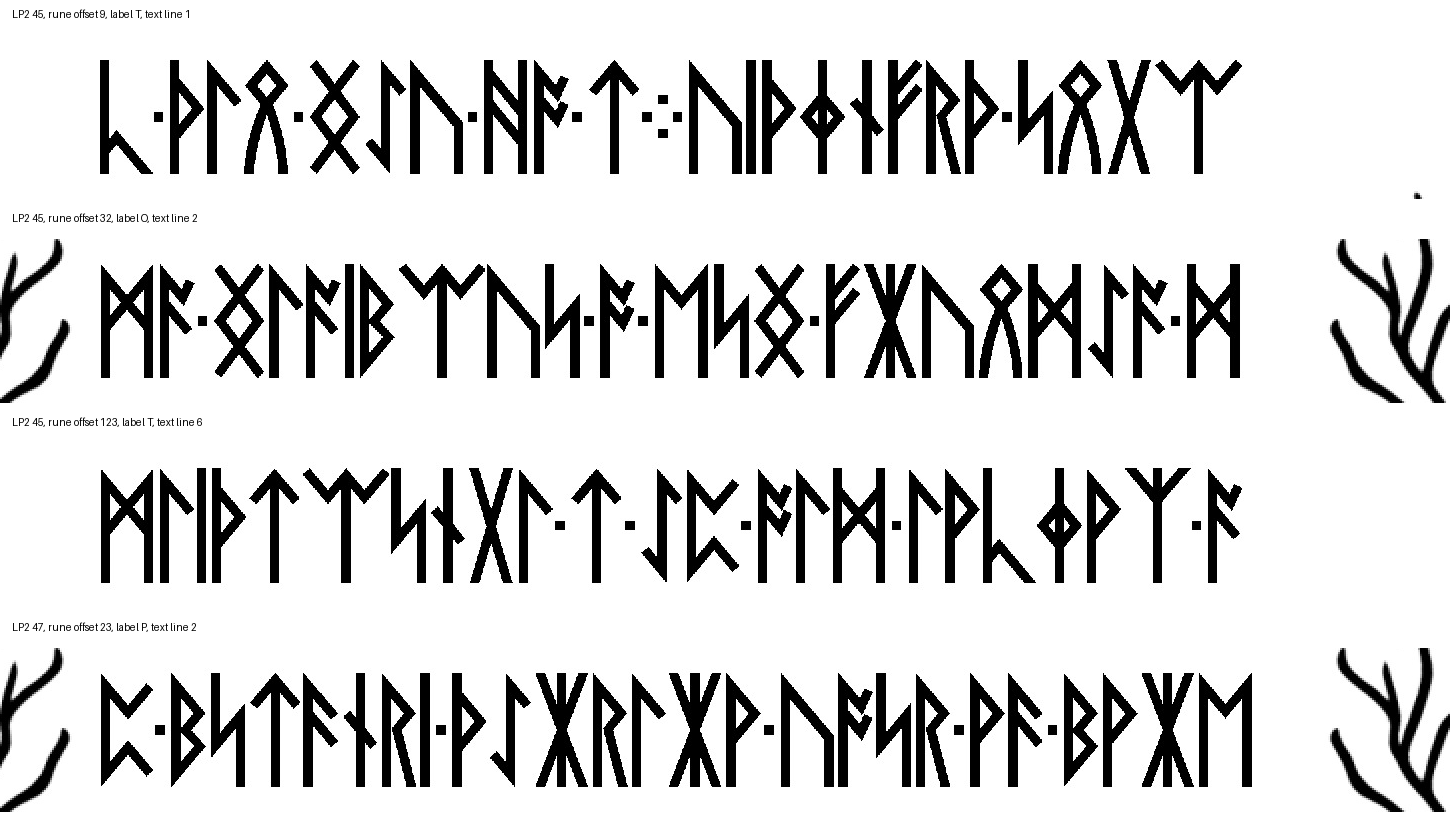
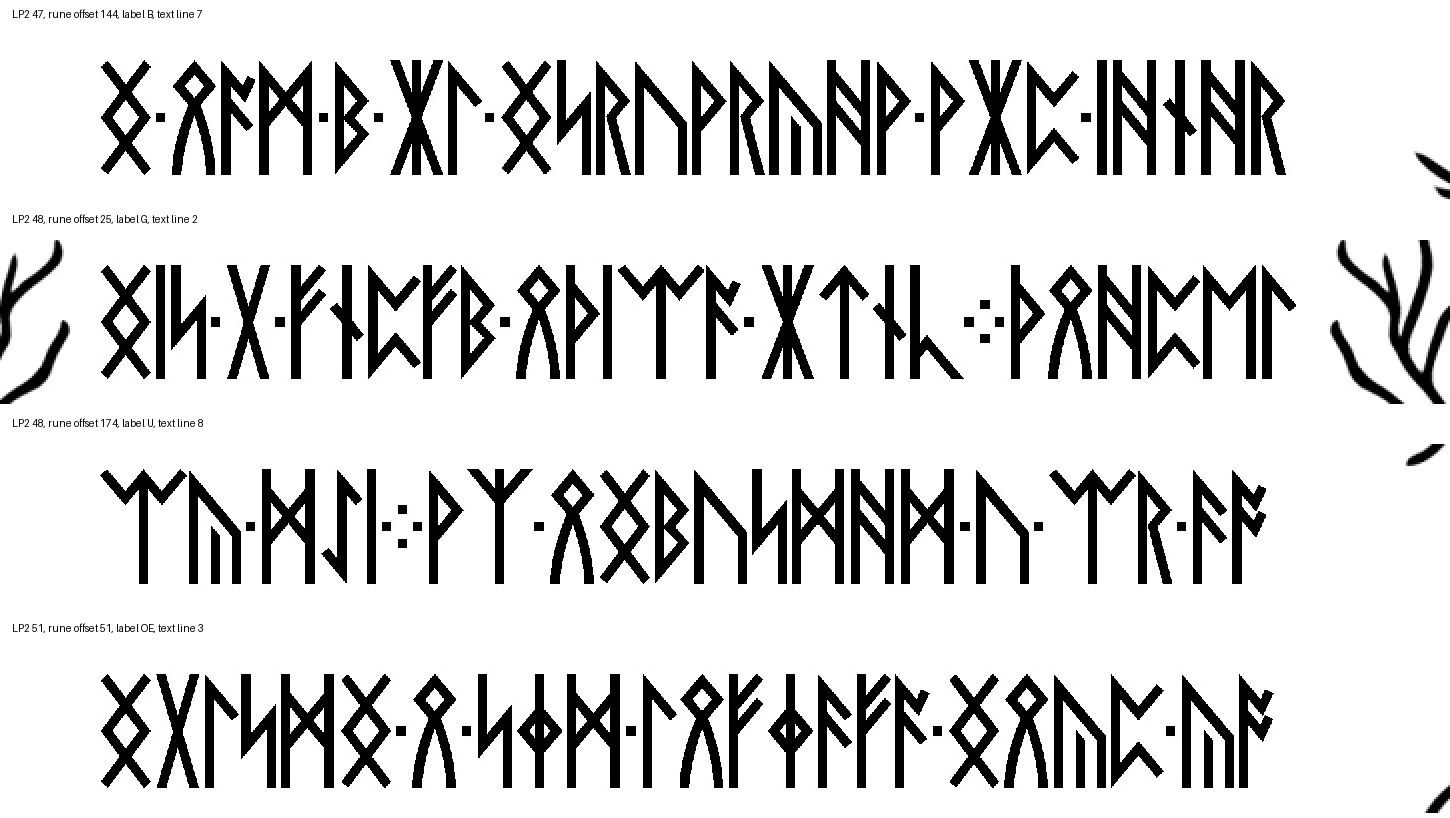
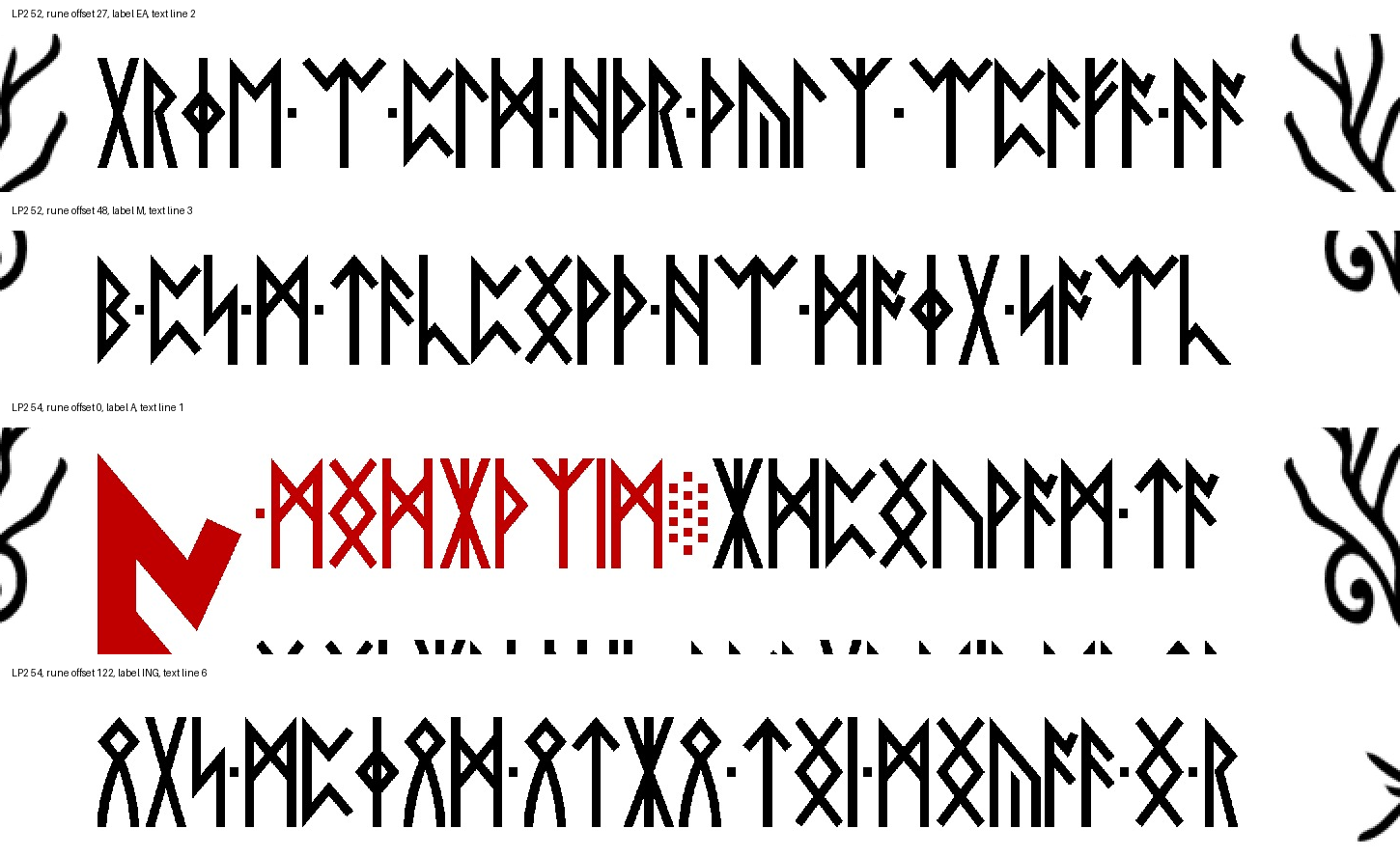
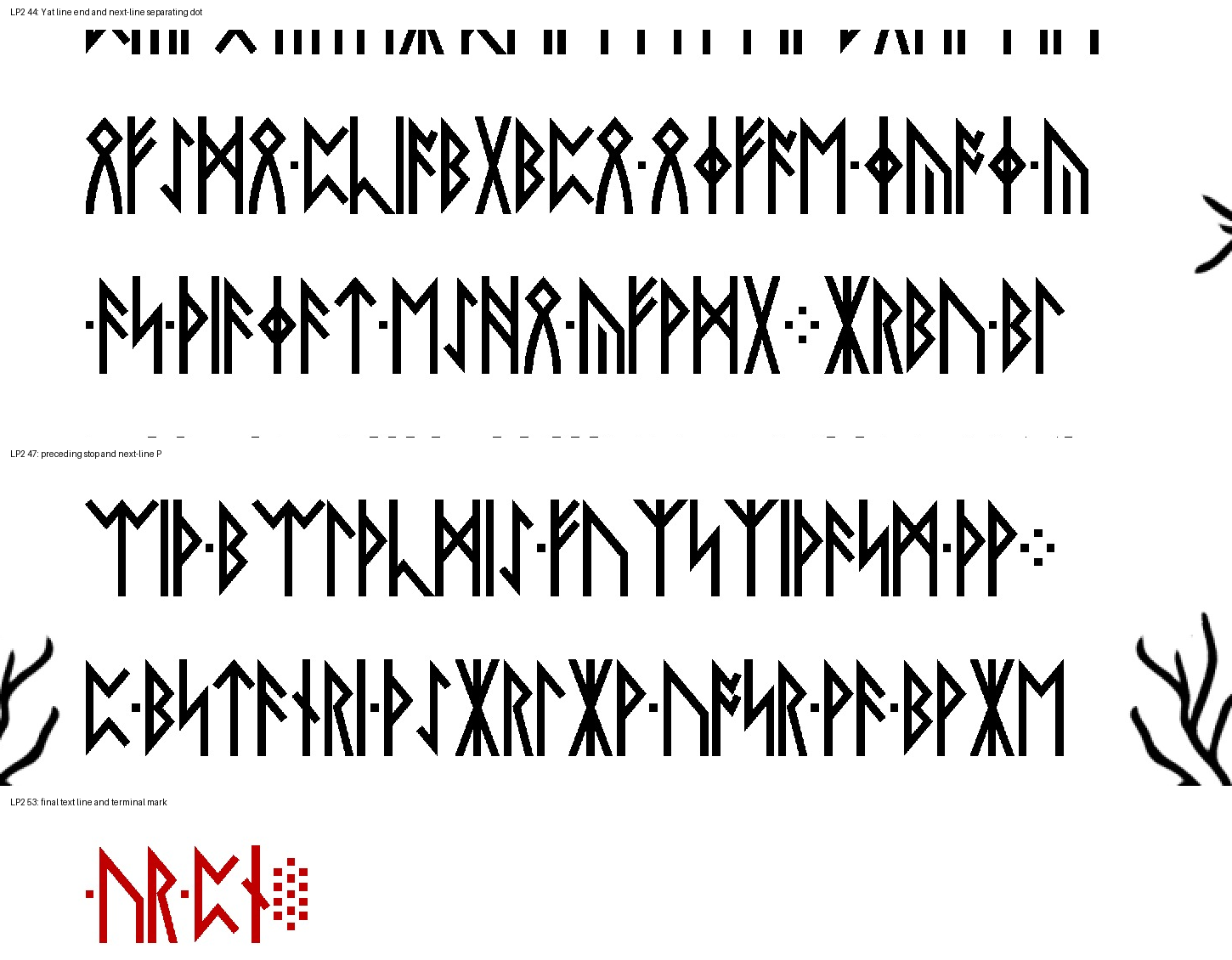
The other 15 target locations are visibly separated. Twelve have ordinary dots on both sides or a dot followed by a stop. One starts a line after the previous line's stop; another ends a line before the next line's separating dot. The red initial is handled separately below. The following table accounts for all 16 original targets.
| LP2 page | Rune offset | Label | Image observation |
|---|---|---|---|
| 40 | 136 | L | Single dots before and after |
| 41 | 75 | OE | Single dots before and after |
| 41 | 218 | K | Apostrophe suffix; remove from singleton list |
| 44 | 161 | Y | Dot before; next-line dot after |
| 45 | 9 | T | Dot before; stop after |
| 45 | 32 | O | Single dots before and after |
| 45 | 123 | T | Single dots before and after |
| 47 | 23 | P | Previous-line stop; dot after |
| 47 | 144 | B | Single dots before and after |
| 48 | 25 | G | Single dots before and after |
| 48 | 174 | U | Single dots before and after |
| 51 | 51 | OE | Single dots before and after |
| 52 | 27 | EA | Single dots before and after |
| 52 | 48 | M | Single dots before and after |
| 54 | 0 | A | Red paragraph initial followed by a red dot |
| 54 | 122 | ING | Single dots before and after |
The red A is genuinely a separate visible token, but its decorative/paragraph-initial role should not be silently equated with an ordinary body-text word. Keeping it gives 15 tokens representing 13 runes. Excluding it as a sensitivity check leaves 14 tokens representing 12 runes. Neither choice establishes that it is a null or decodes to English A.
Native-pixel review sheets: 1, 2, 3, 4, apostrophes, line and paragraph contexts.
Corrected counts
| Measurement | Historical grouping | Apostrophe-aware grouping |
|---|---|---|
| All unsolved LP2 words, pages 0–55 | 2,899 | 2,896 |
| Words in the eight substantial sections | 2,897 | 2,894 |
| One-rune tokens | 86 | 83 |
| Distinct runes used as one-rune tokens | 29 | 28 |
| Section-8 one-rune tokens | 16 | 15 |
| Section-8 distinct one-rune symbols | 14 | 13 |
| Equal-word pairs in the eight sections | 239 | 230 |
Rune totals, rune order, page offsets and section assignments are unchanged. Only word groupings and subsequent word indices change. The solved LP1 benchmark contains no apostrophes, so its 483 words and 1,963 runes remain unchanged.
There are now 1,643 words of at least four runes, still with no repeated complete word at those lengths in the eight-section target.
Session 41 recalculated
The invariant is unchanged: a fixed invertible word-by-word cipher preserves word repetition within its key scope. With the corrected lexical groups:
| Length-matched comparison | Result |
|---|---|
| Solved benchmark, 483 words | 1,385 equal-word pairs |
| Corrected unsolved sample, exact expectation | 10.14897 pairs |
| Central 95% of 1,999 descriptive subsamples | 5–17 pairs |
The previous expectation was 10.14410. The small change does not remove the disparity. Every separately analyzed section still has far fewer repeated words than its length-matched solved comparison. These are descriptive finite-corpus comparisons, not p-values or a universal theorem about English.
The revised numbers of distinct one-rune symbols within the eight sections are 5, 7, 9, 12, 5, 8, 9 and 13. Therefore, the conditional objection to plaintext consisting only of ordinary A/I one-rune words still applies, provided the visible groups really preserve plaintext word boundaries. The whole-corpus “all 29” claim is explicitly withdrawn.
Session 40 recalculated
For the two-rune linear cipher reset at each corrected lexical word boundary, every permitted fixed reset state remains included in the exact frequency calculation.
| Scope | Historical maximum | Corrected maximum |
|---|---|---|
| Shared coefficients and reset state | 575 / 12,947 = 4.4412% | 575 / 12,947 = 4.4412% |
| Separate coefficients and reset state by section | 779 / 12,947 = 6.0168% | 780 / 12,947 = 6.0246% |
Both remain well below the solved sample's 12.6337% peak rune frequency. The recalculation constructs settings attaining the reported maxima. Known-message recovery controls pass. Rune-stream-only results such as Session 39 do not depend on this apostrophe grouping.
Correction policy and limits
A new lexical parser joins apostrophes immediately flanked by runes. It preserves all rune/page/section offsets. Fixtures verify joined suffixes, page-wrap behavior, standalone quotation marks and the unchanged solved benchmark. The old parser and old result files remain available to reproduce historical experiments; the affected reports carry correction notices.
Sessions 40 and 41 have been recalculated here. Earlier word-based experiments have not all been rerun, so their numerical results should be read with their original segmentation rule. A complete re-audit of all page images is also unfinished. The remaining 68 historical singleton locations are listed in the earlier results; the revised 83-location list is in this session's results.
Visible separation is supported for the inspected surviving tokens. Whether it marks plaintext words, cipher blocks, nulls or another structure remains unresolved. No new plaintext, key or authorship finding follows from this correction.
Reproduce and inspect
- Audit and recalculation code
- Apostrophe-aware lexical parser
- Manual observations and crop coordinates
- Image hashes, revised inventories and recalculated results
- Retained image manifest
- Historical Session 40 calculation
- Historical Session 41 calculation
Run alongside the retained helpers, JPEGs and transcription using Python 3, NumPy and Pillow:
python3 -B token_boundary_audit.py
The script verifies source-image hashes and byte-for-byte equality of each saved crop's pixels with its source region. Visual readings are recorded observations, not automated recognition results. Source transcription SHA-256 remains:
b0b2e13c3cd35512ee5955a2d9a56c22d7410e283d35dd9c90abbaa7b99279eb