Date: 19 September 2026.
Result: no verified new plaintext. Mapped the five numbered items on LP2 pages 36–38, checked their repeated ciphertext, and tested three numerical streams under three counter policies. Parameters selected on items 1–3 did not produce a coherent continuation in items 4–5. Nine constructed recovery controls succeeded.
The useful source finding is a boundary caveat: the manuscript's colored paragraph marks carry information that the plain transcription does not fully encode. In particular, item 5 may contain two sentences. Treating every list item as ending at its first transcribed full stop would truncate this reading.
1. Map the list before testing it
The red Arabic numerals identify starts 1, 2, 3, 4 and 5 in normal page order. Items 1–4 are extracted up to the next numbered label, including any intervening line or page wrap. This does not depend on interpreting every transcribed full stop correctly.
For item 5, the primary extraction includes the short second sentence and stops before the visible red paragraph separator preceding ᚫᛞᛟᚫᛟᛗ. The second sentence has the usual line spacing above it; the following red separator has a larger gap. This supports including that sentence but cannot prove its semantic relationship while the text remains unreadable. A shorter, first-sentence-only interpretation is retained as a sensitivity check.
| Item | LP2 pages | Section rune interval | Runes | Words | Opening word lengths |
|---|---|---|---|---|---|
| 1 | 36 | [754, 893) | 139 | 30 | 4, 3, 8, 2, 5 |
| 2 | 37 | [893, 984) | 91 | 20 | 4, 4, 6, 4, 10 |
| 3 | 37 | [984, 1082) | 98 | 25 | 3, 4, 4, 2, 5 |
| 4 | 37–38 | [1082, 1178) | 96 | 19 | 7, 9, 7, 2, 3 |
| 5 | 38 | [1178, 1307) | 129 | 28 | 6, 4, 7, 1, 6 |
Offsets are zero-based, end-exclusive, measured from the 1,589-rune section audited in Session 16. Arabic labels and punctuation do not count as runes. Words are joined across physical line and page wraps unless a word separator intervenes.
The primary list contains 553 runes and 122 words. The shorter item-5 interpretation removes 17 runes in five words, leaving 536 runes and 117 words. It does not change the starts of any items or the material used to select parameters.
Item 4 crosses the numeral motif at the top of page 38: 39 of its runes precede the motif and 57 follow it. Thus this motif occurrence is inside a numbered item, not at its start. This observation constrains layout hypotheses; it does not prove that the cipher ignores the motif.
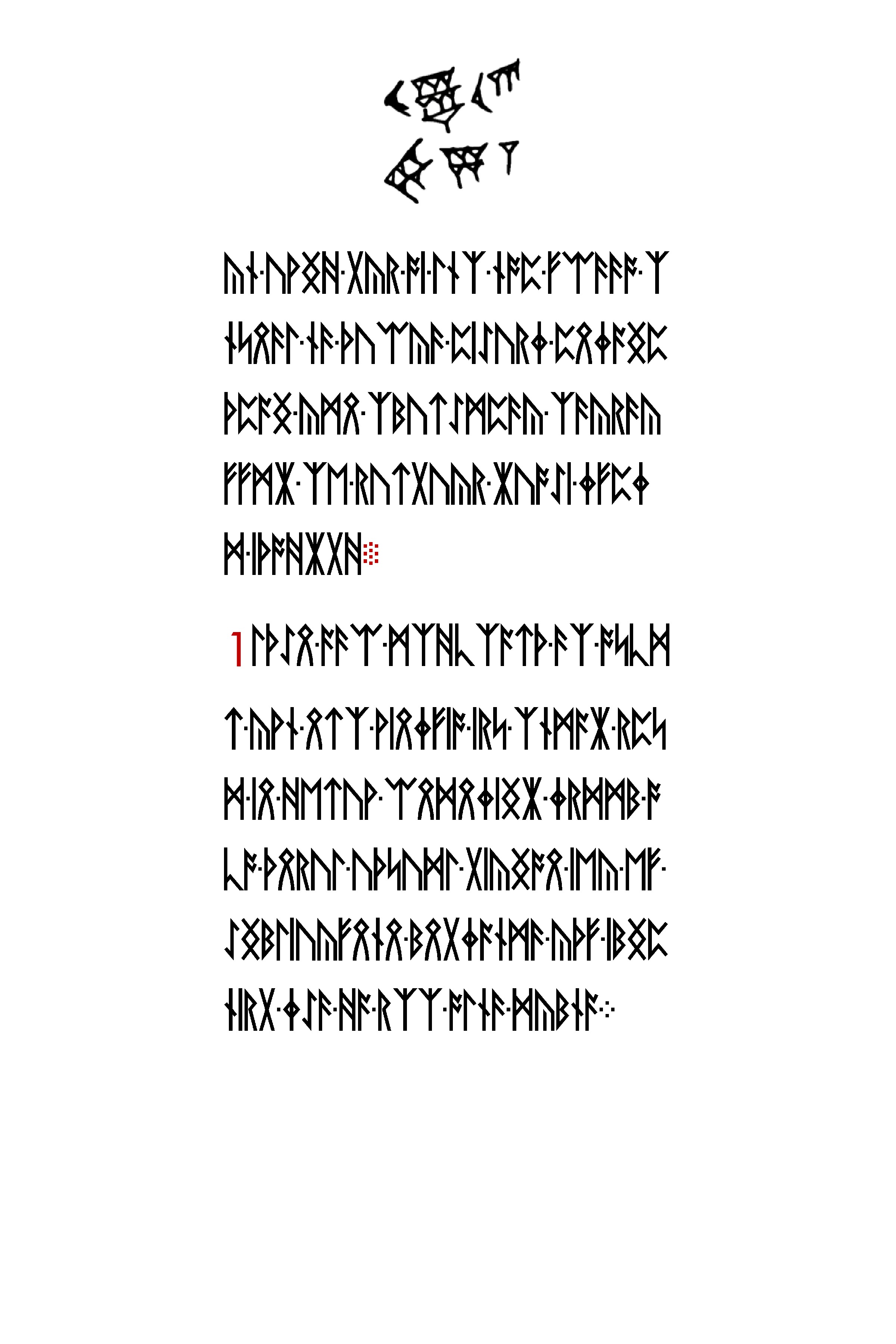
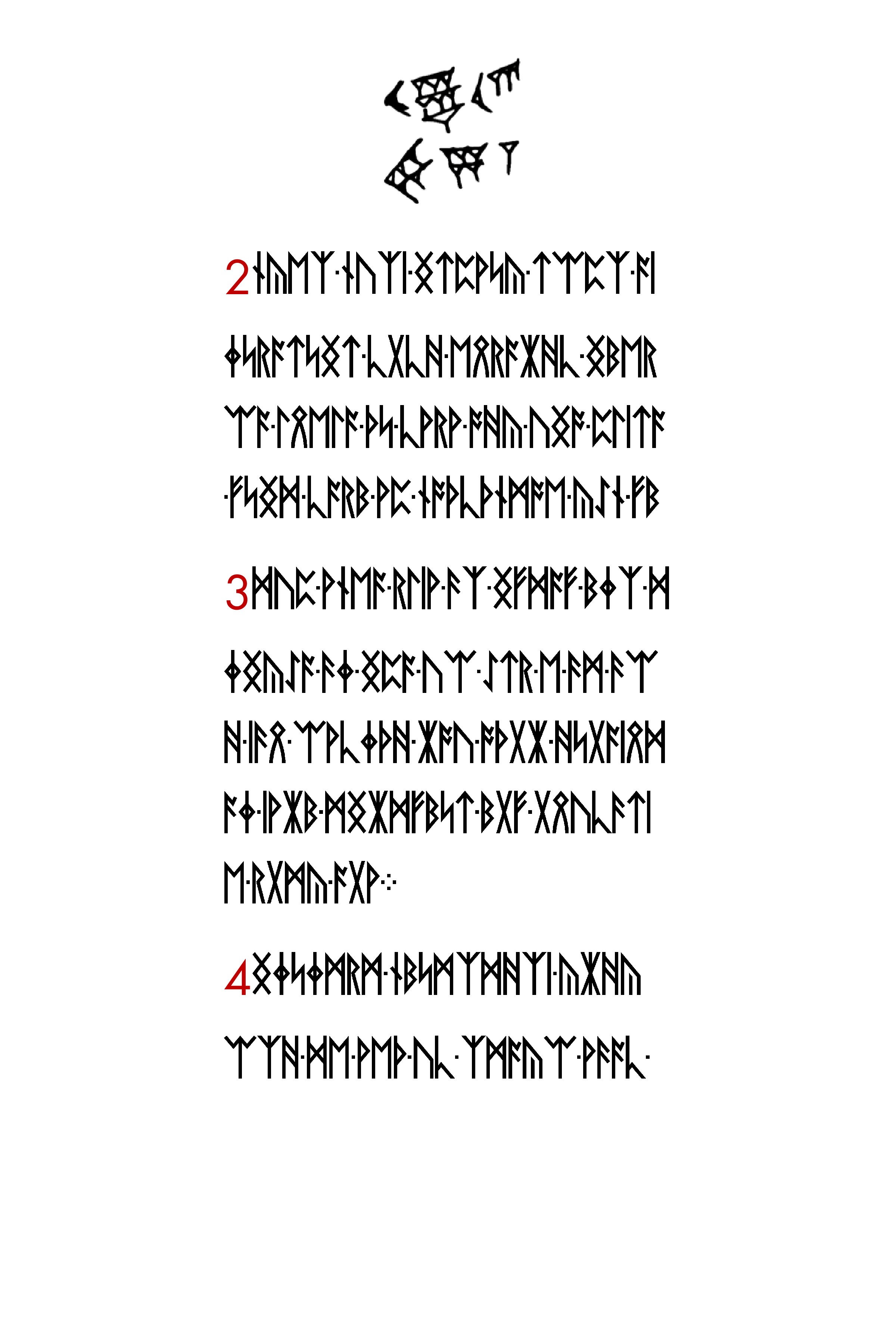
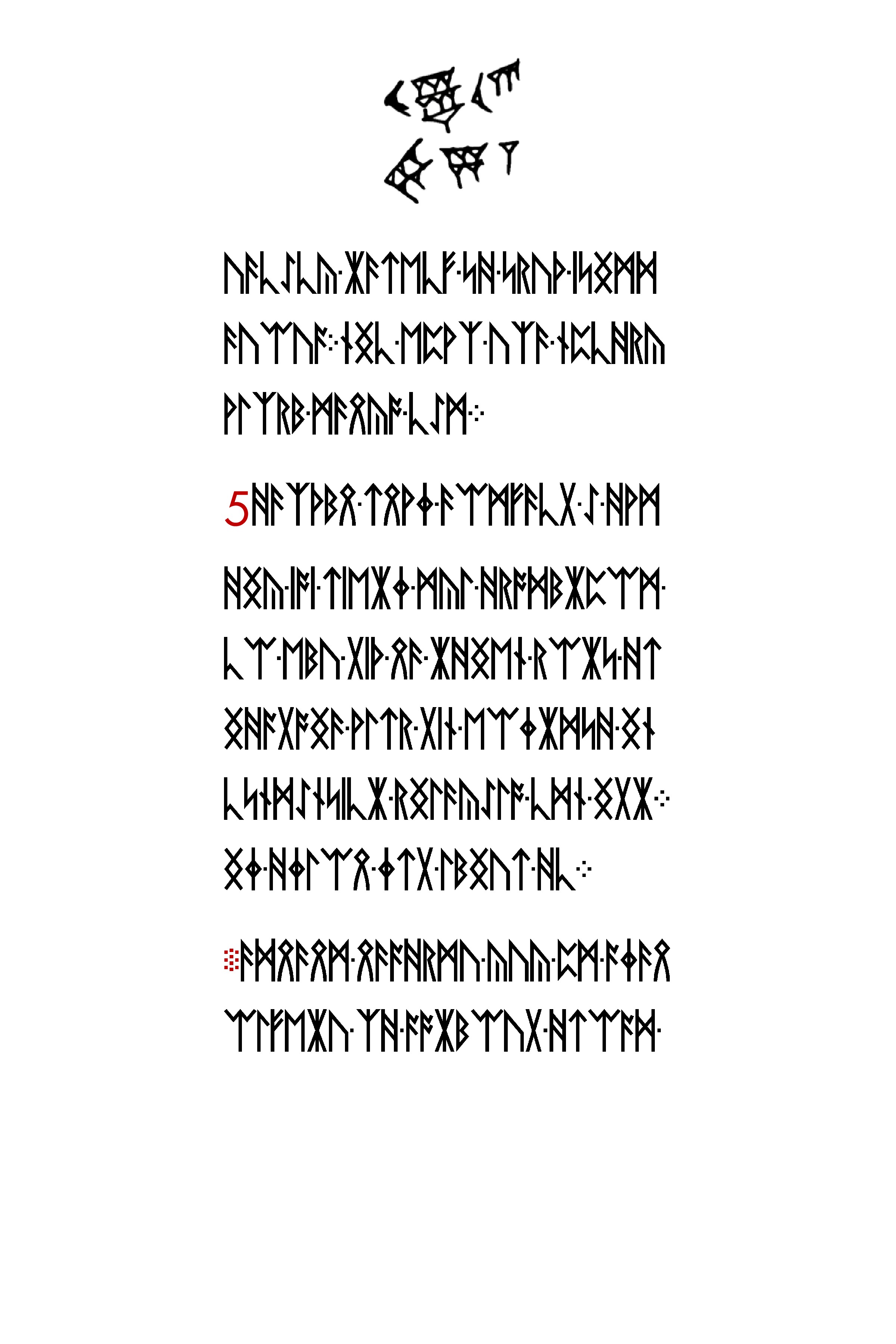
All three full-page images were inspected for this extraction. The master transcription is preserved unchanged. The boundary decision is explicit in the experiment script and results, rather than silently inserted into the historical source file.
Sources: archived original page images, local transcription, extracted text and input hashes. These are archived inputs, not freshly authenticated signed messages.
2. Does repeated wording line up?
The first words are ᛚᚦᛇᛟ, ᚾᚣᛖᛉ, ᛞᚢᛈ, ᛝᛄᛋᛄᛗᚱᛗ and ᚻᚫᛉᚦᛒᛟ. Their first runes are all different.
If every item restarted the same deterministic, invertible rune mapping at its first symbol, identical plaintext openings would produce identical ciphertext openings. These five different first runes therefore rule out one narrow conjunction: the same cipher restart plus the same initial plaintext symbol in all five items. They do not rule out a shared restart with different wording, or label-dependent keys.
Comparing every pair of items gives:
- One shared whole ciphertext word: ᚫᛉ, occurring as the fourth word of items 1 and 3.
- No shared whole ciphertext word of three or more runes across different items.
- No repeated adjacent two-word ciphertext phrase across different items.
- Items 1 and 2 share only the first word's length in their opening length patterns. Every other pair differs at the first word length.
The two-rune match is at different rune positions within its items: offset 15 in item 1 and offset 11 in item 3. Matching word number is not matching stream position for a rune-by-rune cipher. This short match is not an English identification, a crib, or statistically established evidence of shared wording.
3. A bounded shared-parameter experiment
Three streams were selected from the existing arithmetic work: primes minus one, integer totients, and Fibonacci numbers, each reduced modulo 29. The prime-minus-one stream has a known LP2 decryption precedent; the other two remain exploratory candidates here.
| Counter policy | Index for rune j of item i, before a common offset |
|---|---|
| Continuous list | Total runes in preceding items + j |
| Restart each item | j |
| Start from the label | i − 1 + j |
Here i runs from 1 to 5 and j starts at zero. The label-start policy treats the printed number as the starting sequence position. This is a hypothesis, not an instruction recovered from the text.
For each stream and policy, test the decoding rule p = a·c + b·q[index + offset] + shift (mod 29), where c is the zero-based rune index; a and b are independently +1 or −1; offsets range from 0 through 32; and shift ranges from 0 through 28. Every item uses the same chosen parameters. No fitted per-item shifts, selective skipped runes, reading reversals, or later exception rules are allowed. Digits and punctuation consume no sequence positions. Prime-minus-one index 0 is 1; the totient implementation includes the explicit convention q[0] = 0; Fibonacci starts 0, 1.
This gives 34,452 candidate settings, including equivalent or overlapping transforms. Three fixed direct/substitution baselines were also recorded separately. The count is a scope statement, not evidence of progress.
For each of the nine stream/policy families, choose one winner using only the combined language score of items 1–3: 328 runes, 75 words. Apply those unchanged parameters to items 4–5: 225 runes, 47 words. The ranking model is the existing boundary-aware LP1 English rune model. Scores weight each rune and word-ending event equally across the three selection items.
The shorter item-5 interpretation is assessed by truncating the same decoded output. Its score does not choose a new parameter setting. Neither validation item influences selection or the ordering of family winners.
This is a reuse check on different list items, not a historically unseen corpus: these pages were included in earlier work. Session 2 already tested clause resets and arithmetic streams; Session 14 tested word-organized schedules. The present contribution is the explicit list extraction, shared selection across items, label-start comparison and fixed continuation check. It should not be counted as discovery of an entirely untested cipher family.
4. Controls and results
Three hand-specified fixtures check the counter indices. Nine constructed controls cover every stream/policy combination, with nonzero offsets and shifts and both signs represented. Their plaintext consists of five distinct, non-overlapping word blocks from known LP2 pages 56–57, totaling 180 runes. Those pages are outside the LP1 scoring-model training data.
Encryption uses a separate scalar loop. The search selects parameters using only the first three control blocks, then checks all five against the known plaintext. All nine controls recover every plaintext rune exactly. These controls are shorter than the real list and exercise only the implemented cipher families; they do not establish power against an arbitrary unknown cipher or another language.
The nine family winners, ordered only by their items-1–3 score:
| Stream | Policy | Selection score | Item 4 score | Item 5 score |
|---|---|---|---|---|
| Primes − 1 | Restart each item | −4.8639 | −5.5711 | −5.4092 |
| Primes − 1 | Continuous list | −4.8640 | −5.3683 | −5.4579 |
| Integer totients | Continuous list | −4.8689 | −5.5342 | −5.7399 |
| Integer totients | Restart each item | −4.8787 | −5.2146 | −5.3713 |
| Primes − 1 | Start from label | −4.8810 | −5.4294 | −5.3161 |
| Integer totients | Start from label | −4.8869 | −5.4807 | −5.1299 |
| Fibonacci | Continuous list | −4.8954 | −5.2846 | −4.8918 |
| Fibonacci | Restart each item | −4.9278 | −4.9392 | −5.9021 |
| Fibonacci | Start from label | −4.9465 | −5.4252 | −5.1869 |
Higher scores mean a better fit to this small language model. They are not probabilities or calibrated significance measurements. Selection scores benefit from searching thousands of settings; short validation texts have variable scores. An isolated score close to the selection score, such as Fibonacci on item 5, is not a decryption.
The complete decoded items 4 and 5 for all nine family winners were inspected, along with the first 100 rendered characters of each selection item. The three baseline outputs were also inspected. None provided a coherent passage. Keeping or omitting the final short sentence in item 5 did not change that assessment. All five complete outputs for each selected family winner, its parameters, and per-item scores are retained. The remaining tens of thousands of outputs were ranked automatically, not manually read or individually saved; the script regenerates the search.
Decision and limits
There is no support here for these simple shared numerical restarts or the tested label-start variant. The result does not eliminate other key schedules, languages, exceptions, or ciphers that change within an item. The short two-rune repeat is insufficient to supply a reliable plaintext constraint.
The next useful source task is to audit colored punctuation against the transcription in this section. We now have a concrete example where the image distinguishes a paragraph boundary that the source's plain punctuation does not preserve. A reconciled boundary map would help assess what earlier reset tests actually covered before expanding another arithmetic search.
Reproduction
Run numbered_list_pass.py with Python and NumPy beside lp_core.py, word_core.py, the master transcription, and images 53.jpg, 54.jpg and 55.jpg. No network calls are made.
- Fixed search configuration
- Extraction, repetition audit, controls, selected parameters and full selected outputs
The script writes its fixed configuration before computing candidate results. The boundary interpretation is documented, not claimed as an independently verified plaintext fact. No original Cicada solution or creator identity was established.