The original word alignment does not outperform most displaced alignments under the fixed quadratic model. In the primary A/I/O comparison, 78 of 99 rotated cohorts have an equal or lower capped exception cost. Under A/I, all 99 do. This supplies no positive alignment signal for the model's apparent near-fits. Park this speculative polynomial branch rather than expanding its parameters or exceptions.
No new plaintext, actual key, source correction or authorship evidence is established. The result concerns this specific cipher family and comparison; it does not show that Liber Primus lacks structure or that word boundaries are irrelevant to other mechanisms.
What the comparison preserves
Session 83 kept independent quadratic coefficients within each existing marked section and tested every possible single or paired singleton-membership omission. Its A/I/O book-wide lower bound was seven additional exceptions, with section 4 still failing through two.
Keep exactly that decoder, ordinal rune alphabet, full encoding domain, eight substantial sections, fixed singleton positions, both prior exemptions and two-exception budget. Only the alignment between ciphertext and word marks changes in the controls.
The saved plan fixes seed 330184 and samples 99 distinct nonzero circular shifts per section, without replacement. Sample index pairs eight independently sampled section shifts into each of 99 cohorts. The full shift schedule is saved and hashed before any rotated real coefficient solving.
Each right rotation preserves the section's rune inventory and complete circular two-predecessor context multiset. It therefore retains the circular neighboring-repeat pattern and local context frequencies, while moving their positions relative to the fixed word marks.
As before, only positions with two within-section predecessors are decoded. For a right shift s of length N, the omitted original circular context positions are (-s) mod N and (1-s) mod N. Both are recorded for every rotation. Circular context counts are preserved; linear neighboring-repeat counts can differ by one when the omitted wrap edge changes. No word, punctuation or page reset is added.
The rotated text is a mathematical control, not a proposed reading or a replacement for the master.
Freeze the statistic before inspecting rotations
For each section, use its exact minimum exception count if it is zero, one or two. If the complete search fails through two, assign a capped cost of three. Sum these costs across the eight sections.
The primary branch is A/I/O. Its original capped cost is 7. The secondary A/I branch has original cost 12. A lower cost means greater ordinary-word membership capacity in the specified model. It does not mean better English.
An individual cost of three means minimum exceptions at least three, not an exact minimum of three. The capped book-wide score is a fully defined comparison statistic even when the actual minimum beyond the budget remains unresolved.
Exact counting and verification
The efficient implementation recomputes the independent basis for every retained-word subset. It caches complete basis-compatible affine families by their actual basis and allowed values, representing them through multiplicities and word-violation bit masks. It never restricts later searches to keys fitting an earlier basis. Rank-deficient subsets keep all free coefficients analytically.
Before rotated real solving, the implementation passes:
- 744 saved unrotated deletion-count comparisons, including the original costs and minimum-level key totals.
- 438 complete-enumeration subset comparisons across sixteen three- and five-symbol toy matrices, covering ranks zero through seven and dependent or zero constraints.
- 630 subset-count comparisons from all twelve prior false-singleton fixtures, retaining planted vectors and exact known full-message recovery.
- 47 toy rotations checking direct scalar context rows, inverse rotation, inventories, circular context counts and the two omitted contexts.
Controls are saved and hashed before the rotation screen. The screen then verifies invariants for all 792 section rotations and evaluates 72,179 deletion subsets. These counts describe exact necessary-condition checks, not independent cipher discoveries.
After the run, the first, middle and last cohort indices in every section are cross-checked with the unchanged slower Session 83 solver: 48 section/branch cases and 2,002 subset counts agree. These are post-run implementation checks, not additional statistical selections. The schedule, controls, results and figure reproduce byte for byte on a second run.
Primary result: the original A/I/O alignment is typical here
| Comparison | Original capped cost | Rotated mean | Rotated range | Lower cost | Equal cost | Greater cost |
|---|---|---|---|---|---|---|
| A/I/O, primary | 7 | 7.00 | 5–9 | 20 | 58 | 21 |
| A/I, secondary | 12 | 10.86 | 9–12 | 83 | 16 | 0 |
Thus 78/99, or 78.79%, of A/I/O controls have equal or greater membership capacity at the capped-cost level. Under A/I, 99/99 do. The original A/I score is at the high-cost end of this control sample rather than unusually favorable.
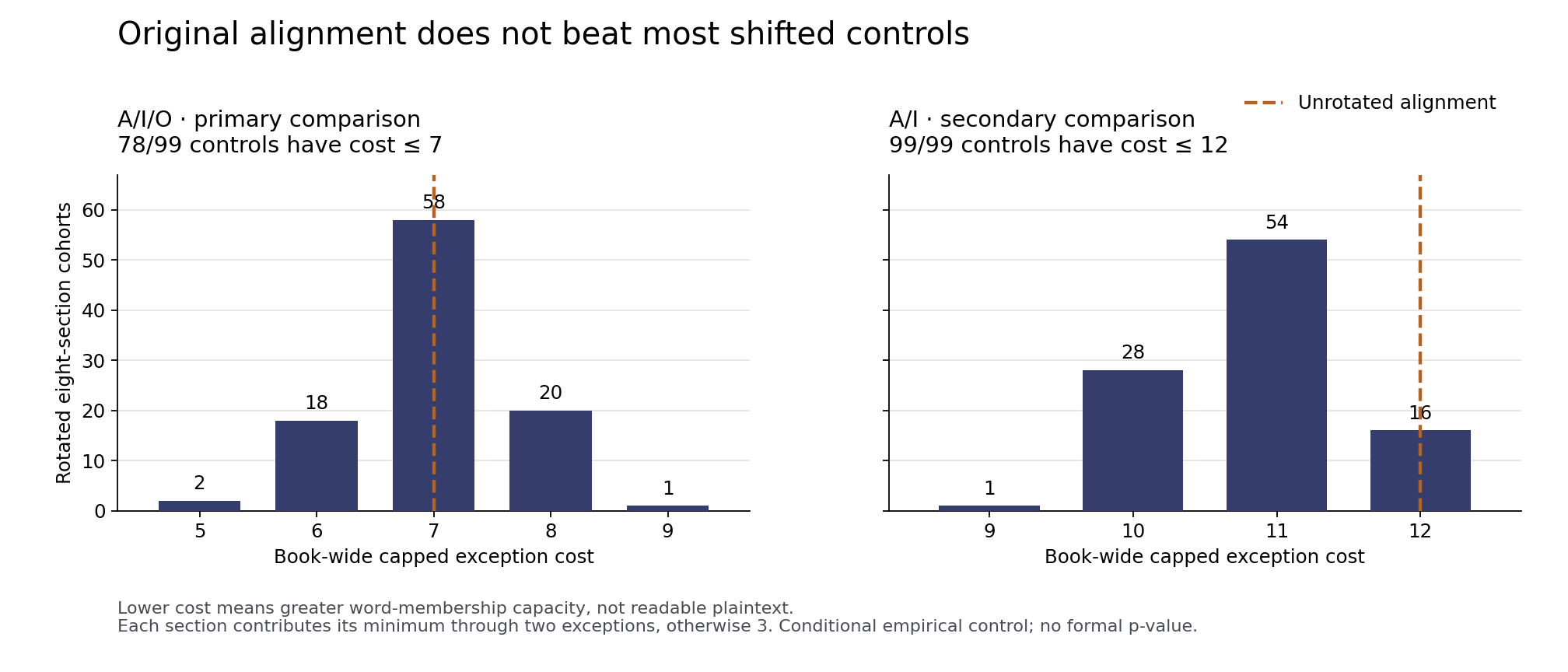
The A/I/O section distributions explain much of the comparison:
| Section | Original capped cost | Rotations with cost 0 | Cost 1 | Cost 2 | Cost ≥3 |
|---|---|---|---|---|---|
| 0 | 0 | 99 | 0 | 0 | 0 |
| 1 | 0 | 99 | 0 | 0 | 0 |
| 2 | 1 | 21 | 78 | 0 | 0 |
| 4 | ≥3 | 0 | 0 | 0 | 99 |
| 5 | 0 | 99 | 0 | 0 | 0 |
| 6 | 1 | 1 | 90 | 8 | 0 |
| 7 | 0 | 99 | 0 | 0 | 0 |
| 8 | 2 | 0 | 5 | 75 | 19 |
Sections 0, 1 and 5 already retained unrotated key families; every rotation also fits without exceptions. Section 7 does too under A/I/O. At the other end, section 4 fails through two exceptions in every rotation as well as the original alignment. These patterns are consistent with word-count and parameter-capacity effects, rather than distinctive support for the original coefficients. That is an interpretation of this control result, not a universal claim about the book.
Every minimum-level compatible key count is retained in the results, including rank gaps. Small survivor counts are not proposed keys, and no real language score or coherent continuation is attempted.
What this comparison cannot establish
The empirical fractions are not formal p-values or probabilities that the book is random. The data and polynomial family were chosen retrospectively. Rotations reuse the same ciphertext, exclude the identity shift in each section, and share finite samples across cohorts. Circular shifts test displaced alignment, not every random-text model or every possible cipher.
This does not undo Session 83's exact within-model rejection or justify additional word exemptions. It explains why a few survivors after relaxed word checks were not enough to support the speculative family.
The source-recognition limitations from Session 74 remain. The master, prior exemptions and previous results are unchanged.
Decision and next step
Park the full-domain quadratic branch at this declared scope. Its unrelaxed version fails, a two-word relaxation still fails in section 4, and the apparent near-fits do not beat most displaced-alignment controls. There is no independent Cicada instruction identifying this polynomial rule. More coefficients or exceptions would add fitting freedom without new supporting evidence.
Return to the mechanisms actually demonstrated on solved pages and the documented puzzle clues. The next useful work is a mechanism and coverage ledger: record each successful transformation, its exact key advancement, skips, boundary behavior, source clue and validation; then compare that with the tests already run using the corrected word and boundary maps. Choose a new experiment only where that ledger identifies a concrete, motivated gap. The ledger has not been completed here.
This preserves the strongest lesson of the solved pages: a reproducible complete reading and an independently fixed rule matter more than isolated matches.
Reproduce and inspect
Run python3 -B quadratic_alignment_audit.py beside its retained companions. Requires Python and NumPy. Run python3 -B quadratic_alignment_plot.py for the figure, additionally requiring Matplotlib. Earlier files are read without rewriting them.
- Fixed schedule design, statistic and limits
- All 792 nonzero section shifts
- Exact cached counting implementation
- Pre-screen regression and positive controls
- All rotated features, deletion counts and comparisons
- Figure generation
- Comparison figure
- Exception sensitivity baseline
- Section-specific affine families
- Shared full-domain quadratic classification