The duplicate continuations in Session 78 come from loss of starting-state information in its square update. The three selected paths in section 2 merge after six runes, and those in section 6 merge after twenty. Beyond those points, changing among the selected starting states cannot change a later decoded symbol.
The wider diagnostic traces all 6,728 real section/parameter paths without changing the rule or choosing new readings. In all 232 section/designated-rune groups, all 29 possible initial states merge before the frozen validation cut. The same effect occurs in the six saved controls: every initial state gives the correct continuation once the designated rune is fixed, while only the planted state recovers the full message.
This explains the search's equivalences and qualifies what continuation can validate. It does not overturn Session 78's word contradictions, recover new plaintext, or establish Cicada's mechanism.
A known state permits inversion; the next-state map can still collide
Session 78's encoder is a permutation of the 29 plaintext runes at a fixed known running state. Its decoder recovers a unique plaintext symbol and then updates:
K_next = K + P² (mod 29)
That does not make the map from an unknown current state to the next state a permutation when the ciphertext is held fixed.
At a section initial, or at a later ordinary output unaffected by the exchange, decoding gives P = C − K. Substitution yields:
K_next = K + (C − K)² (mod 29)
For two distinct states K_a and K_b, the next states are equal exactly when:
K_a + K_b = 2C − 1 (mod 29)
This follows by factoring the difference of the two quadratic expressions. Over the 29-element field, the quadratic has fifteen distinct outputs from its 29 inputs. The audit checks the collision identity for every initial ciphertext value and every pair of distinct input states.
At a later nonrepeated ciphertext symbol, the output exchange changes the decoder at only one current state, K = C − R. Its plaintext there is previous C − C + R, rather than R. Altering that one state can remove or add one image value, so the complete next-state map has 14, 15 or 16 distinct outputs. These counts describe a full set of possible current states; they do not imply that an already reduced set halves at every step.
At a repeated ciphertext symbol, every path decodes P = R, giving K_next = K + R². That map is a permutation and preserves existing state distinctions.
Exhaustive one-step check
The diagnostic covers all 29 initial-symbol maps and all 24,389 later contexts of designated rune, previous ciphertext and current ciphertext, evaluating 707,281 later state cases.
| Later ciphertext relation | Distinct next states from all 29 current states | Contexts |
|---|---|---|
| Repeated | 29 | 841 |
| Nonrepeated | 14 | 377 |
| Nonrepeated | 15 | 11,803 |
| Nonrepeated | 16 | 11,368 |
A direct collision witness uses R = 0, previous ciphertext 0, and current ciphertext 1. Starting states 1 and 6 decode plaintext values 28 and 24, respectively. Both update to state 2. The scalar encoder confirms that both plaintext/state pairs emit the observed ciphertext.
For a fixed designated rune and the same observed input position, equal states cannot split again: the decoder and update are deterministic. Different designated runes remain different parameter cases, even if their running states happen to agree at one point.
Merging does not make the cipher invalid. With a known initial state, every full message still decodes reversibly. A cipher can intentionally synchronize from different starting states. The implication here concerns identifying the initial state from later plaintext, not a general requirement that valid ciphers preserve that distinction forever.
Where the selected real paths merge
The six readings are exactly those selected in Session 78. Nothing is selected using these new traces.
| Section | Designated rune | Selected initial states | Selected paths merge after | All 29 initial states merge after | Frozen prefix cut |
|---|---|---|---|---|---|
| 2 | EO | 11, 12, 25 | 6 runes | 22 runes | 254 runes |
| 6 | S | 4, 14, 23 | 20 runes | 54 runes | 253 runes |
The section-2 selected merge occurs at LP2 page 8, rune offset 5. The states before that symbol are 15, 15, 12; the decoded values are 28, 28, 2; the next states are all 16. Later decoded symbols agree.
The section-6 selected merge occurs at LP2 page 27, rune offset 19. The states before it are 25, 21, 21; the decoded values are 13, 17, 17; the next states are all 20.
Page and rune offsets are zero based, as in the retained master. “After six runes” means the merge happens at offset five and common subsequent plaintext begins at offset six. No fresh image reading is performed.
Every real designated-rune group merges before the cut
For each of the eight substantial sections, trace all 29 initial states at each of the 29 designated runes. Keep section boundaries, the alphabet and all source runes unchanged.
| Section | Earliest full merge among its 29 designated-rune groups | Latest full merge | Prefix cut |
|---|---|---|---|
| 0 | 26 | 152 | 254 |
| 1 | 17 | 201 | 256 |
| 2 | 12 | 183 | 254 |
| 4 | 28 | 192 | 256 |
| 5 | 18 | 137 | 255 |
| 6 | 29 | 144 | 253 |
| 7 | 17 | 157 | 256 |
| 8 | 29 | 79 | 255 |
All values count consumed runes. Every one of the 232 groups has just one state at its validation cut. Within a section and fixed designated rune, all 29 starting states therefore give the same entire continuation used in Session 78.
The 841 parameter settings per section yield at most 29 distinct continuation streams at these cuts. Different initial states still produce different full plaintexts, beginning with different first symbols. Their opening scores can differ and can identify a planted starting state; their common later continuation cannot distinguish those states.
This is a trace diagnostic, not a new rescoring or an expanded key search. The earlier retained readings and their failures remain unchanged.
The controls expose the same validation limit
For each saved control ciphertext, hold its planted designated rune fixed and decode from all 29 initial states.
| Control | Designated rune / planted initial state | All 29 states merge after | Prefix cut | Seeds recovering the exact full message | Seeds recovering the exact continuation |
|---|---|---|---|---|---|
| Welcome | X / 7 | 34 | 255 | 1 | 29 |
| Welcome | EO / 19 | 34 | 255 | 1 | 29 |
| Welcome | D / 0 | 18 | 255 | 1 | 29 |
| Second koan | X / 7 | 31 | 187 | 1 | 29 |
| Second koan | EO / 19 | 87 | 187 | 1 | 29 |
| Second koan | D / 0 | 60 | 187 | 1 | 29 |
Session 78's full-message recovery and prefix rank-one results stand. What needs qualification is the role of its continuation check: correct continuation alone does not confirm the initial state after synchronization. It can still test the designated rune and the overall model's language output.
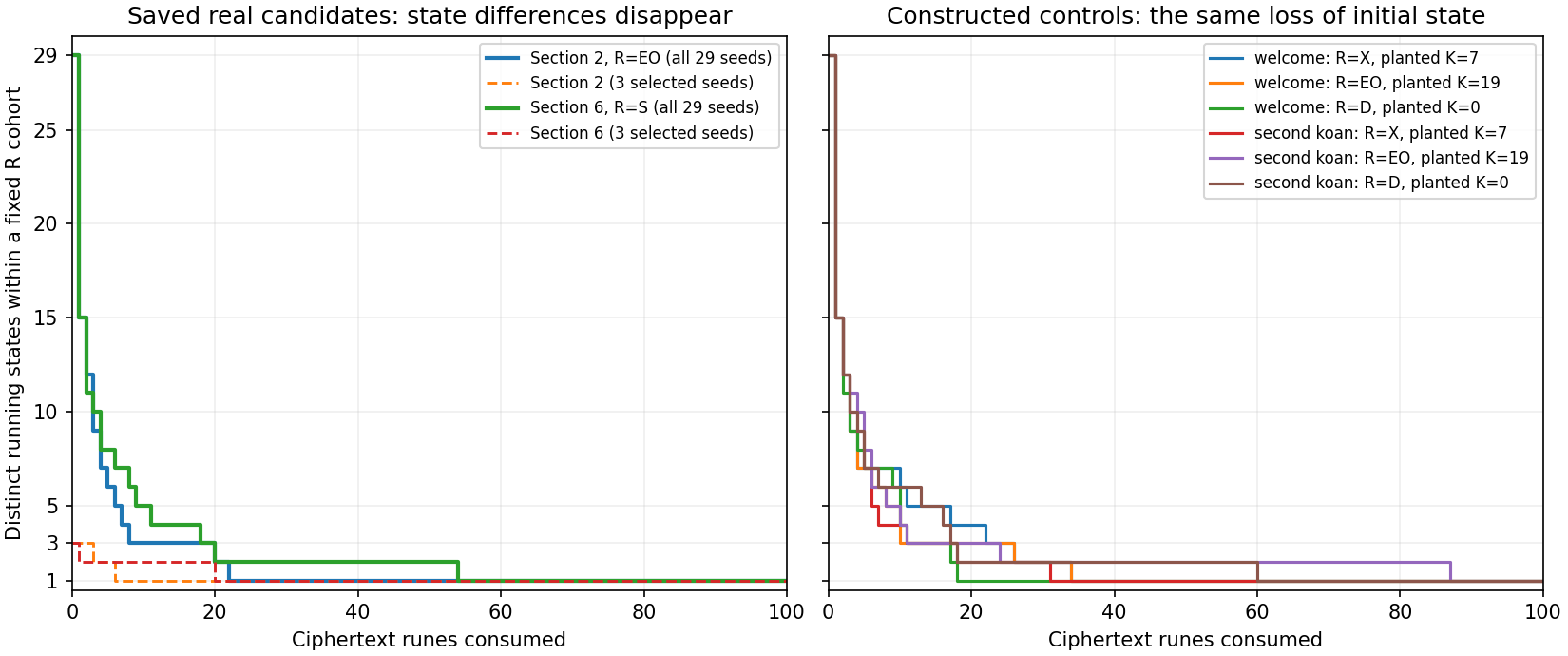
Solid real curves trace all 29 initial states at the selected designated rune; dashed curves trace only the three selected states. Each control curve uses all 29 initial states at its planted designated rune. These are deterministic counts, not probabilities or significance tests.
Convergence is not guaranteed for every ciphertext
A constant ciphertext stream supplies a counterexample. Its first symbol reduces the 29 states to fifteen. Every subsequent repeated symbol adds R² to each state, preserving all fifteen distinctions indefinitely.
The implementation checks all 841 combinations of constant ciphertext value and designated rune for 128 symbols. Every case retains fifteen distinct states after the first symbol. The algebra extends that observation to arbitrary length. Thus the complete mergers above describe the saved inputs, not every possible ciphertext stream under the rule.
Decision and reproduction
Close the starting-state diagnostic for this prototype. Trying another initial state cannot improve its frozen real continuation within a fixed designated-rune group. Its source-word contradiction still rejects the rule under the declared English word-preservation premise. There is no reason here to enlarge its starting-key sweep.
Carry forward two practices: count distinct decoded outputs when parameter paths merge, and require exact full-message recovery in controls when testing starting-key identification. Do not reject other mechanisms merely because they synchronize, or invent a new state update solely to avoid this one’s collisions. A different model needs independent motivation and the existing word, continuation and cross-section phrase checks.
This specification is a post-search diagnostic. It was written after a limited exploratory enumeration and selected traces; it is not a blind preregistration. No scorer, update, reset, exception or selected parameter changes. No new plaintext, real key, source correction or authorship attribution is established. Prior recognition limitations remain attached.
Run python3 -B plaintext_state_audit.py beside its retained companion files. Requires Python, NumPy, SciPy and matplotlib. The vector traces match the frozen decoder, and a separate scalar inverse enumerating encoder outputs checks 12,261 rune steps across all six selected real paths and all six planted control paths. Pairwise assertions verify that merged paths never diverge. All original evidence hashes remain unchanged. A second run reproduces the results and figure byte for byte in this environment.