Forcing the expected repeat rate to match the observed one exposes a larger transition mismatch. Both pooled solved-text profiles are infeasible at that expected rate. The individual profiles that can reach it leave 3.68%–16.80% minimum total-variation gaps in the remaining transitions. The smallest gap comes from the shortest original reference, with only 88 transitions.
These are exact conditional optimization results within the declared marginal model, subject to numerical tolerance. They do not recover an actual key stream, reject all additive ciphers or decode new plaintext.
The question left by Session 76
Session 76 showed that the saved full-histogram optimum generated roughly four times the observed neighboring repeats in known-key controls. Minimizing the aggregate histogram distance had sacrificed the repeat feature.
This session changes the optimization constraint: match the expected repeat rate first, then fit the remaining transition values. The plan was fixed before solving these new fits. The underlying repeat count, reference profiles and previous results were already known; this is a retrospective diagnostic.
Model and scope
Keep modular addition in the established 29-rune index order:
C_i = P_i + K_i (mod 29)
delta C_i = delta P_i + delta K_i (mod 29)
If plaintext and key increments are independent at an eligible transition, their marginal probability distributions combine as a cyclic convolution. Hold the plaintext-increment profile fixed, while allowing every probability distribution of key increments. No seed, short period or temporal independence is assumed by this one-step calculation.
The observed target remains the same eight substantial unsolved sections: 12,947 runes, 12,939 within-section transitions and 86 neighboring repeats. The required expected zero-increment probability is therefore 86/12,939 = 0.6647%. Section seams and the nine-rune numeric segment are excluded. Non-runes consume no positions.
The primary comparison uses the two pooled profiles and the five original individual solved groups. Four additional fixed sensitivities use Welcome, the second koan and solved LP2 pages 56 and 57. Their literal decoded rune streams come from the retained Session 76 source manifest; no new source reading or spelling correction is made.
First check whether the expected rate is possible
For a fixed plaintext profile, the expected repeat probability is a weighted average of its increment probabilities. Its attainable range is the interval between the smallest and largest of those probabilities.
| Fixed pooled profile | Reference transitions | Smallest expected repeat count at this exposure | Can match expected 86? |
|---|---|---|---|
| Original five groups | 1,958 | 105.73 | No |
| Expanded nine groups | 2,968 | 170.02 | No |
The additional Welcome profile also fails this expected-rate constraint: its floor is 125.87 at the same exposure. These floors were available from the earlier profiles; the new contribution is the constrained comparison of the feasible profiles' other transitions.
An expected-value floor is not a hard lower bound on every realized ciphertext count. The true unknown plaintext profile is unavailable, and finite realizations can fluctuate. These infeasibilities do not declare the real cipher impossible under all additive mechanisms.
Fit the remaining 28 transition values
For each feasible profile, impose the equality that the expected zero bin equals the observed zero bin. Then minimize total-variation distance to the full observed histogram. Because the zero bin is matched, the residual is entirely in the other 28 bins.
Total variation is half the sum of absolute probability differences. A gap of 10% means 10 percentage points of probability mass must be reassigned to match the empirical histogram. It is not a percentage of incorrectly decrypted characters, a p-value or a probability that the hypothesis is false.
| Primary individual profile | Reference transitions | Previous unconstrained gap | Gap after matching expected repeats | Conditional nonrepeat gap |
|---|---|---|---|---|
| Warning | 183 | 1.85% | 7.40% | 7.45% |
| Wisdom | 156 | 2.16% | 16.80% | 16.91% |
| First koan | 777 | 1.80% | 14.30% | 14.40% |
| Divinity | 754 | 1.91% | 11.47% | 11.55% |
| Instruction | 88 | 1.75% | 3.68% | 3.71% |
The final column compares the two histograms after conditioning on a nonzero increment. With both zero bins fixed at the same probability, it equals the full distance divided by 1 − 86/12,939.
The shortest original reference is the most permissive here. Its missing increments and small counts should not be treated as a universal profile for a long English passage. Selecting it after seeing the smallest score would not establish the unknown plaintext or a key.
The additional fixed sensitivities give:
| Additional profile | Reference transitions | Previous unconstrained gap | Repeat-constrained gap |
|---|---|---|---|
| Welcome | 514 | 1.94% | Infeasible expected rate |
| Second koan | 318 | 2.06% | 16.50% |
| LP2 page 56 | 84 | 2.11% | 6.43% |
| LP2 page 57 | 94 | 1.88% | 6.16% |
Thus eight of eleven declared profiles are feasible at the expected rate, but none exactly matches all 29 empirical bins.
More suppression does not improve these optima
A second fit allows the expected repeat probability to be at most the observed rate. It retains the full 29-bin distance objective, including any mismatch caused by predicting fewer repeats.
All eight feasible profiles give the same minimum distance as the equality-constrained fits, within the declared tolerance. Allowing still fewer expected repeats supplies no better aggregate fit for these profiles. The three infeasible profiles remain infeasible under this upper-cap rule.
This conclusion covers the stated optimization problems; it does not impose a repeat cap on all possible finite encodings.
A concrete necessary constraint on key changes
Let m be the smallest repeat coefficient, and v the next distinct coefficient. If the required rate t lies below v, the key-increment distribution must put at least
(v - t) / (v - m)
of its probability mass on the minimizing key-increment bins. The inequality follows because all remaining bins have coefficients at least v.
For the Wisdom profile, at least 96.31% of key increments must equal 12 modulo 29. For the first-koan profile, at least 70.89% must equal 4. For Divinity, at least 66.47% must equal 22. These are necessary probability-mass bounds under those fixed profiles, not recovered keys or proposed plaintext.
Matching the rare-repeat rate forces heavily biased key changes in these cases. The larger residuals quantify how poorly their other transition values then resemble the observed near-balanced histogram. The fitted distributions satisfy the analytical mass bounds; all are retained in the results.
The tradeoff across expected repeat counts
The figure forces expected repeat counts from 0 to 500 in steps of five, adding the observed count, each profile's analytical floor and its unconstrained optimum. At every feasible point, a new constrained linear program minimizes the full distance to the unchanged real target histogram.
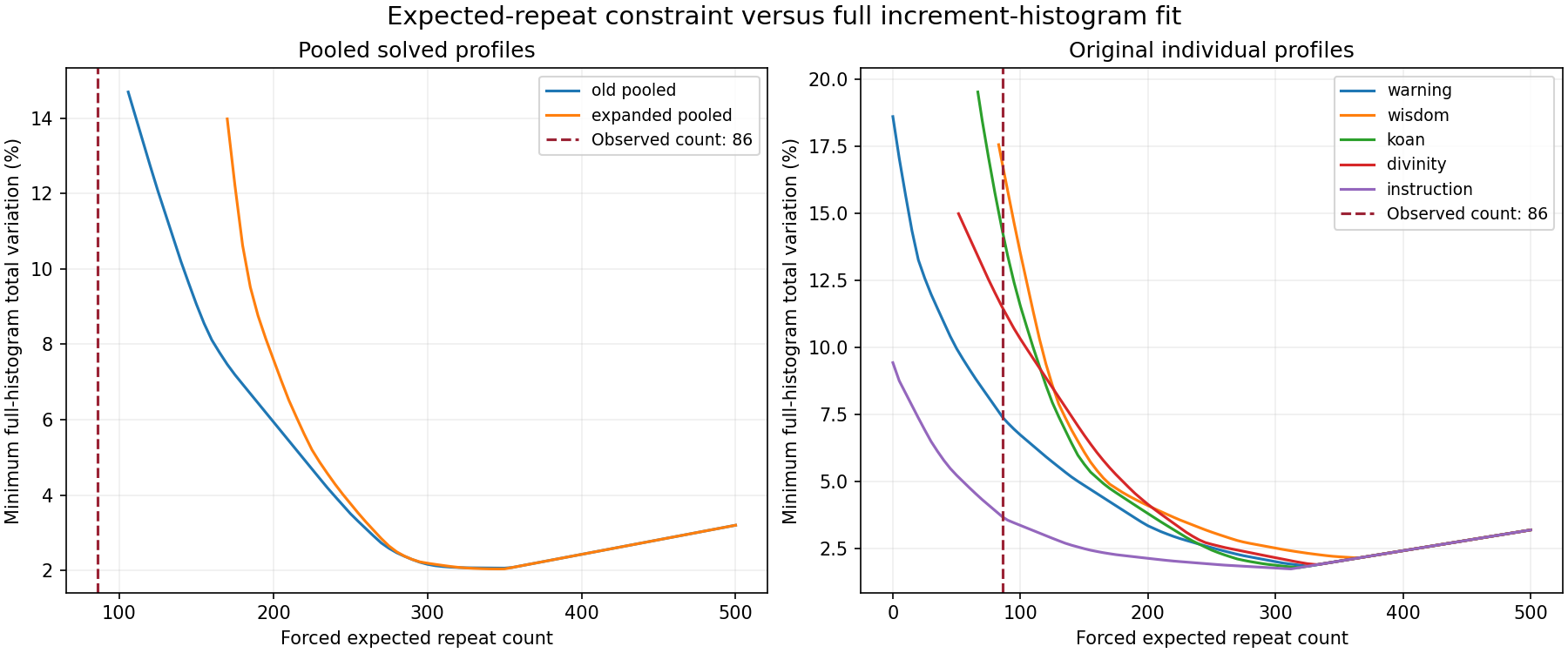
The pooled curves begin above 86 because that expected value is outside their feasible ranges. The individual curves show the larger gaps at the observed rate and the lower aggregate gaps when hundreds of repeats are permitted. Points are joined for display; the two panels use different vertical ranges with the same percentage units. These are optimization frontiers on empirical profiles, not confidence bands or actual plaintext decodes.
Controls and numerical verification
- All 29 constant key slopes encrypt and exactly decrypt all nine known source groups. For each resulting histogram, constraining its own repeat rate yields a zero-distance fit. The upper-cap variants also yield zero distance.
- An exact independent weighted-product fixture pairs every known plaintext increment with a fixed 2:3:5 multiset of key increments. Its 29,680-transition sequence decrypts exactly with its known key and has a zero-distance constrained convolution fit. This is a constructed increment-pair sequence, not additional natural prose.
- Two three-symbol problems agree with a complete piecewise-linear breakpoint calculation. One has minimum distance 0.045; the other is zero within floating-point precision. A third analytically infeasible rate is correctly rejected.
Every solved fit records its probability distribution, residuals and linear-program dual certificate. Feasibility and the primal/dual objective agreement are checked at tolerance 1e−9. The maximum recorded dual-feasibility violation across the frontier fits is about 1.5e−11. These checks support the optimization implementation, not unknown-key recovery.
What changes and what remains open
Matching the repeat feature alone is insufficient. Under the declared fixed profiles, an independent-increment additive model either cannot reach the requested expected rate or pays a larger mismatch elsewhere. This is a reason to deprioritize a simple marginal fit as a route to a seed or key.
It is not a universal English result. The short reference samples may differ from the unknown plaintext, and expected histograms need not match finite realized histograms exactly. Session 76's reference-mismatch examples remain relevant. Other rune orderings, dependence between plaintext and effective key increments, state changes or an intermediate encoding are outside this calculation.
No model here accounts for the corrected singleton inventory or the cross-section six-rune phrase. A new mechanism should specify how it generates those features, rather than relying on a marginal score.
The next bounded question is whether an explicitly plaintext-dependent repeat-avoidance rule can fit both the repeat rate and the remaining increment distribution while preserving invertible known-key controls. Any such extension must be specified before fitting and retain the separate singleton and phrase requirements. This session does not invent or search that rule.
No new plaintext, source correction, actual key or author attribution is established. The master and all earlier evidence files remain unchanged. No fresh image recognition is performed, and the prior recognition limitations remain attached.
Reproduce and inspect
Run python3 -B repeat_tradeoff_audit.py beside the retained companion files. Requires Python, NumPy, SciPy and matplotlib. No network call or key dictionary is used.
The result JSON contains all eleven profiles, unconstrained fits, exact and upper-cap fits, analytical bounds, controls, and complete fitted distributions and certificates for the frontier points. Repeating the command reproduces the result JSON and figure byte for byte in this environment.