The saved best histogram-fit key model does not reproduce the repeat shortage. Its length-matched controls average roughly 347–351 neighboring repeats, versus 86 in the real text. Across all 7,992 constructed encodings under four specified key-generation rules, the smallest count is 236. Every constructed book decrypts exactly with its generated key, but no unknown key or plaintext is recovered.
The histogram diagnostic also depends on the chosen plaintext reference. Using a mismatched reference makes 58 of 999 valid encodings reach or exceed the real text's 2.06% gap. That warns against turning a reference-dependent score into an exclusion of all additive ciphers.
What was fixed before running the calibration
Session 75 showed that a finite independently generated key could give a nonzero convolution-fit distance. Its supplementary control had only 1,958 transitions. This session asks what happens at the unsolved corpus's actual length, while distinguishing sampling variation from reference mismatch.
The protocol was frozen after checking the known decoding conventions and before constructing the long books or generating calibration trials. The real corpus and the Session 75 optimum were already known. This is a conditional model comparison, not a fresh blind discovery.
Construct two plaintext books, each with 12,947 runes split into the same eight section lengths as the substantial unsolved sections. Score 12,939 transitions, excluding cross-section edges.
- Original-source book: concatenate the five previous solved groups, then cycle that string to the required length.
- Expanded-source book: concatenate nine solved groups in original book order, then cycle that string to the same length.
These are repeated known passages with artificial joins, rather than new natural prose or an asserted unknown plaintext. Their actual increment distributions are measured separately. Cycling does not create independent new language evidence.
The expanded solved reference
The nine groups cover all 17 parsed solved text pages: the 15 parsed LP1 text pages and solved LP2 pages 56 and 57. The two separate LP1 title images are outside the parsed master. The expanded reference has 2,977 runes and 2,968 within-group transitions.
| Group | Runes | Treatment |
|---|---|---|
| Warning | 184 | Retained reversed-rune decoding |
| Welcome | 515 | Known DIVINITY key and eleven selective unchanged F positions |
| Wisdom | 157 | Retained direct reading |
| First koan | 778 | Retained reversed-rune-plus-shift decoding |
| Divinity | 755 | Retained direct reading |
| Second koan | 319 | Known FIRFUMFERENFE key and two unchanged F positions |
| Instruction | 89 | Retained direct reading |
| LP2 page 56 | 85 | Known prime-minus-one stream and one unchanged F position |
| LP2 page 57 | 95 | Retained direct reading |
The three enciphered additions pass exact re-encryption. Welcome and the second koan also match the retained alphabetic translation under the declared comparison conventions. Welcome's literal reading contains ALOING and WIDSOM; only the translation-comparison copy normalizes those to ALONG and WISDOM. Their original rune values remain in the calibration. This is not a source correction or a new image reading.
The known methods and selective cleartext-F convention are documented in the solver's research record. Exact page mappings, offsets, checks and input hashes are in the source manifest. This reproduces existing solved material; it does not discover these keys.
Four explicit key-generation rules
For every constructed section, start the additive key at 7. Each subsequent key value adds the generated increment modulo 29. Restart sections independently. No word, page or punctuation reset is added, and no generated position is skipped.
| Rule | Key increments |
|---|---|
| Uniform independent | Each increment drawn independently and uniformly from 29 values |
| Sparse independent | Fixed weights 2:3:5 at increments 0, 4 and 17 |
| Fitted independent | Independent draws from the saved Session 75 pooled-reference full-histogram optimum |
| Fitted persistent | Start from that same distribution; retain the previous increment with probability 0.95, otherwise draw again |
The persistent rule has the same stationary one-step marginal as the fitted independent rule, but introduces temporal dependence. It is one specified correlated model, not a test of all structured key streams.
Each book/rule combination gets 999 trials. Seeds are fixed from base 3301076, with offsets recorded in the results. Keys are generated independently of the known plaintext. Every trial verifies exact decryption and the intended key increments.
The best histogram fit sacrifices the repeat rate
The old real-text histogram fit predicts 349.72 expected repeats when evaluated with its own short pooled reference. The expanded-reference optimum predicts 346.65. Both optimize all 29 increment bins, rather than constraining the zero bin to match 86 repeats.
Approximately 99% of each minimum total-variation gap comes from the zero-increment bin. Thus, the small overall distance was hiding a large mismatch in the very feature that motivated the investigation.
| Constructed book | Key rule | Mean repeats | Central 95% trial range | Smallest count |
|---|---|---|---|---|
| Original | Uniform independent | 446.16 | 407–485 | 367 |
| Original | Sparse independent | 273.40 | 248–298 | 236 |
| Original | Fitted independent | 348.99 | 315–385 | 291 |
| Original | Fitted persistent | 350.74 | 312–392 | 292 |
| Expanded | Uniform independent | 445.61 | 405–487 | 357 |
| Expanded | Sparse independent | 278.01 | 252–302 | 236 |
| Expanded | Fitted independent | 347.23 | 313–383 | 283 |
| Expanded | Fitted persistent | 346.03 | 311–384 | 282 |
| Real unsolved text | Unknown | Observed: 86 | Not a trial interval | 86 |
Neither persistence at the declared level nor expanding the solved reference makes these four models reproduce the observed shortage. Zero trials at or below 86 does not mean probability zero. These conditional simulations also do not establish an omnibus significance level for additive encryption.
With the expanded short plaintext profile held fixed, the analytical minimum expected repeat count over every key-increment distribution is 170.02, versus 105.73 for the old pooled profile. Those are conditional expected-value floors, not universal English limits or hard lower bounds on individual realized counts. Several individual short-group profiles in Session 75 have lower floors, so reference choice remains material.
What changes when the reference is right or wrong
Using each constructed book's own known plaintext-increment profile, the real text's old-reference distance of 2.06% is above every simulated distance in all eight cases. The largest true-profile distance among the 7,992 controls is about 1.85%. However, the real book's own plaintext profile is unknown; its true-profile distance cannot be measured.
The expanded real reference gives a 2.0403% empirical gap, close to the prior 2.0623%. Expanding the short reference does not remove the real gap.
Reference mismatch can nevertheless enlarge valid-control gaps:
| Valid generated case | Scoring reference | Central 95% histogram-distance range | Trials reaching corresponding real gap |
|---|---|---|---|
| Expanded book, sparse independent keys | Actual constructed plaintext | 0.78–1.61% | 0 / 999; real old-reference value used only as a scale marker |
| Expanded book, sparse independent keys | Short original reference | 1.20–2.17% | 58 / 999 against 2.0623% |
| Original book, sparse independent keys | Short expanded reference | 1.60–2.48% | 481 / 999 against 2.0403% |
The latter two rows are deliberately mismatched comparisons. Their conditional trial fractions are not calibrated cipher-hypothesis p-values. Even when a valid encoding has a histogram gap like the real one, its repeat count here is still far above 86. Matching that score alone does not make it a viable explanation of the real corpus.
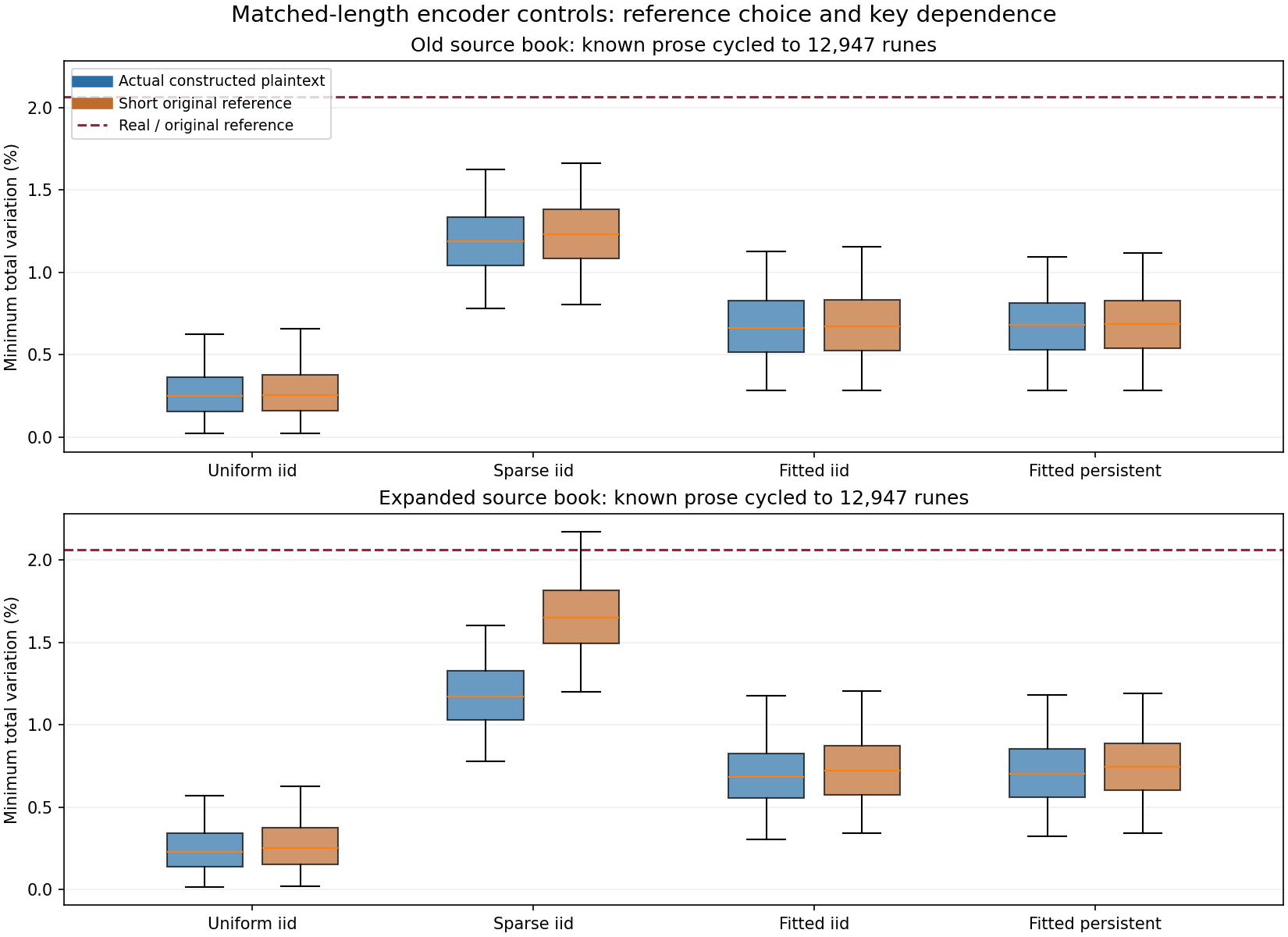
Boxes show quartiles and medians; whiskers show the central 95% trial range, with outliers omitted from this display but retained in the data. The dashed line is the real text's original-reference distance, not an unavailable true-plaintext score. The figure compares controls and illustrates reference dependence; it does not rank recovered keys.
The known solved ciphers demonstrate the broader limit
The original enciphered Welcome, second koan and LP2 page 56 all recover their established readings, yet the minimum histogram distances using their own plaintext profiles are 5.83%, 6.98% and 10.85%. Their samples are short, their keys are deterministic, and selective F exceptions couple effective key advancement to the text. They are outside the four declared long-book generators.
These controls show why the conclusion must concern the specified key-generation rules and profiles. A marginal convolution diagnostic does not prohibit known deterministic additive encodings, selective skips, other temporal structure, different plaintext statistics or another encoding layer.
Decision and next bounded question
Deprioritize the saved full-histogram optimum as a key-generator lead: it produces roughly four times the observed repeats in both constructed books. Its small aggregate distance is not a joint fit to the real text's features. The declared 95%-persistent variant gives no rescue in these controls.
The next useful question is the explicit tradeoff: if a key model is required to match the low repeat rate under a declared plaintext profile, how far must the remaining increment bins move? That needs a constrained fit, separate reference sensitivities, and known-key controls. It should not become another unconstrained seed search. Singleton words and the cross-section phrase remain additional requirements, not features accounted for by this calibration.
No new plaintext, unknown key, source correction or author attribution is established. The master, translations and earlier results remain unchanged. The failure of Session 74's complete-page recognition controls remains attached to this source record.
Reproduce and inspect
Run python3 -B increment_calibration.py beside the retained companion files. Requires Python, NumPy, SciPy and matplotlib. It reproduces the known baselines, writes the source manifest, runs all 7,992 trials, checks every known-key recovery and renders the figure. No network call is made by the script.
The main JSON preserves every trial distance and repeat count, not only the plotted ranges. Repeating the command reproduces the source manifest, result JSON and figure byte for byte in this environment.