The six-page separator inventory is complete. All 355 small physical dot groups align with the reviewed readings, with stable counts and boxes at three thresholds. The 20 ordinary four-dot groups agree with the master transcription. The two exceptional locations remain separate source events rather than being forced into that class.
The page-46 diagnostic adds a useful result: a fourth square merged into the adjacent rune does not fit the expected geometry. We can now record the visible mark as an inline three-dot group. Its meaning, and whether it resets anything, remain unknown. No plaintext was recovered.
Scope and extraction
The fixed plan covers the same LP2 pages as Session 58: 4, 11, 18, 25, 34 and 46, totaling 72 text lines. Page numbers are zero-based.
For each saved text-row box, the script detects small black connected components with area 30–150 pixels and width and height 6–13 pixels. Nearby components are grouped and compared left-to-right with the physical separator sequence in the reviewed reading. The apostrophe on page 4 is retained in the earlier transcription check but is not counted as a dot group.
The inventory is repeated at grayscale thresholds 80, 100 and 120. All three settings produce the same group counts, group boxes, individual dot boxes and rune-gap alignment. There are no unmatched groups or missing reference groups. Source-image and reviewed-reading hashes are checked.
This is pixel extraction aligned to an existing reading, not independent OCR. It checks the physical marks in this six-page sample, not every separator in the book. A component detector can miss a mark joined to a rune; the targeted overlap diagnostic below addresses the particular case already flagged on page 46.
Inventory
| LP2 page | Single-dot groups | Four-dot groups | Three-dot groups | Physical groups |
|---|---|---|---|---|
| 4 | 56 | 4 | 0 | 60 |
| 11 | 50 | 5 | 1 | 56 |
| 18 | 59 | 2 | 0 | 61 |
| 25 | 55 | 2 | 0 | 57 |
| 34 | 56 | 5 | 0 | 61 |
| 46 | 57 | 2 | 1 | 60 |
| Total | 333 | 20 | 2 | 355 |
These contain 419 isolated squares. The 355 physical groups occupy 354 distinct rune gaps, because page 11 places a three-dot fragment at one line's end and a single dot at the next line's beginning, with no intervening rune.
At the gap level, the source ledger therefore contains 332 single-dot gaps, 20 four-dot gaps, one split 3+1 gap and one inline three-dot gap. It retains both physical fragments at the split location.
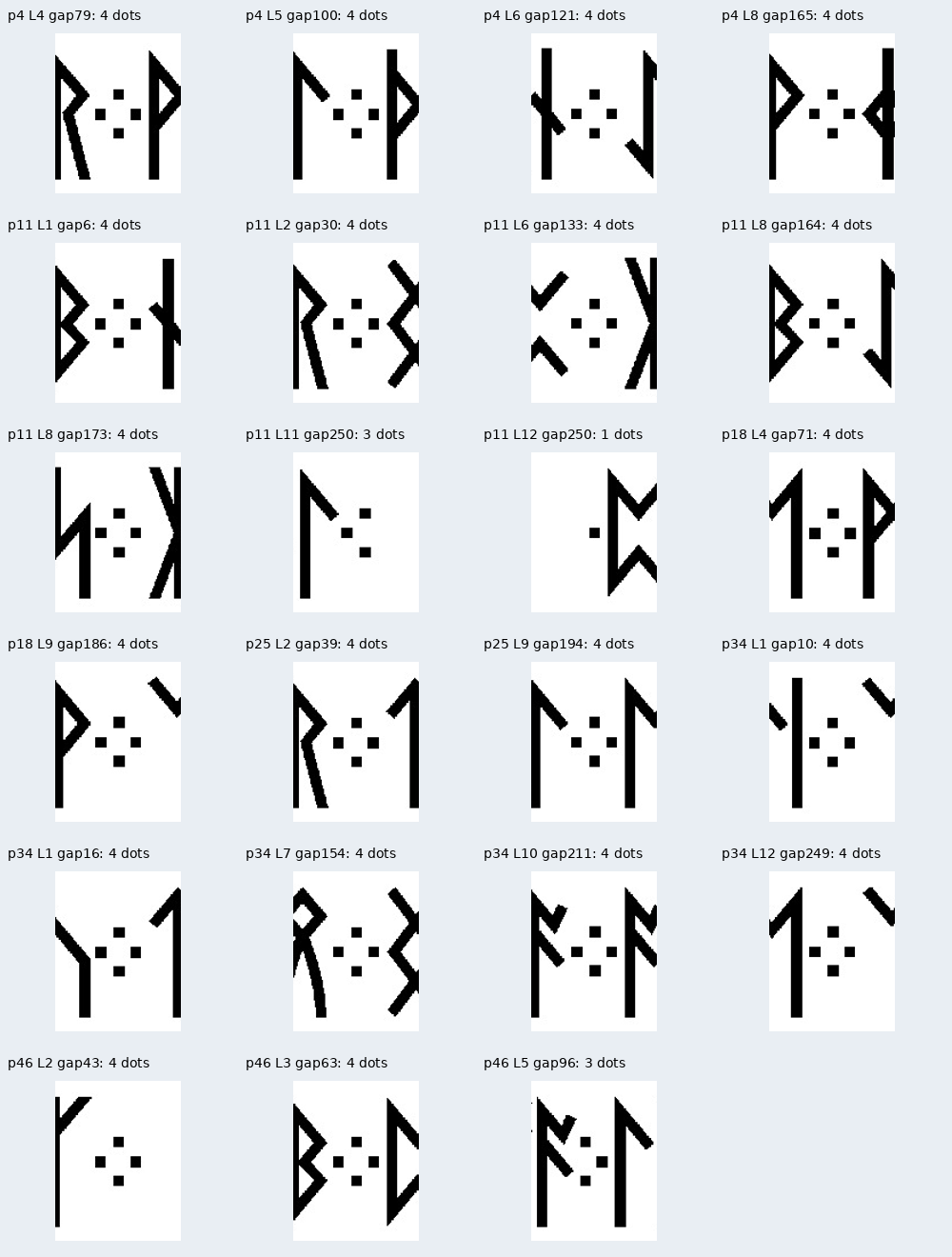
Page 11: preserve the split mark
At rune gap 250, line 11 ends with three squares and line 12 begins with one. The master records ;- before the line break. The source geometry and line placement are more informative than silently converting this to an ordinary period.
The ledger records split_three_plus_one. It does not decide whether the author intended a wrapped four-dot symbol, a three-dot symbol followed by a single-dot separator, or some other convention. All interpretations share the same gap between runes.
Page 46: test the overlapping-square explanation
At gap 96, on line 5, the master records -, while the image contains three isolated squares. Session 58 left open whether a fourth square had merged into the preceding A rune.
This follow-up diagnostic was chosen after the inventory; it is not a preregistered statistical test. It compares the A before that gap, at rune offset 95, with another A on the same line at offset 106.
At all three thresholds:
- Both rune masks contain 1,638 black pixels.
- Their aligned binary masks have zero differing pixels.
- Reflecting the group's right-hand square across the centerline through its top and bottom squares gives the expected fourth-square position.
- That 10-by-10-pixel position contains 29 black pixels and 71 white pixels. A complete black square is absent there.
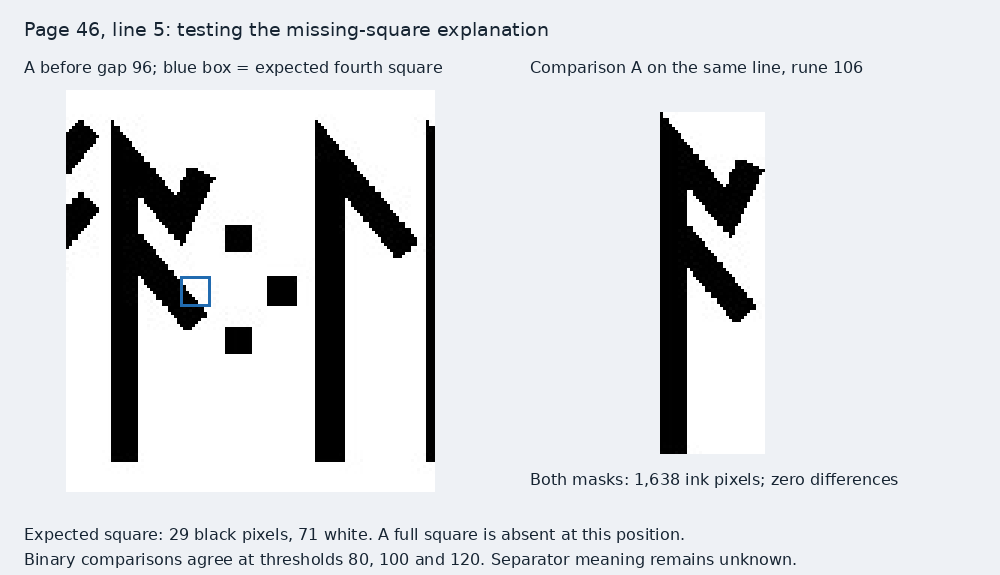
The adjacent rune has no extra ink relative to the comparison glyph, and the expected square would require filling visible white pixels. Thus the simple expected-position overlap explanation fails. This narrows the earlier uncertainty: three_dot_inline is the appropriate physical record. It does not establish why the author used that mark or rule out every hypothetical nonstandard drawing.
The original master remains unchanged. The ledger carries the corrected physical classification, including coordinates and provenance. This is a source-quality finding within our project, not an established new-to-community discovery.
What changes under hypothetical reset rules?
All 20 literal periods in the master on these pages match the 20 detected ordinary four-dot groups. Neither exceptional gap is a literal period. We can therefore measure the effect of including either exception without choosing a key or scoring decoded text.
For this comparison only, start a counter at zero on each sampled page and reset it before the rune following a selected gap. The page-start convention is bookkeeping, not evidence for real page-based key resets.
| Hypothetical reset policy | Selected reset gaps | Counter positions changed from the four-dot-only baseline |
|---|---|---|
| Ordinary four-dot groups only | 20 | 0 |
| Also include page 11's split mark | 21 | 23 |
| Also include page 46's inline three-dot mark | 21 | 174 |
| Include both exceptions | 22 | 197 |
On page 11, the optional reset at gap 250 changes the local counter by −77 for offsets 250–272. On page 46, the optional reset at gap 96 changes it by −33 for offsets 96–269. These are counter-index differences, not necessarily different key symbols or decoded letters. A repeating key can map different indices to the same value.
No scenario has been selected as correct. No key search or plaintext ranking was run. The sample's 11 adjacent repeated pairs remain unchanged, because separator classification changes neither rune identity nor rune order.
Evidence and reproduction
- Fixed inventory plan
- Pixel inventory and all 355 event records
- Gap-level source ledger
- Overlap diagnostic and reset scenarios
- Pixel-audit and contact-sheet code
- Overlap and counter-scenario code
Run the pixel-audit script first and the diagnostic script second, beside the retained evidence files. They use Python, NumPy, SciPy and Pillow. The earlier readings and original JPEGs are linked from Session 58.
Plan SHA-256: c1192cdd6c7a916859598842112adea1a353ba07bacb0d45e54a4e1c39915d14.
Consequence for the hunt
The three-dot mark should remain its own observed class in future tests. Treating every multi-dot mark as a period would introduce an unsupported reset assumption. The next source task is to extend this inventory to more pages and see where the same physical classes recur, before expanding cipher searches around them.