A simple brightness curve predicts untouched branches at 0.910 and 0.877, improving on both ordinary ink and the inner rim.
This was an exploratory follow-up to the fixed boundary comparisons. Instead of detecting edges, we asked whether the same smoothed source darkness always maps to roughly the same printed darkness. A broken-line brightness curve with nine fixed knots is learned on one side. Width, height, position, smoothing and curve coefficients then remain fixed on the opposite side.
Both sides select smoothing 1.0 on the common source canvas. Both learned curves leave white nearly white, darken the roughly 5/8–3/4 ink range, then return near-solid source ink to pale. That leaves light centers inside thick dark branches. Held-out errors are 7.27 gray levels on the right and 8.44 on the left. It predicts 11 of 14 right-side loops and 9 of 18 left-side loops, with 15 and 11 predicted respectively.
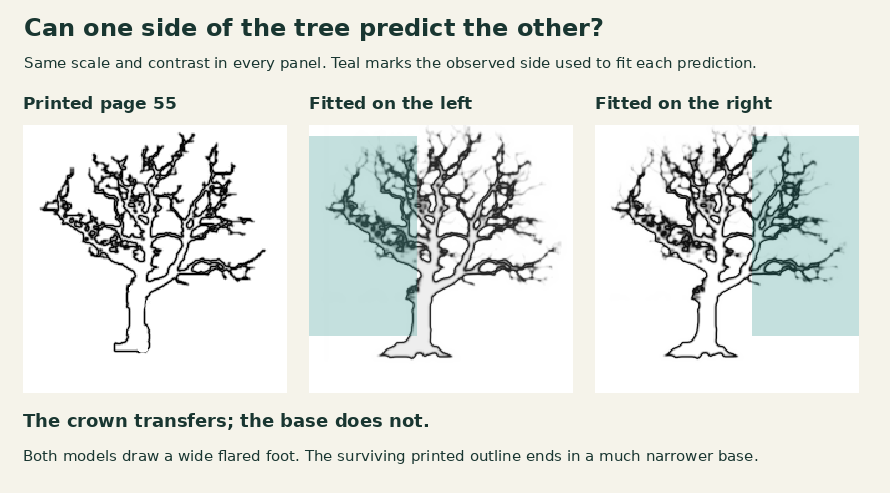
This is a useful approximation to the crown. It does not identify a particular editor command, and the base is conspicuously wrong.