One verified 2014 message is a useful counterexample to reading the cipher width from the page. Its signed text has two lines of seven groups, each exactly five characters long. The recorded solution instead treats the same 70 characters as five rows of fourteen. We reproduced the readable message with the archived column order and applied its inverse to recover every original character.
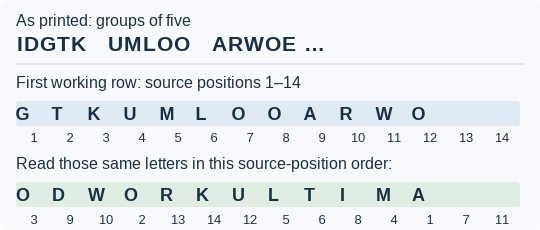
The input is the signature-checked payload 2014-3. Session 341 also reconstructs that same signed object from three earlier payloads; it is one message, not two independent precedents. We isolated the two rows of uppercase letters and digits. The separate words “Good luck.” and the sign-off “3301” do not belong to the cryptogram; neither does the OpenPGP envelope. The signing key authenticates the grouped text. The explanation of the transposition is later archive commentary, not signed instructions.
Could the 70 characters hide a second instance of the printed byte notation? None of the fourteen native groups is two characters. Even if we deliberately erase all separators, the only two-character substrings starting with digits are 7T, 5J and 4M. The first two have illegal leading digits; the last would be 262, outside a byte. Thus none of the 69 adjacent pairs obeys the grid's grammar. Pairing from the first character crosses seven original separators and yields zero legal pairs out of 35. Pairing from the second crosses six and yields zero out of 34.
What did the historical layout do? Take successive 14-character rows, then read each in this archived zero-based column order: 2 8 9 1 12 13 11 4 5 7 3 0 6 10. The first row becomes GOODWORKULTIMA; the next continues the phrase “ultimate truth is the ultimate illusion.” The output is exactly 70 characters. The archive infers an extra character for a subsequent address; that character was not output by this permutation and was not inserted in our replay.
This is an authentic example of printed group length and working cipher width differing. The number five nevertheless also equals the number of working rows. We learn that the visible layout need not identify which dimension does what. We have no evidence that this specific key, width or method applies to the unsolved eight-cell grid, nor that its cells should be split apart.
Comparison design · Offline replay · Signed original, reconstructed by XOR · Archive’s permutation line · Draw the diagram · Pair counts, inverse check and full-output hash.
To replay offline, put the linked files next to the verification record and Cicada public key. Run python -B fives_358.py . result.json with GnuPG installed, then python -B fives_358_draw.py result.json figure.svg. Passing --archive PATH to the first command additionally requires the exact pinned archive and checks that it contains the quoted permutation line. The permutation line is an archival excerpt, separate from the signed ciphertext.
Reproduce all twenty sessions · Next test: could any rearrangement contain the page-56 digest?.