At the typical measured spacing, the same 256 cells could fit into 31 rows instead of 32 while keeping each cell on its original page. If the complete stream could flow across the two page breaks, it could fit into 29. The difference between those answers matters: space for an extra cell on one line does not automatically buy another line of space on that page.
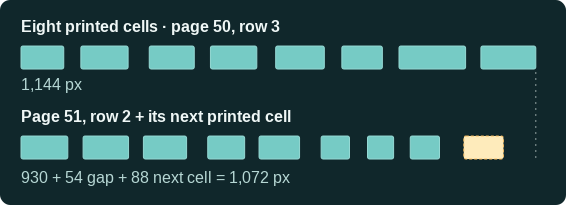
The diagram shows the local counterexample with left edges aligned for scale. For the whole-display calculation we kept the actual ink width of every cell, its place in the sequence, and the measured gap between neighboring cells originally on the same line. At an old line break the missing gap has to be estimated. We borrowed the minimum, median, or maximum from pages containing neither side of that join. A new line starts without a leading gap. We did not tighten known gaps or guess any byte values.
| At the measured 1,196-pixel width | Narrowest borrowed gap | Median borrowed gap | Widest borrowed gap |
|---|---|---|---|
| Minimum lines if page assignments are fixed | 31 | 31 | 32 |
| Breakdown for pages 49, 50, 51 | 10 + 12 + 9 | 10 + 12 + 9 | 10 + 13 + 9 |
| Minimum lines if the stream may cross pages | 29 | 29 | 30 |
The minima at the two extremes bound every choice of gaps inside those ranges. Each interior cell and gap has nonnegative width. Reducing any gap cannot require more lines. Under the median choice it is page 50 that could use one fewer line; neither of its neighbors has enough room to save a line of its own. Under the widest choice it takes 32 lines to preserve the three page assignments, exactly as in the book. That line count does not establish why the breaks occupy their particular positions.
Fixing each composed line to the physical page center, instead of giving it the full observed text band, leaves 1,192 usable pixels. The median result stays at 31 rows with page assignments fixed and 29 with free flow. Free flow with the widest gaps changes from 30 to 31. Whether an extra line is saved therefore depends on both the allowed text width and what happens at page turns. The prose margins are measured ink extents, not a surviving typesetting specification.
A forward algorithm packed the longest line that fits; a second search independently minimized row counts over every legal split. They agreed, including on 64 small generated layouts checked against all 128 possible break sets each. The saved results include explicit row ranges so the counterfactual layouts can be reconstructed. These are plausible uses of space, not proposed new reading orders.
Follow-up scope · Row packing replay · Rebuild the width diagram · Independent measurement of the margins.