Result: both archived page images confirm ᛞᛄᚢ · ᛒᛖᛁ, two three-rune words. No transcription correction and no new plaintext. The conventional rune labels are D J U / B E I. These are ciphertext labels, not a translation.
This session checks the retained original-page image copies against the master transcription. It does not independently authenticate their historical origin. The archive URLs are recorded in provenance.json, and source-image hashes, exact crop coordinates and findings are in the audit results.
What the images confirm
LP2 page numbers and rune offsets below are zero-based. Text lines are one-based. The combined archive filenames use a different numbering convention.
| Feature | LP2 page 27 | LP2 page 55 |
|---|---|---|
| Retained source image | 44.jpg | 72.jpg |
| Phrase starts at page rune | 28 | 70 |
| Phrase starts at section rune | 28, section 6 | 3,310, section 8 |
| Text line | 2 | 4 |
| Six runes | ᛞ ᛄ ᚢ / ᛒ ᛖ ᛁ | ᛞ ᛄ ᚢ / ᛒ ᛖ ᛁ |
| Internal word separator | Single black dot | Single black dot |
| Immediately preceding complete word | B F, two runes | K EA I M K X, six runes |
| Separator immediately before phrase | Single black dot | Single black dot |
| Immediately after phrase | Single black dot, then AE F | Red 13-dot mark, end of text |
| Nearby red mark | Before phrase, with nine intervening runes | Immediately after phrase |
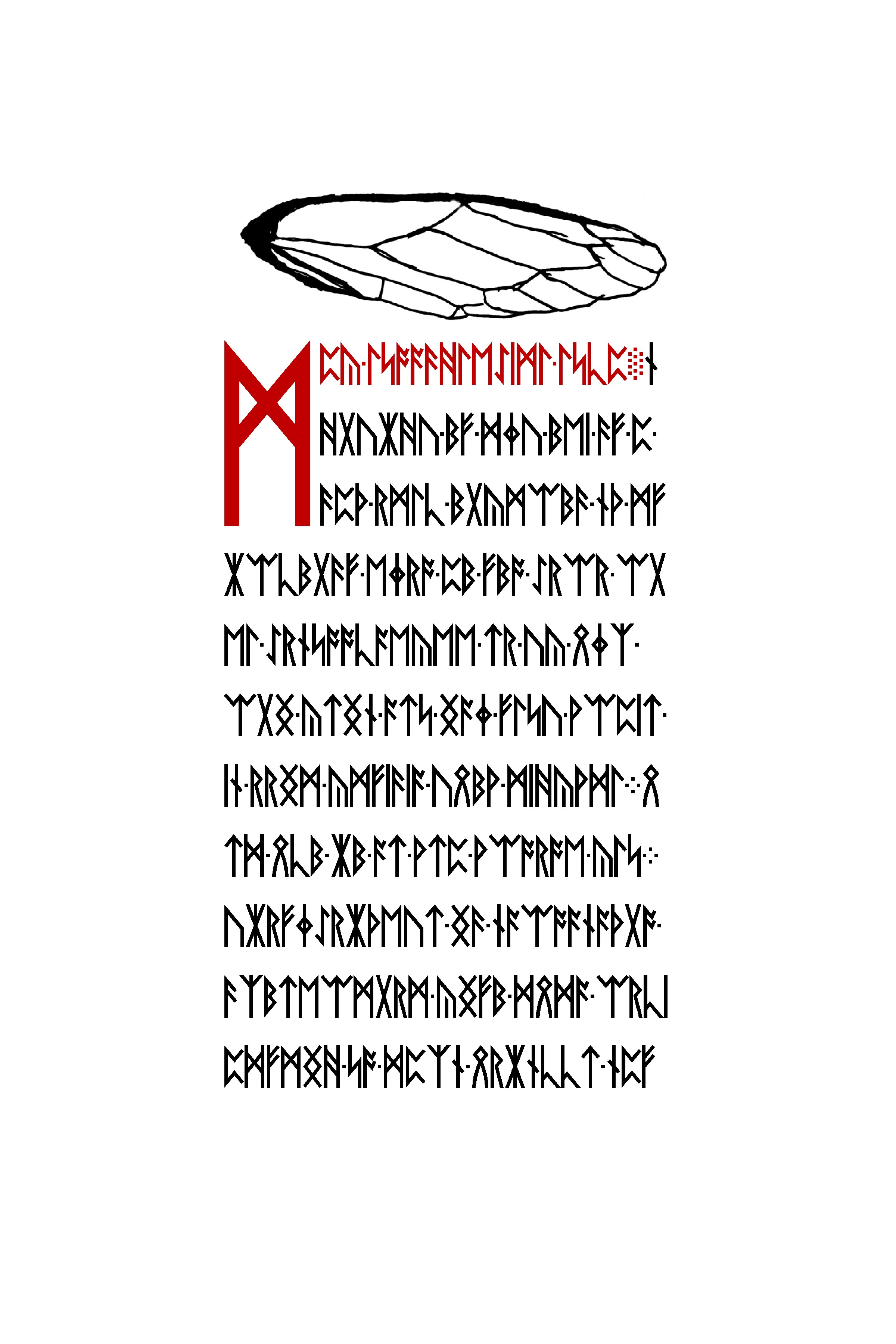
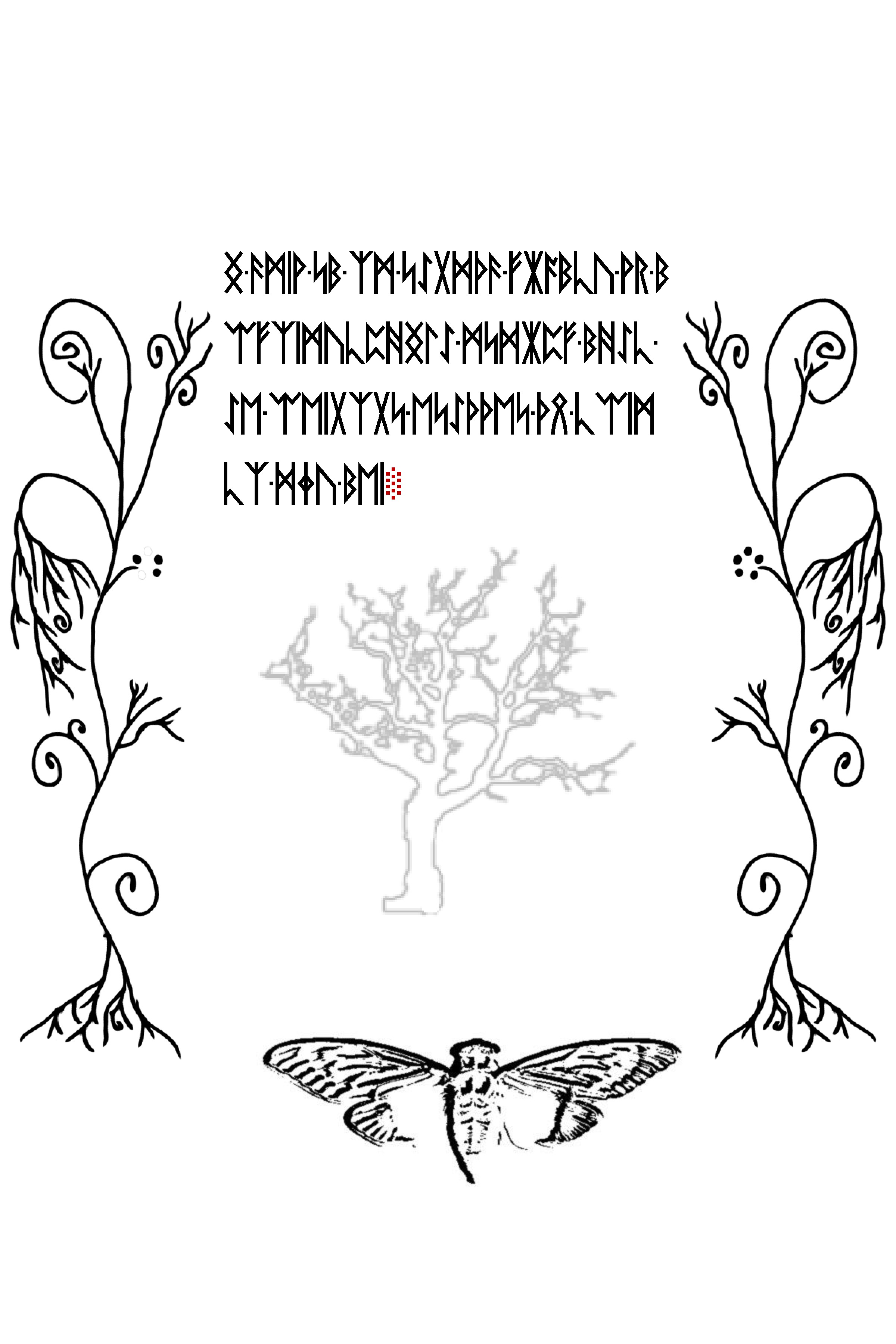
The labels EA, AE and X each stand for a single rune. They should not be counted as ordinary English letters.
The previous word on page 55 begins at rune 64 on line 3 and continues as K X at the start of line 4. There is no word separator at that line break. Treating K X as a complete two-rune word would create a false match to the two-rune word before the page-27 occurrence.
Inspect the source pixels
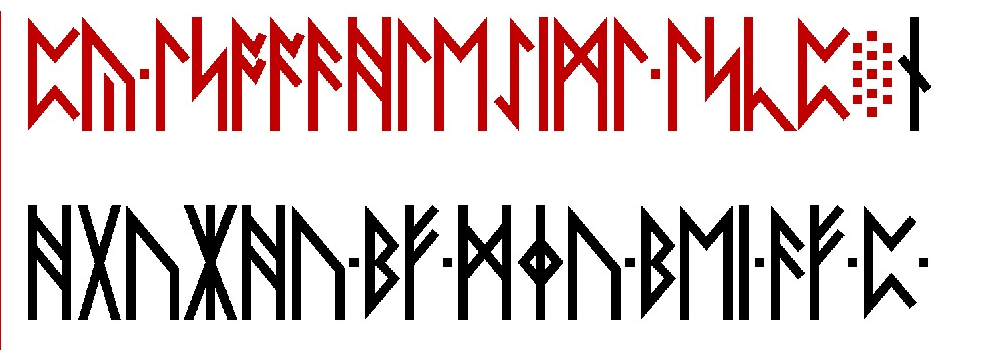
These are rectangular crops of the decoded JPEG pixels, saved losslessly as PNG. No sharpening, reconstruction, inversion or glyph replacement was applied. Both source images are 2,400 by 3,600 pixels. The page-27 crop includes the end of its red opening line and the phrase on the next line. Its oversized opening rune lies mostly outside this crop.
Page 27, opening lines:
Page 55, final two lines:
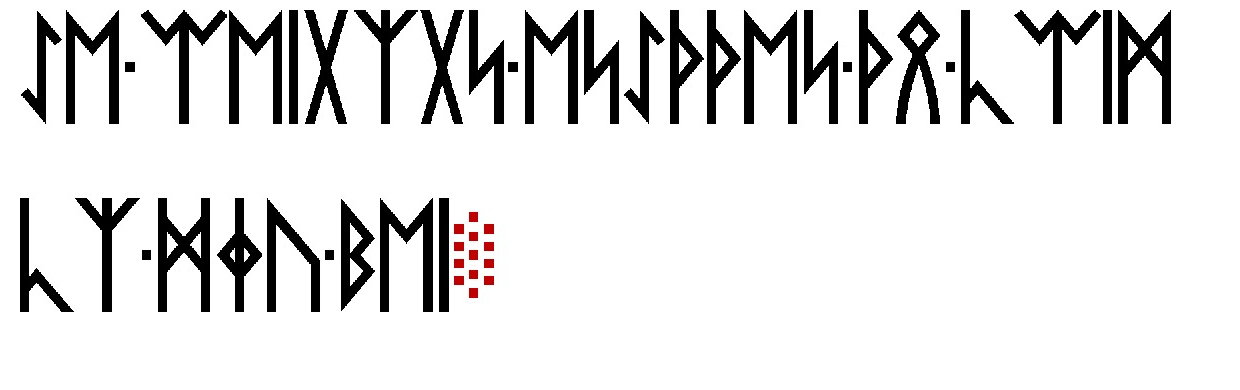
Both red marks contain 13 dots, arranged in three columns of 4, 5 and 4. Visual inspection agrees with connected-component counting inside the recorded rectangles, using RGB red > 130, green < 100, blue < 100 and a minimum component area of 20 pixels. This is a count of the visible marks, not a decoded punctuation meaning. The page-27 mark ends the red opening text at rune offset 19; nine black runes intervene before the repeated phrase at offset 28. The page-55 mark follows rune 75, the final rune of the phrase and section.
The master transcription represents both these marks with a period. Its punctuation encoding does not preserve their color or dot count. That is an abstraction to account for, not a newly found rune error.
Does the match extend?
The immediately preceding runes differ: F versus X. Thus the match does not extend one rune to the left. More broadly, none of the 28 rune positions preceding the two aligned phrases match. This is a descriptive comparison selected around an already known repetition; it is not a new significance test.
A right extension within the second section cannot be tested: its phrase ends that section. Page 27 continues with AE F, then P and further text. We do not splice the following solved section onto page 55 to manufacture a continuation comparison.
Both phrases occupy complete words and sit on single text lines. Their larger roles differ: early body text after a red opening on page 27, final words on page 55. A common red mark type is present, but there is no matching immediate punctuation context or equal distance from that mark. This audit provides no new common reset position.
Constraints on the next cipher hypothesis
- Keep the six-rune equality and its two-word division. An explanation must allow this observed repetition, without assuming that it necessarily reflects identical plaintext. The repeated phrase was already found unusual in Session 5's adjacent-pair-preserving comparison; this image audit confirms the input, not that statistical conclusion independently.
- Retain the adjacent-repeat shortage as a separate constraint. Session 29 found 86 equal neighbors versus about 445 expected under section inventory shuffles. A candidate mechanism should be assessed against both observations. Explaining one by itself is insufficient evidence for a decryption.
- Do not infer a common state from the punctuation. The matching red mark type occurs at different positions relative to the phrase. A mark-based reset or finalization rule would need explicit handling of both contexts and validation elsewhere.
- Do not turn ciphertext equality into a guessed English phrase. For an additive mod-29 cipher, identical ciphertext implies identical six-value keystreams only if the two plaintext spans are also assumed identical. That extra assumption was already tested in bounded periodic and local fits in Sessions 6 and 7, without a verified result.
The next useful experiment is a tightly specified mechanism that can accommodate rare adjacent repeats and occasional longer repetitions, with recovery controls and unchanged continuation checks. Another unconstrained phrase guess or repeat of the earlier period search would not gain support from this audit. No such new mechanism is selected or tested in this session.
Reproduce
Run python -B phrase_image_audit.py beside the retained transcription and images. Requires Pillow, NumPy and SciPy. It recreates the crops, checks phrase positions and word boundaries, counts red components, compares the preceding 28 positions and records SHA-256 hashes. Visual identification of the six runes remains a documented human/model inspection, not automated OCR validation.