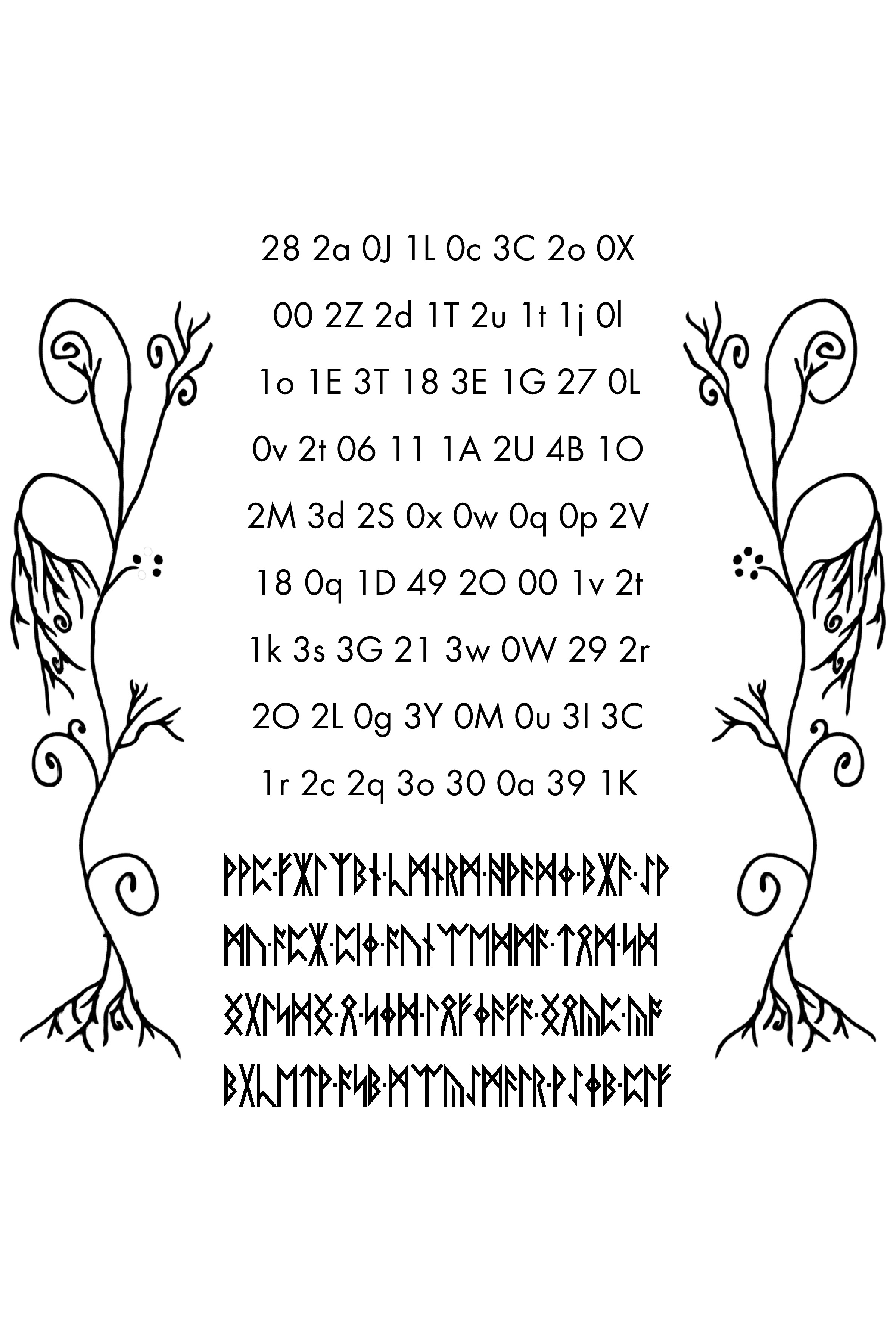
Even when the two three-rune blocks are allowed to cross word separators, the page-51 example stands alone. Of 12,893 eight-rune windows in the continuous unsolved text, just one starts and ends with the same three runes. That is the eight-rune word beside the grid. None of the other 12,892 windows repeats a triple five positions later.
For each manuscript section we removed the word boundaries, kept the rune order, and scanned its real eight-rune windows. We did not join the end of one section to the next or wrap text from the end back to the beginning. We then restored the actual word positions. Of the 12,893 windows, 731 fit wholly inside a word and 156 coincide with an entire eight-rune word. The sole return does both. This tests whether the missing replication in Session 299 was simply hidden by a word break.
Given a return, where could the boundaries land? Section 8, which contains the example, has 3,309 possible eight-rune windows. Keeping the continuous text and return fixed, we rotated the labels marking where eight runes fit within a word over the valid start positions. Exactly 193/3,309 (5.83%) of shifts put the return wholly inside a word, and 48/3,309 (1.45%) make it a complete eight-rune word. Shifts in other sections cannot add a hit, because there is no return there. Those fractions describe how punctuation aligns to this already selected return. They do not measure the frequency of the pattern under a cipher. Remove the selected window and all rotations yield zero.
Given this particular letter inventory, why spacing five? The page-51 word contains three doubled rune types and two singletons, so it has 5,040 distinct orderings. We enumerated them rather than estimating their frequency:
| Result in a rearrangement of the eight printed runes | Number of orderings |
|---|---|
| No repeated three-rune block | 4,968 |
| Repeated block at distance 3 | 36 |
| Repeated block at distance 4 | 24 |
| Repeated block at distance 5 | 12 |
The categories do not overlap. The chances under this artificial shuffle are 12/5,040 for spacing five before asking whether any block repeats, but 12/72 (one in six) once a return is known to exist. With only two copies of each repeating rune, distances one and two are impossible. Distance three offers three possible pairs of starts in eight runes; four offers two; five offers one. That accounts for the 36:24:12 ratio.
The interval of five is a verifiable feature of one printed word; it remains a single observation whichever side of the word boundary we search. To test a key period we need a procedure that recovers real, known periods from withheld text, or separate evidence that singles out the same interval.
View the printed word’s page · Source transcription · Rotation and enumeration protocol · Full data · Reproduce the checks.