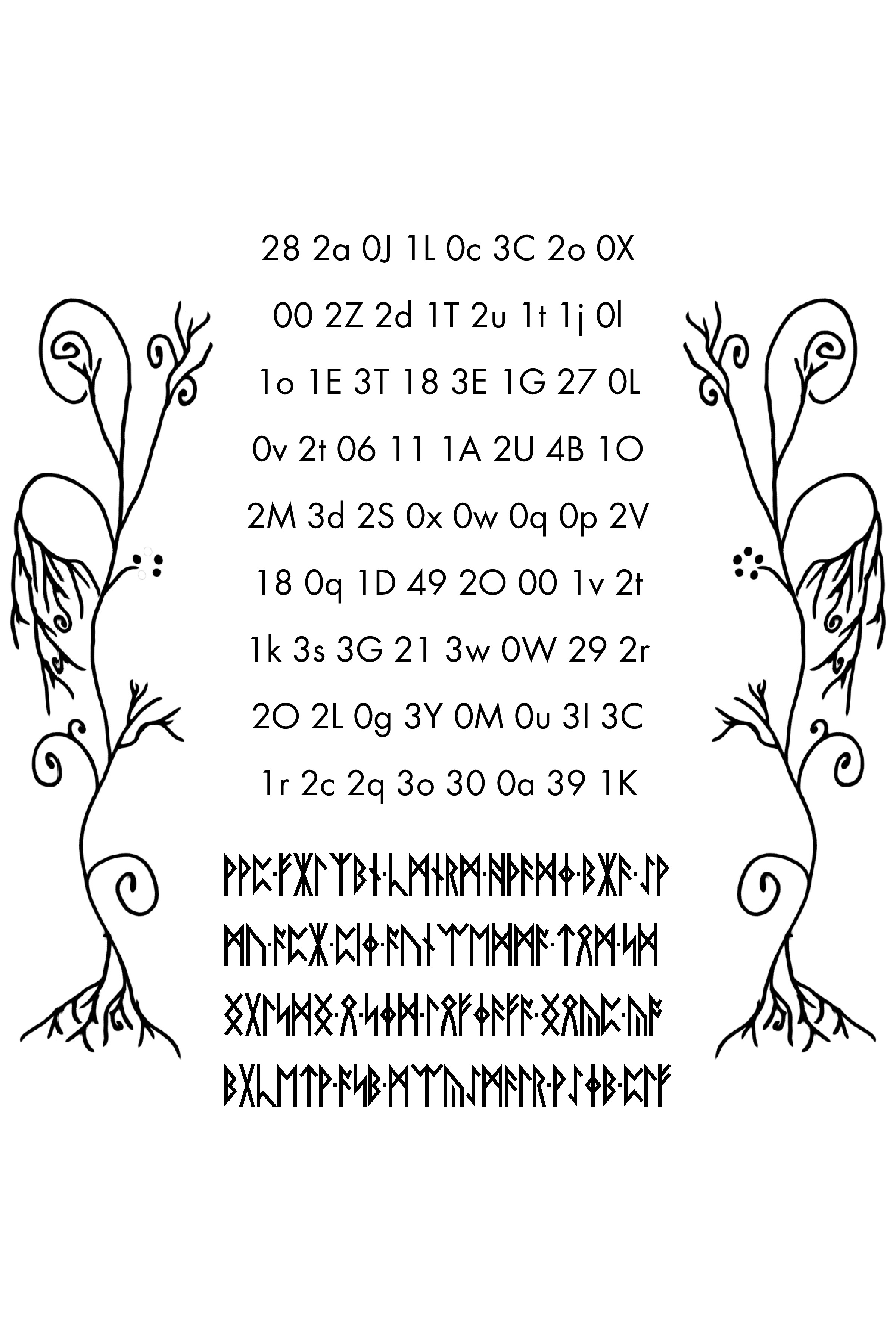
Across all 2,896 words on unsolved pages 0–55, only the word on page 51 at rune offset 43 contains the same three consecutive runes twice. It reads S D ING G L S D ING in transliteration. ING is one rune. The block S D ING starts at positions zero and five. Set that word aside and there is no second example at five positions, or at any other spacing.
We compared every pair of three-rune blocks within each word. Two starts can overlap: a return one position later requires four identical runes, and a return two positions later requires a run of the form A B A B A (including the all-equal case). No comparison crossed a word separator. As in the previous word census, a word may continue over a line or page turn. In total there were 12,974 pairs of block starts, not 12,974 independent words.
| Distance between starts | Eligible pairs | Equal blocks | Expected equal pairs after shuffling runes within each word |
|---|---|---|---|
| 1 | 4,882 | 0 | 0 |
| 2 | 3,237 | 0 | 0.0658 |
| 3 | 2,105 | 0 | 0.0582 |
| 4 | 1,290 | 0 | 0.0400 |
| 5 | 731 | 1 | 0.0219 |
| 6–11 combined | 729 | 0 | 0.0228 |
The first 28 pages supplied 389 pairs at spacing five, none equal. The remaining 28 pages supplied 342, including the grid-side word. Removing it leaves 0/730. Counting each of the 2,731 distinct word spellings once does not change the table: no duplicated spelling was long enough to contribute a pair. An independent procedure indexed the starts of each triple instead of scanning lags; it returned the same single occurrence.
How surprising is one return? In each of 32,768 simulated books we independently rearranged every word's runes, keeping its length and its exact inventory of letters. A hit at spacing five occurred in 702 (2.14%) of them. A hit at any of the eleven eligible spacings occurred in 6,113 (18.66%). The latter comparison uses the largest count across lags, divided at each lag by its exact expected count or one, whichever is larger; here every expectation is below one, so a single return anywhere meets the observed score. These are two answers to different questions, not probabilities that the cipher is random. Five was noticed in this very word before the census. Its interval does not recur in another word to support a five-slot key.
The expectations in the table are calculated by drawing letters without replacement from each word's own inventory. Overlapping starts impose different equalities from disjoint starts, and are counted accordingly. The simulated books estimate how often any return occurs and preserve dependence among overlapping opportunities. This comparison discards normal rune order within words; the next test keeps the rune stream intact.
Source page 51 · Predeclared tests · All lags, words with hits, sections, pages and distributions · Replay.