The 32 words with matching outer runes fall inside the range produced by a comparison that preserves which runes appear at each position. The ten words with adjacent doubles fall well below it. That changes where to look: the more unusual feature of these three-rune words is how seldom identical runes touch.
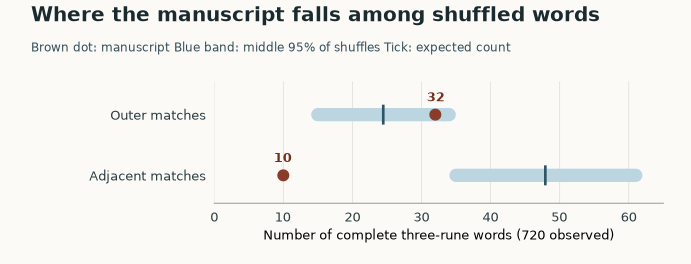
Within each of the eight eligible sections, we kept the first rune of every word in place, independently shuffled the middle runes among those words, and separately shuffled the final runes. Thus even a rune strongly favored at the beginning or end kept its exact count at that position in its own section. The shuffle deliberately breaks the association between runes inside the word. We generated 99,999 arrangements and compared them with the manuscript.
| Count across 720 printed words | Observed | Exact expected count | Middle 95% of shuffled counts |
|---|---|---|---|
| AAB: first two match | 3 | 23.55 | 15–33 |
| ABA: outer two match | 32 | 24.46 | 15–34 |
| ABB: last two match | 7 | 24.37 | 15–34 |
| Either adjacent pair alone | 10 | 47.92 | 35–61 |
| All three match, counted separately | 0 | 0.89 | 0–3 |
Of the 99,999 shuffled arrangements, 7,619 gave at least 32 ABA words; none gave as few as ten AAB and ABB words combined. The difference between the observed and expected ABA count is about 7.5 words, while adjacent doubles fall short by 37.9 words. All eight sections have fewer adjacent doubles than expected from their own rune frequencies. Omitting any one section still leaves a large outer-versus-adjacent contrast: on the scale twice ABA minus AAB minus ABB, the observed contrast is 41–54 across omissions, versus means between 0.4 and 1.6 by this comparison. These are checks on the same manuscript, not eight independent discoveries.
Deduplication gives the same diagnosis. We retained only each spelling’s earliest occurrence, before any shuffling. Among 704 words, ABA is 30 against an expectation of 23.86 (middle 95%: 15–34). Adjacent doubles are still ten against 46.72 (34–60). Shuffling this smaller input can itself generate duplicate spellings; the comparison preserves the positional counts of the deduplicated input, not uniqueness in its output.
We also calculated the means directly from the three position-frequency tables; exhaustive rearrangement of a small example verified the formula. No simulation is needed to see which side of the contrast contributes most. The bands describe the shuffled arrangements, not confidence intervals on the manuscript. This controls for position and section, but does not preserve grammar, adjacent-rune dependence or a cipher’s movement. The imbalance was noticed before this test. It does not identify a key or imply that the outer runes carry a message. The earlier boundary test concerned substrings inside and across words; this test concerns complete words of exactly three runes.
Section and page counts · Exact means, simulated tails and every section omission · Method and replay · Frozen protocol.