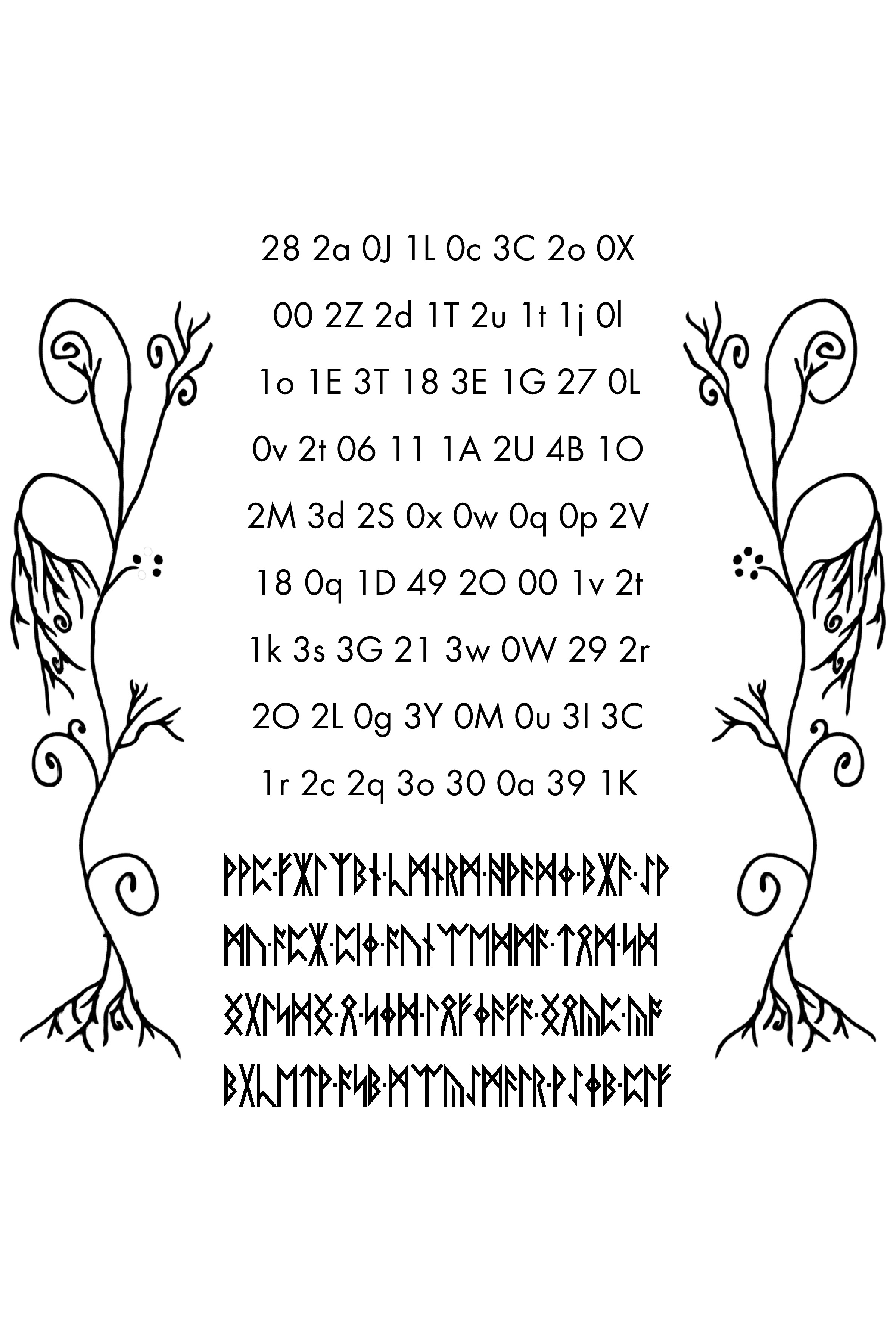
The first word after the grid is W W P in rune transliteration. Under any fixed one-to-one substitution it must still start with two equal runes followed by a different third. Across the nine solved groups we counted 176 three-rune word occurrences, representing 42 distinct forms. Not one begins with a double rune. So a fixed substitution would produce a word shape absent from the solved sample. This is a constraint on reusing the known vocabulary. It does not exclude an unfamiliar word, an abbreviation, or an atypical opening after a display. A three-rune word need not have three Latin letters.
Would a moving key make the double disappear? We began with the two historical repeating shift sequences from Welcome and the Second Koan. Session 262 tried them from slot zero. Here we allowed every starting slot, every legal way to handle a printed F, and all 29 constant adjustments to the advancing shifts. We required no English, no singleton-word rule and no guesses at the masked words. The letters of the grid itself did not advance the clock in the continuous test; a separate test allowed the next page to start at any phase.
| Historical shift sequence | Adjustments allowing the 138 runes just before the grid | Adjustments allowing the 170 just after it | Adjustments allowing both together without a restart | Adjustments allowing either complete side (2,474 or 842 runes) |
|---|---|---|---|---|
| Welcome, 8 slots | 16 of 29 | 7 of 29 | 0 of 29 | 0 of 29 on each side |
| Second Koan, 13 slots | 25 of 29 | 9 of 29 | 2 of 29: +8 and +17 | 0 of 29 on each side |
Each first-column or second-column fit can start in its own best phase. Fitting both together requires the same path to cross the display. The unadjusted Second Koan key, for example, fits each short side separately yet cannot fit all 308 runes together. Starting at the break with any phase, that literal key can extend 160 runes back into the left passage or 365 forward on the right, considered separately. For the literal Welcome key the corresponding limits are 173 left and 79 right. Every tested key and adjustment eventually fails even if the full sides start independently. The two short fits would require a local rule change somewhere outside their span to explain the rest of section 8.
How big is the mismatch? Under the strict historical rule, plaintext F prints F and does not advance. As a diagnostic only, we let an F instead advance and print the current shift, counting one exception each time. Over the full 3,316 runes, the unadjusted Welcome and Second Koan sequences need at least 37 and 22 exceptions. Even choosing the best constant adjustment and initial phase leaves 21 and 20, respectively. These are exact minima under that one change to the rule, not counts of transcription errors. Both historical positive controls need zero exceptions with their own keys. The replay independently checks forward and backward feasibility, and checks minimum costs on 972 small cases by enumerating every permitted history.
Which rune would be most useful to know? Once the two local adjustments survived, we compared them with the two stateless alternatives that tied in Session 262. We kept only word strings belonging to a path through all 308 runes, with no target plaintext supplied. In these four named models the two printed W runes could read:
| Rule | Possible opening pair in plaintext | Possible plaintext at the second printed W |
|---|---|---|
| Direct reading | W W | W |
| Reflection about 1 (2 minus the rune) | A A | A |
| Second Koan shifts +8 | A I | I |
| Second Koan shifts +17 | N S or S M | S or M |
The first rune after the grid does not separate the reflection from the +8 shift. The second, page 51 rune offset 1, would separate all four rules and even the two surviving +17 transcriptions. A value outside W, A, I, S, M would reject all four. Across the 17 adjacent runes, 12 locations distinguish the four named rules by themselves. No trustworthy source for any of those plaintext values emerged from the solved-fragment search. This is a way to choose where to look for a clue, not a reading of the page.
A next test that does not require guessing a word: compare the repeated-rune shapes of every whole word near the display with equally long passages elsewhere. First hide each solved passage in turn to measure how often ordinary words have shapes missing from the rest of the book. Then check whether the double opening is isolated or part of a broader pattern at the grid.
Original page 51 · Predeclared clock test · Clock search · Clock results · Follow-up protocol · Projection and word count · Per-position possibilities · Replay all ten sessions.