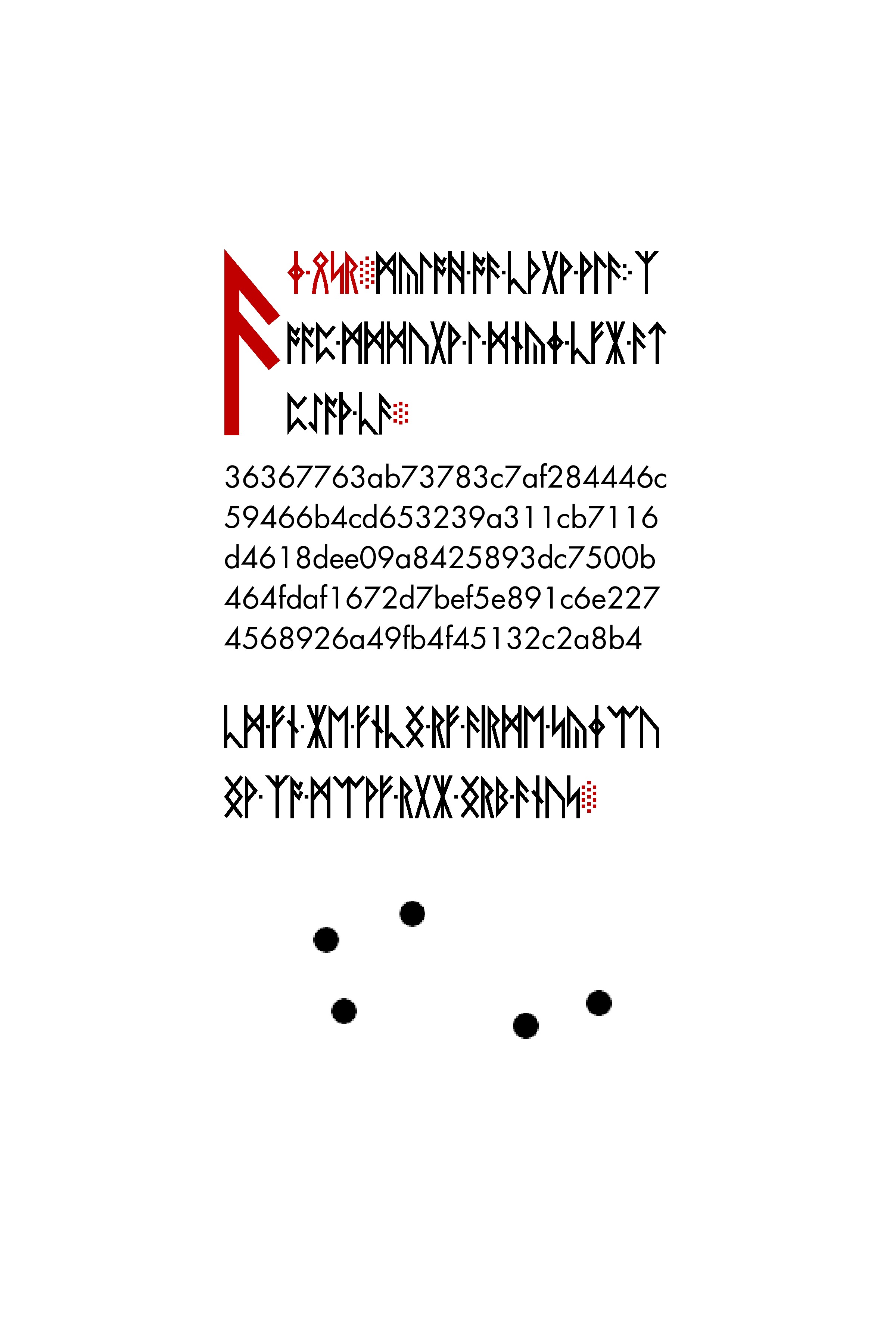
A short known passage can fit two incompatible stories perfectly. On solved page 56, we measured eight shifts from the opening plaintext and treated them as one turn of an eight-position repeating key. We separately did the same for thirteen. Both keys fit their donor by construction. Both predicted a wrong shift at their very next step and became impossible before reaching the displayed digest.
For each rune with known non-F plaintext we measured the shift as ciphertext minus plaintext, modulo 29. An unshifted plaintext F prints F and does not advance. The first eight and thirteen runes here all advance. We used the same donors to fit a different list: a positive or negative prime sequence, one of 128 starting positions and one of 29 additive constants (7,424 schedules). The only exact fit for either donor was positive primes, starting at 2, with a constant of minus one. It is the established page-56 solution. No word after either donor selected a model.
| Schedule and donor size | First wrong shift after donor (zero-based step) | First printed rune with no legal path (zero-based) | Later shifts right, true timing supplied | Later words unique, timing withheld |
|---|---|---|---|---|
| Repeat 8 | Step 8: predicts 1, observed 22 | 27 | 2 / 39 | 0 / 12 |
| Repeat 13 | Step 13: predicts 1, observed 13 | 26 | 2 / 39 | 0 / 12 |
| Prime model, 8 or 13 | None | None | 39 / 39 | 0 / 12 |
The last two columns answer different questions. We first gave the schedules an advantage: compare their proposed shifts at the historically correct advancing positions in the 40-rune block after the hex display. One rune there is an unshifted F, leaving 39 measured shifts. Two matches for the repeating model were isolated collisions. They did not rescue the earlier contradiction.
We then withheld the true timing, working forward from the donor on ciphertext alone. At a printed F we kept both a legal standard shift and a literal unshifted F; we rejected a standard shift that would have produced plaintext F. A word was reportable only if all legal paths agreed by its end. For the repeating keys there were no legal paths at the digest. For the prime key there were paths and the correct word appeared in all twelve lists of alternatives, but not one word stood alone. For example, the first two-rune word could be historical IT or the rune pair EO, EA. No historical target holds, target words, dictionary, or later ciphertext were used to resolve it. Explicit enumeration of F choices independently reproduced every word’s candidate set.
This separates knowing the schedule from knowing which step was taken. The earlier language-scored replay chose a path using evidence we purposely withheld here. Original image · Fixed test protocol · Full word alternatives and individual shift comparisons · Python replay.