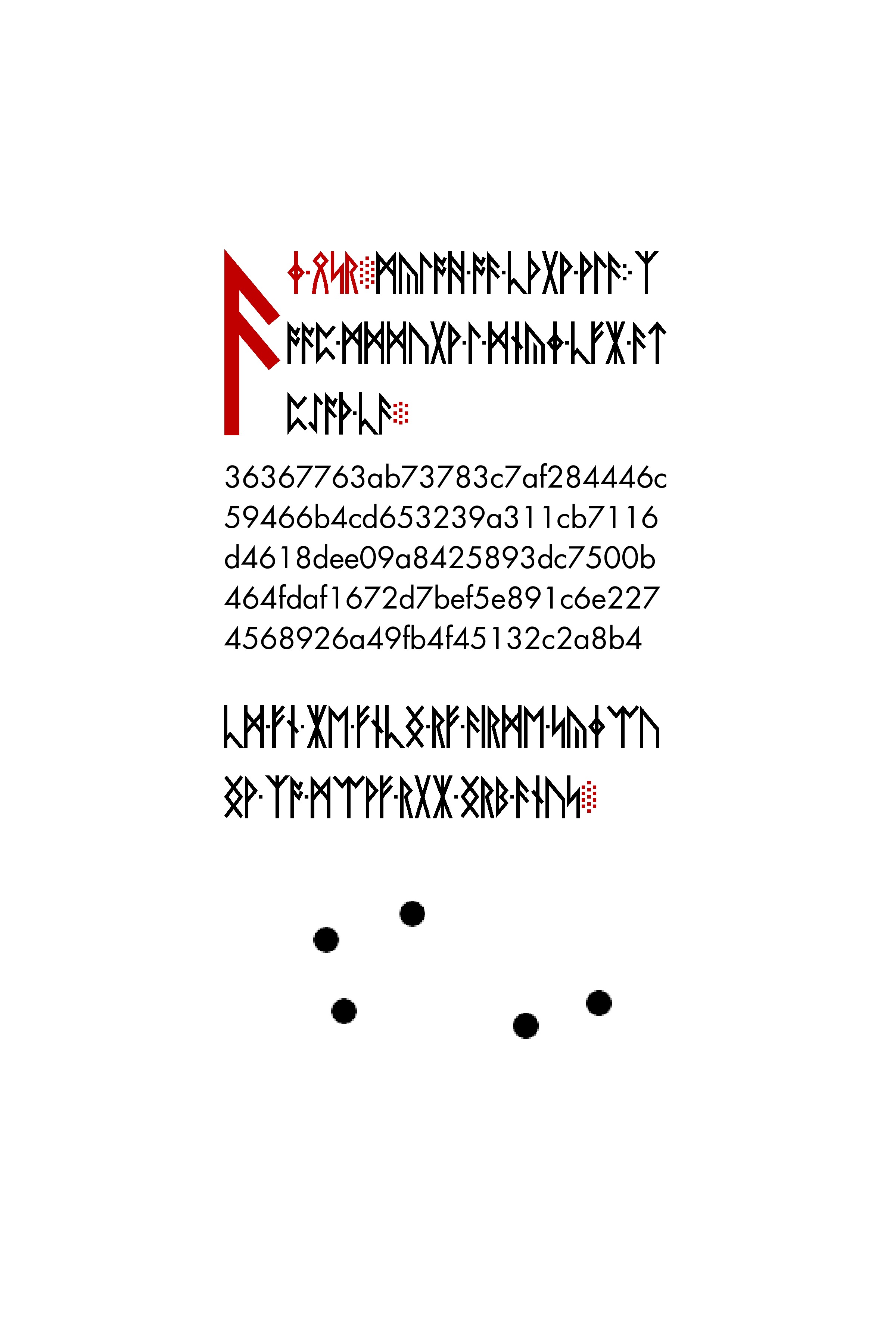
When the search could score both encrypted halves of solved page 56, it recovered all 23 words around the digest. It selected the prime schedule, continued across the display, and held at offset 56 without being given the hold. A deliberately altered version of the page, encrypted with a restart instead, selected the opposite clock correctly.
The first experiment kept the five-rune title crib from Session 257. We scored each allowed plaintext using bigram and trigram frequencies trained on seven solved LP1 sources only. Neither page-56 arm contributed training examples; neither arm’s correct words, the true skip position nor the true display rule were available to the selector. Its 96 admissible texts contained six different pairs of words facing the display. The top one recovered the known reading, but the runner-up was close: −5.34103 vs −5.35158 on the fixed log score. Holding at 51 instead of 56 turns DUTY OF into FOYO NEA and then rejoins; it still gets ten of the twelve following words right. The score gap is not a probability of correctness.
| Test ciphertext | Distinct texts with known title | Winning clock / F hold | Words exactly recovered before / after |
|---|---|---|---|
| Historical page 56 | 96 | Continue / 56 | 11/11 · 12/12 |
| Same gold re-encrypted with a restart at the digest | 12 | Restart / 56 | 11/11 · 12/12 |
The planted and historical pages have identical titles, identical ciphertext for the entire left arm, and the same word spacing throughout. They must therefore receive the same one-sided choice. It got only one rune and no complete words right after the planted restart. Allowing the second arm’s ciphertext to help choose the clock and hold recovered the planted text. Its new ciphertext had only two printed Fs, so its twelve candidates were not the same panel as the historical 96.
Follow-up with no title crib. We then removed the title entirely from both filtering and scoring, retaining the declared family list. Using only the 80 body runes for the language score, the historical gold ranked uniquely first among 4,451 distinct full readings (4,803 parameter combinations); the synthetic case ranked uniquely first among 559 (603 combinations). Both winning schedules also produced AN END in the five unscored title positions. This follow-up was specified after the primary result and uses the same texts and model. It tests reliance on the supplied title, not general performance on future puzzles.
These are reconstructions selected with the ciphertext on both sides; only the one-sided experiment in Session 257 kept the second arm out of selection. The comparison illustrates why a phrase inferred beside the unsolved grid needs evidence beyond a plausible beginning, and why a page with a known cipher in the candidate list is a favorable control.
Original printed page · Historical solution record · Frozen primary protocol · Title-free follow-up · Standard-library Python replay · All counts and control readings.