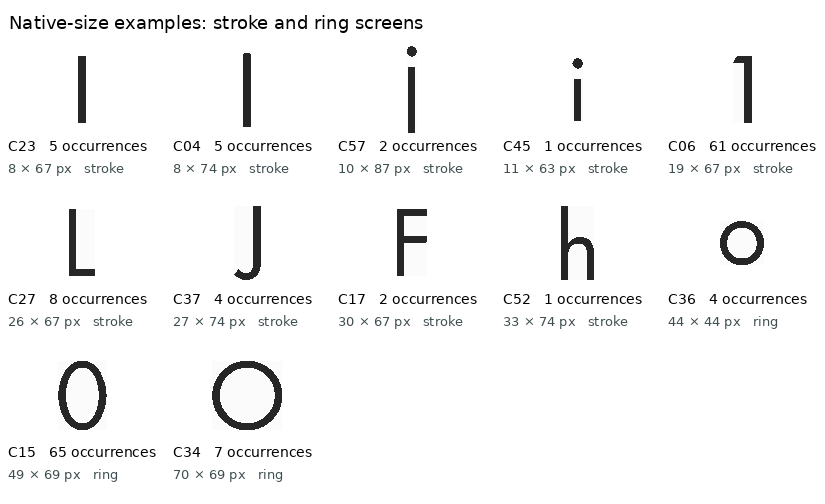
Yes. The ten apparently plain vertical strokes separate into five of height 67 pixels and five of height 74 pixels. All ten are eight pixels wide. Both forms occur on all three pages; their bottoms lie on or at most one pixel above the same-row reference line (median bottom of the eight left glyphs). The extra seven pixels are at the top. A third common, numeral-like form has a flag projecting from its top, making it 19 pixels wide. Treating all three as one glyph would discard visible source information.
| Appearance | Native width × height | Count | Left / right of printed pair |
|---|---|---|---|
| C23, shorter straight bar | 8 × 67 | 5 | 0 / 5 |
| C04, taller straight bar | 8 × 74 | 5 | 0 / 5 |
| C06, flagged stem | 19 × 67 | 61 | 58 / 3 |
| C15, tall narrow ring | 49 × 69 | 65 | 60 / 5 |
| C34, tall round ring | 70 × 69 | 7 | 0 / 7 |
| C36, small round ring | 44 × 44 | 4 | 0 / 4 |
The shorter bar occupies the same vertical range as an angular L-shaped capital; the taller one reaches as high as a lowercase h-shaped ascender. Those comparisons support reading shorter as capital I and taller as lowercase l, but the image comparison itself establishes only the two physical forms. The small round ring and the two full-height rings also differ in native size. A tailed capital-sized ring (C39) even shares C34's box dimensions, yet the rendered marks distinguish them. The atlas includes all glyphs meeting the prespecified symmetry/shape screen, including forms with a flag, feet, dots or hooks.
Unsupervised check. At native resolution, divide every one of the 512 glyphs into groups by best aligned intersection-over-union of binary ink; preserve dimensions, allow translation, and require at least 92% overlap with every member already assigned. This gives 59 groups. The least overlap within any group is 99.4132%, while the greatest overlap between groups is 90.8475%, between the two straight bars. Thus any cutoff from 91% to 99% reproduces the same groups. No prior transcription, symbol labels, encoding, decoded bytes or expected digest entered the experiment.
Degradation check. For each page, use reference glyphs from only the other two pages. Eleven glyphs in six classes had no such exemplar and are outside this test. All 501 eligible glyphs rejoined their native group at each of five native thresholds (64, 96, 128, 160 and 196). Half and quarter sizes at middle threshold 128 also scored 501/501. At half size and the high threshold of 196, all 61 flagged stems instead matched the shorter straight bar. At quarter size and 196, all five shorter straight bars matched the taller group, and all four small round rings matched a different small one-hole form. These are failures of the stated resizing/threshold/matching method; they do not undo the native pixel measurements. Held-out-page matching tests reproducibility of visual groups learned on the three pages; it is not an independently labeled transcription.
Fixed protocol · Reproduction script · Per-class coordinates, geometry and cross-page confusion