Restarting the same key at the grid and at the page-54 heading makes a period-eight reading possible. It does not give the same reading to a six-rune phrase that Cicada printed twice. This is a test outside the section that selected the key. It checks an additional hypothesis: that the key starts the same way at two red openings and that the repeated ciphertext represents the same plaintext.
The original image comparison locates the same groups of three runes at LP2 page 27, offset 28, and page 55, offset 70. We took the only nonzero period-eight key from the marked section, shifts (14,0,0,0,0,0,0,0). We kept that key fixed and started it in slot zero at the red openings on pages 27 and 54. All printed Fs kept their legal alternatives: hold a literal F, or decrypt to a non-F rune and advance. No words, new shifts or starting offsets were fitted for the primary comparison.
| Copy | Six printed runes | Six predicted plaintext runes |
|---|---|---|
| LP2 page 27, offset 28 | D J U · B E I | D J U · B E AE |
| LP2 page 55, offset 70 | D J U · B E I | N J U · B E I |
These labels name individual runes; AE is one rune. All three whole-section histories allowed on the page-55 side give the reading in that row. On page 27 the fixed starting phase gives only the reading shown, and the entire key becomes impossible at page 28, offset 100, a printed X. The additional shared-key/shared-reading claim fails. The two ciphertext copies need not mean the same thing, and the two sections need not use the same key.
Can a different starting phase save it? We tried all eight starting phases at the page-27 opening as a separate diagnostic. Slot five can produce the same six runes as the page-55 copy, but it also allows another local reading. With that start, every legal history dies at page 30, offset 203. None of the eight starts reaches the end of section 6. A short fit cannot override that contradiction. A planted example using the same decoder recovered the known phrase. Fixed transfer question · All eight forecasts and failure locations · Reproduce.
How much of the period change comes from adding a cut at all?
For comparison, we tried one mandatory restart at each of the 3,315 possible internal gaps under a shared key reset to slot zero. Without a cut, nine is the shortest nontrivial period. With the two real marks, the shortest is eight. With one cut chosen solely to admit a key, the shortest is seven. Neither of the two real marks, taken alone, belongs to any viable single-cut position for periods seven or eight.
| Nominal period | Single-cut positions allowing a nonzero key | Different nonzero ordered keys across those positions |
|---|---|---|
| 1–6 | 0 of 3,315 at each period | 0 |
| 7 | 340 of 3,315 | 7 |
| 8 | 599 of 3,315 | 15 |
| 9 | 3,039 of 3,315 | 65 |
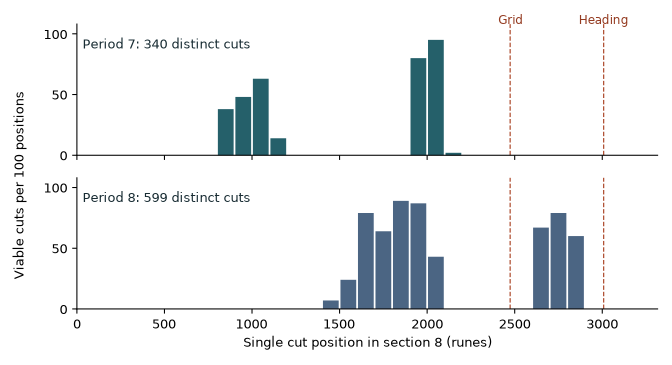
A cut cannot split both chronological halves. We therefore enumerated every key rotation that could traverse at least one half uninterrupted with a free incoming phase, then checked every orientation against every cut in the complete text. At each gap we required the prefix to reach the gap from slot zero and the suffix to finish from a new slot-zero start. A witness at local offset 1,920 under period seven changes 456 runes and re-encrypts. Direct trial of every possible gap on 96 small examples checked the counting method. These are counts of feasible placements, not probabilities that an editor meant a particular mark. Scope · All keys and gap positions · Two-sided scan · Runner and tests · Chart source.
What the ten tests establish. The images identify two real structural breaks. Under the strict F rule, restarting in both locations changes the list of possible keys. But the same ordered eight-position key also works at 12 of 64 nearby unmarked word-boundary pairs. And it fails the independent phrase prediction above. No verified plaintext or instruction to restart has emerged.
Where to dig next
Return to the 256 alphanumeric cells on pages 49–51. Session 2 converted them to bytes and matched a second archive, but the archives may share a transcription. Its visual check did not settle every similar-looking letter. A fresh image-only reading, done without showing the reader either byte list, could test the input itself. Record every uncertain glyph, compare repeated type shapes, and only then unmask the existing transcription. That would tell us whether the two archives agree with the original printing at precisely the places where a one-character change alters a byte.