Under the literal-F rule that reproduces three solved passages, section 8 eliminates every nonzero four-position repeating key. This result needs no dictionary, English frequencies or guessed words. The only survivor, shifts 0, 0, 0, 0, returns exactly what is printed. That is always possible and gives no new reading.
The rule starts from the plaintext: whenever the writer encounters F, they print F and do not advance the key. Every other plaintext rune uses the next shift. A non-F plaintext rune can still encrypt to F. So at a printed F we allow both legal branches. At a different printed rune, there is a contradiction whenever subtracting the current shift would yield F: the writer would have printed F instead. For example, a printed rune of value 7 cannot use shift 7, since 7 minus 7 would be plaintext F.
We began with all 707,281 ordered keys and retained a key as long as any sequence of legal decisions at the printed Fs remained possible. After the first 300 runes, 5,490 keys remained. After 1,000, there were 39. By the 1,457th rune, the W at LP2 page 45, zero-based page offset 133, only the all-zero key remained. This is before the alphanumeric grid. An independent calculation processed whole stretches between printed Fs and obtained the identical survivor set.
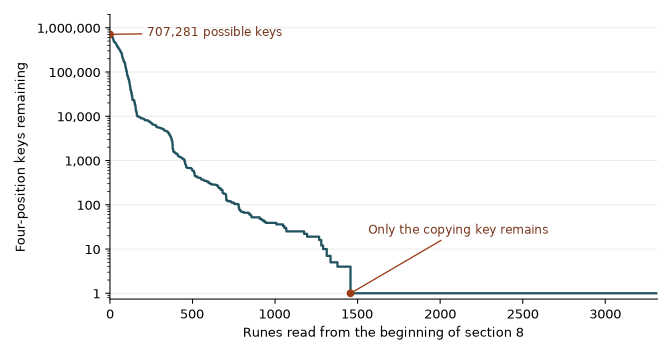
The answer holds independently in both halves. Starting afresh on either half of 1,658 runes and letting the key start in any phase still produced only the identity key. On seven solved passages that we encrypted anew under the same rule with a known nonzero four-slot key, the true key survived all seven tests. And when we retested each of the 136 possible earlier or later four-rune words against the page-51→52 anchor, no strict four-position key yielded equality. This closes the three older candidates under this rule and a shared four-position key. The earlier candidates used a different clock assumption; nothing here proves what those words say under another cipher.
How much depends on requiring every plaintext F to pause? If ordinary encryption is allowed to produce a plaintext F exceptionally, the nearest nonidentity key requires five such advancing Fs; allowing four is not enough. With all four shifts nonzero, at least 21 are required. These are departures from the encoder, not a count of transcription errors. If we change only one detail and permit a printed F to advance at a zero-shift slot without penalty, 18 nonidentity keys already become possible with no F printed as a different rune. That distinction is why the clock rule has to be stated explicitly.
Strict rule and scope · Two independent four-position scans · Prefix counts and witnesses · Figure reproduction · Exception costs, half checks and solved controls · Cost enumerator · Independent replay · Robustness test specification.
Cross-check under the more permissive rule
The frequency ceilings below deliberately allow a choice excluded above: a plaintext F may also be an ordinary decryption that advances. This tests how far section 8 can be stretched once the historical requirement is relaxed.
One shared four-position key with optional holds at printed Fs can produce at most 238 copies of any one ordinary rune and 324 copies of F. An independent calculation recovers both maxima. We can also see where the much more permissive bounds in Session 229 lost precision.
We partitioned the printed-F-delimited stretches into adjacent blocks of fixed sizes. At a block boundary we allowed a free choice of starting phase. Inside each block we enforced the real clock: each non-F advances; each printed F either holds and reads F, or decrypts normally and advances. A trailing printed F, if present, is part of the preceding stretch. Every real decoding is permitted with all block sizes, so even the intermediate rows are valid upper bounds.
| Stretches linked before allowing a fresh phase | Ordinary rune | F |
|---|---|---|
| No links; printed-F credit also unconstrained | 343 | 397 |
| 1; trailing F must use its real phase | 284 | 397 |
| 2 | 255 | 374 |
| 4 | 242 | 352 |
| 8 | 239 | 341 |
| 16 | 238 | 332 |
| 32 | 238 | 327 |
| 64 | 238 | 326 |
| All 132; exact model | 238 | 324 |
The ordinary-rune number already equals the exact maximum at 16 stretches per block. That numerical agreement does not make every 16-stretch winner a legal global path. For F, even one allowed restart after the first 64 and another after the next 64 still permit 326; enforcing the entire clock removes the last two.
Can the exact ceilings actually be reached? Yes. With E as target, our recorded path pauses at 56 printed Fs and earns all 238 hits at non-F positions. Those pauses do not count as E; they change the phase of later readings. Our F path pauses at 101 printed Fs, collecting those literal Fs and another 223 from ordinary decryption. Direct replay of the other implementation’s F path also gave 324, using 100 literal Fs and 224 ordinary decryptions; its two E paths reached 238 with 55 and 56 holds. These are optimizing examples; they do not identify actual Cicada keys or interpret the remaining text. All 28 non-F targets have the same ceiling: changing the target and shifting all four key entries by the compensating amount preserves every hit.
The verification used 177,045 patterns up to rotation; allowing each possible initial phase covers all 707,281 ordered keys. It also reproduced the fixed clocks: 156/156 for ordinary/F if nothing holds and 167/298 if all printed Fs hold. We checked the exact full-section paths one rune at a time, compared them with the separately implemented ordered-key search, and compared the optimizer against exhaustive enumeration of every key and hold mask for all 81 length-four texts over a three-symbol alphabet. Two planted texts of length 3,316 reached the theoretical maximum: one ordinary-rune fixture earned 829 hits by advancing at printed Fs; the F-target fixture earned 131 by holding them. Thus neither way of scoring a printed F was inadvertently omitted.
Reproduce the bounds, fixtures and witness checks · Results and held positions · C++ strip solver · Source reader · Protocol.