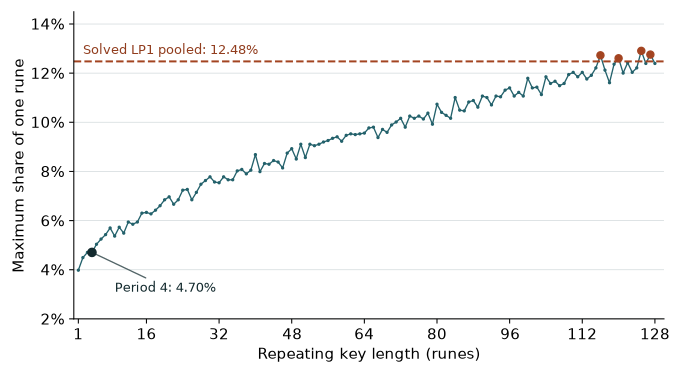
If section 8’s most frequent plaintext rune occurs as often as E in the pooled solved pages, no continuous repeating key of length 1 through 115 can produce it. Of the nominal key lengths 1–128, only 116, 120, 125 and 127 have enough capacity to reach that benchmark. This is an exact frequency constraint, not a proposed 116-rune key.
We arrived at this follow-up after the four-position calculation: each key slot can contribute no more copies of a given plaintext rune than its most common printed rune. For each period, sum those slot maxima. The bound is attainable by a key chosen solely to collect that rune; all other letters are free to be unreadable. The computation covered all periods in the range and independently counted every slot twice. Witness keys in the data reproduce the first crossings.
| Assumed minimum share for the most frequent rune | Copies needed in section 8 | First period that allows it | Periods reaching it out of 128 |
|---|---|---|---|
| 8% | 266 | 36 | 91 |
| 10% | 332 | 71 | 56 |
| 12% | 398 | 110 | 15 |
| Solved LP1 pooled: 349/2,797 | 414 | 116 | 4 |
Why not pursue 116 as a key length on this evidence? Longer keys have more opportunities to gather occurrences of the same rune. We rearranged the same section’s rune inventory 255 times and repeated the first-crossing search. In 33 shuffles, some period at or below 116 reached the pooled threshold. Among the 253 that crossed by 128, the median first crossing was 121; two never crossed in the search range. This conditional shuffle is a check on the selected threshold crossing, not a model of how Cicada wrote. Nor does capacity rise at every step: period 116 permits 422 copies, while period 128 permits only 411.
Section 8 need not use the language, register or symbol frequencies of the solved texts. The hard constraint is on the combination of that specific frequency premise with a continuously repeating key. Period-by-period counts and witnesses · Algorithm · Follow-up protocol · Reproduce figure.
Two real word guesses fail at the seventh rune
None of 2,429 site-and-wording comparisons in section 8 reproduced a complete long word or word pair from solved LP1 under any uninterrupted four-position additive key. Just two guesses survived the first six runes. At the seventh rune each made a specific, incorrect prediction.
We removed the four earlier anchor and comparison words, including every two-word span touching one of them. We kept the original token order and boundaries; no removed word was bridged. The reference consisted of 42 distinct word forms of at least eight runes and 182 distinct two-word forms totaling at least ten. All seven solved LP1 sources contributed. Different occurrences of the same reference form were counted only once per site.
| Section-8 test | Eligible sites | Sites with matching reference lengths | Site × form comparisons | Fit first five runes | Fit first six | Fit entire form |
|---|---|---|---|---|---|---|
| One long word | 94 | 93 | 1,168 | 43 | 1 | 0 |
| Two consecutive words | 290 | 244 | 1,261 | 35 | 1 | 0 |
The first four runes of each guess fix all four shifts. That part always fits. From the fifth rune onward we require the same four shifts to work again without adjustment.
- LP2 page 41, rune 67, eight-rune word: the candidate transliterated D I S K O U E R starts with lag-four differences 9, 20, 3; the actual ciphertext starts with 9, 20, 17. The difference at the seventh rune cannot come from the proposed key.
- LP2 page 51, rune 9, split 5+5: AGAIN AFTER requires differences 14, 18, 5; the ciphertext gives 14, 18, 22. This second near match fails at exactly the same point.
These are rejected examples, not readings. The zero-completion result holds before restricting the keys to the three repeat families, so it holds for all three. It excludes those specific forms at corresponding sites under this model. It cannot exclude unlisted wording, alternative rune spellings, or a four-position cipher.
How surprising is zero? We made 1,023 comparison versions by independently shuffling each word’s runes while preserving its rune inventory, length and position. Neighboring word pairs shared the same shuffle wherever they overlapped. 1,019/1,023 shuffled versions had zero single-word hits; each of the other four had one. 1,023/1,023 had zero phrase hits. As a separate scale check, independent uniform ciphertext would yield only 0.00117 expected single-word hits and about 0.00000113 phrase hits under these lengths and candidate counts. Thus an exact hit would be worth testing farther, but the observed absence does not distinguish section 8 from these comparisons. A larger dictionary chosen after seeing the two near misses would be a different experiment.
Controls and mathematical test · Protocol · All sites, near matches, controls and shuffles · Independent four-shift verifier.
Next experiment
Some solved Liber Primus passages treat a printed F literally and pause the key. Test whether applying that documented exception at selected Fs in section 8 could close the measured frequency gap. Compute the largest possible count separately for F itself and for an ordinary rune such as E. Use the actual F locations and one shared key, then verify the count on solved controls where the skipped positions are known. This would test a book-specific alternative to both the unbroken clock and arbitrary key changes.