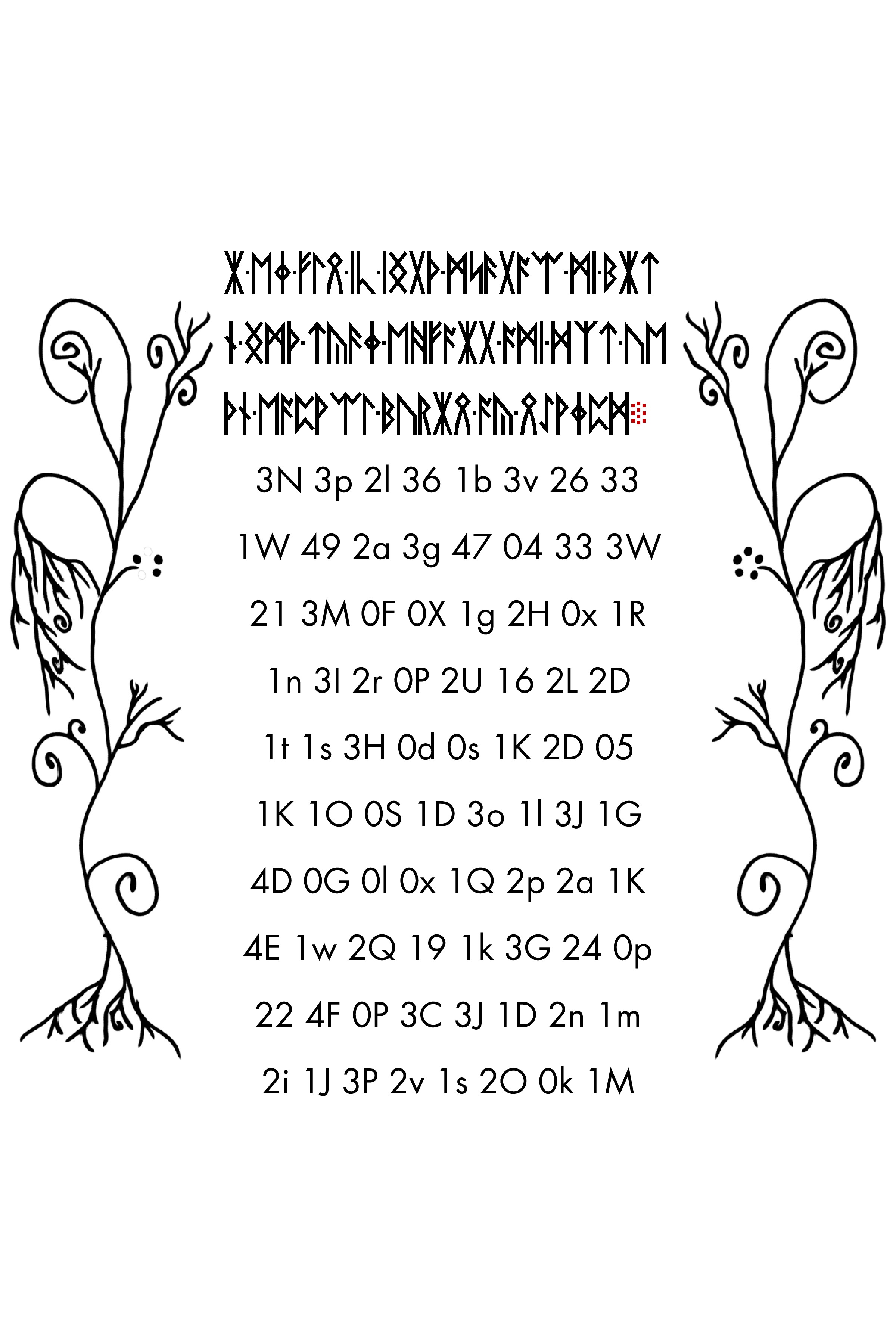
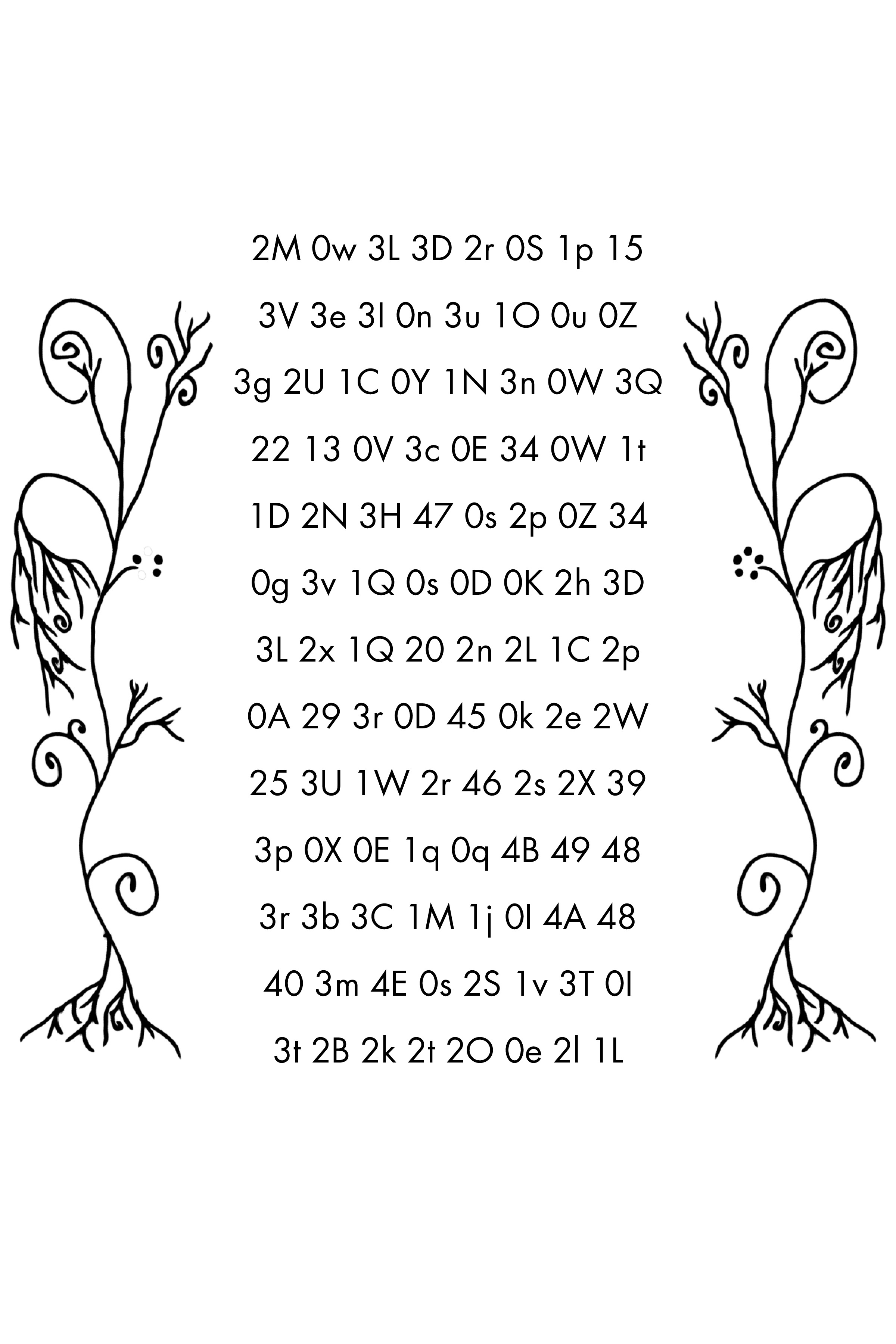
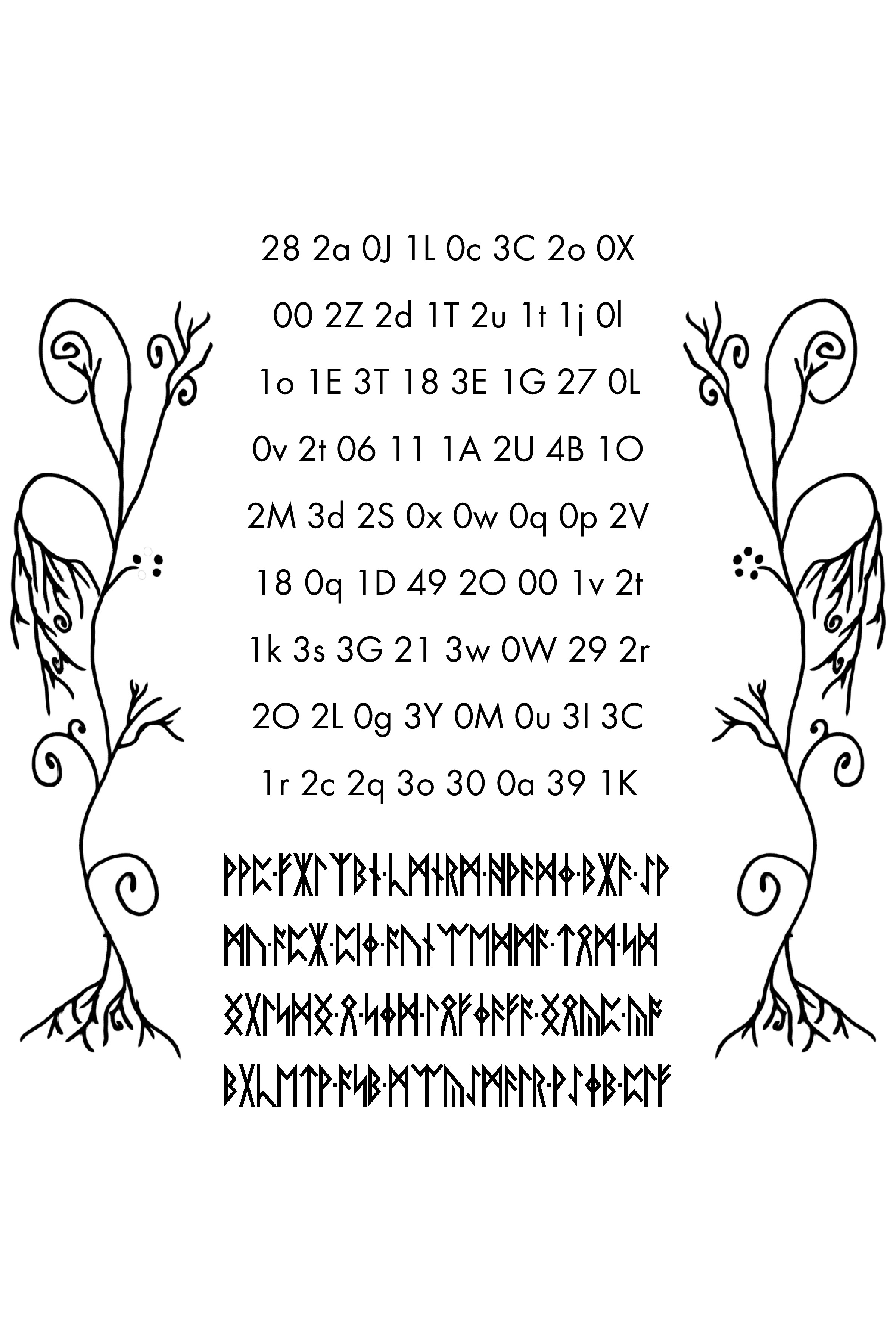
Changing the key’s phase anywhere in the alphanumeric grid cannot add a fourth word to the page-51 shortlist. Between the page-40/42/46 candidates and the page-51 anchor, the runes give way to an alphanumeric table. The original images show 10 rows on page 49, 13 on page 50 and 9 on page 51, each eight cells wide. Counting one step per row (32 steps), per cell (256), or per printed alphanumeric character (512) gives exactly the same phase at the next rune as ignoring the table. All three counts are multiples of four. This is a property of the table's dimensions, not a claim about what its contents encode.
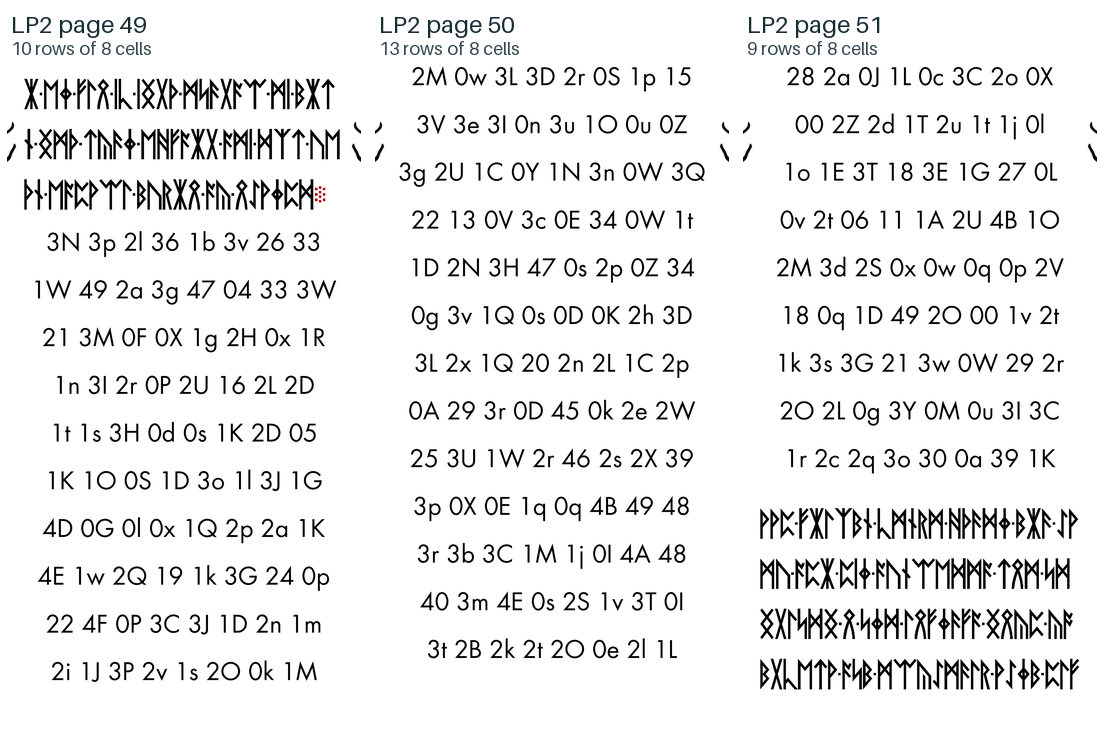
We also tested the most that one arbitrary phase change at the grid could do, keeping the same key on both sides. The table below gives the full result across all 136 other four-rune words in section 8. Each listed location is individually possible; none of the rows permits two matches under the same key.
| Extra key steps at the grid, modulo four | Possible earlier matches | Keys for each match, in listed order |
|---|---|---|
| 0 · skip, or count rows, cells or characters | Pages 40, 42 and 46 | 841, 29, 29 |
| 1 | Page 40 | 29 |
| 2 · also the result of restarting at the section’s initial slot | Pages 42 and 46 | 29, 29 |
| 3 | Page 40 | 29 |
Why can no new location appear? In any complete four-rune word, each of the four shifts is used once. If two such words share a plaintext, their ciphertext sums must agree modulo 29, regardless of starting phase. Only the three earlier words pass that necessary check. The four phase tests then decide which of those three actually admit a key. The first rune after the grid is 2,474 runes after the start of section 8, so restarting the key there changes its phase by two. That conditional result drops page 40; nothing found here establishes a restart. A new, unrelated key after the grid would be a different model.
Original page 49 · Page 50 · Page 51 · Test specification · Scan and independent cycle check · Full counts and keys · Figure reproduction.
Do any of the six matching layouts settle which word repeats?
The page-51 anchor investigation left three mutually exclusive explanations for an earlier copy of the same plaintext. The page-40 hypothesis admits 841 keys; the page-42 and page-46 hypotheses admit 29 each. None can produce an entire repeat at any of the three new layout-selected pairs. Neither can any other four-position key. That last check matters: a failed extra premise about a repeated phrase cannot distinguish the three anchor hypotheses.
| Proposed new pair | Best matching runes out of 19: page-40 family | Page-42 family | Page-46 family |
|---|---|---|---|
| Pages 41 and 47 | 4 | 0 | 2 |
| Pages 41 and 43 | 0 | 1 | 1 |
| Pages 45 and 51 | 0 | 0 | 1 |
We also tested each of the four corresponding words separately, as specified in the protocol. On the primary pair, each of the two interior three-rune words can match under 29 unrestricted keys when considered alone, but none of those keys belongs to any of the three older families. Across the twelve individual word comparisons, there was only one family-level survivor: all 29 page-46 keys reproduce the one-rune word in the 45/51 pair. Under those same keys, none of its other 18 runes match. That singleton was one component of a failed phrase, not evidence that the page-46 anchor hypothesis is right.
A positive check on the actual layouts. For each pair and each key pool (unrestricted, 40, 42, 46), we picked a key, retained the left passage, and re-encrypted its exact plaintext into the right positions. All twelve deliberately planted repetitions were recovered. The unrestricted planted tests admitted 29, 841 and 841 keys, respectively: different shifts can preserve equality without identifying a unique key. Graph solving and exhaustive decryption agreed on 168 counts, including the planted controls and the original keys tested against each component.
Separate punctuation-first check. All three primary patterns have ordinary word separators. As a sensitivity check we also ran the identical test on the separately selected marked pairs, which favor a shared stop and do not reuse a primary occurrence. On pages 41/45 (13 runes), 41/44 (11) and 43/52 (13), even unrestricted four-position keys fail by rune 3, 4 and 3 respectively. Their best unrestricted counts anywhere in each phrase were 4/13, 4/11 and 3/13. No individual word in any of these three pairs matched in any of the old families. The second and third word of different pairs can match outside those families, so component tests and whole-phrase tests remain distinct. The two calculations agreed on 136 comparisons in this separate panel; all 12 of its own planted controls recovered. Marked selection · Marked counts.
The result settles a narrow question. These three structural matches supply no exact period-four confirmation for the page-40, 42 or 46 word. Finding a different linguistic reason to pair passages would be a new hypothesis; choosing a component because it happened to survive here would reuse the same evidence.
Fixed assumptions · Enumerator and independent graph calculation · Word counts, key families, injections and histograms.