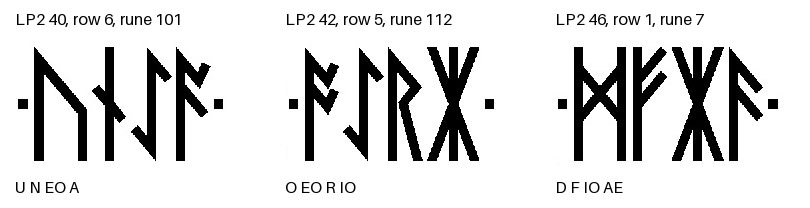
On LP2 pages 40, 42 and 46, we found three different ciphertext words that could represent the same plaintext as P L F | P on pages 51→52 under a four-position repeating key. No one key can make even two of those earlier words agree with the anchor. We checked the printed groups against their original page images. These are three competing possibilities, not three confirmations. The anchor’s plaintext is still unknown.
| Earlier location (zero-based rune offset) | Printed group | Key positions displaced by | Four-position keys that make this word equal the anchor |
|---|---|---|---|
| Page 40, rune 101 | U N EO A | 2 | 841 |
| Page 42, rune 112 | O EO R IO | 1 | 29 |
| Page 46, rune 7 | D F IO AE | 1 | 29 |
What the planned forward test found. Using the word types from solved LP1 and only keys completely determined by the first word, we obtained 152 word/key hypotheses across the four page breaks. None of the 5,122 comparisons at the 103 eligible later word slots was an exact repeat (4,022 comparisons at a different phase, 1,100 aligned). At 48→49 there was one later slot but no fully determined candidate key in the preset period list. In fact, rearranging the eligible later words among their same-length addresses cannot create a shifted match for any hypothesis: no candidate predicts any available word at any eligible shifted position. The 4,095 random rearrangements therefore all tied the actual result. This comparison has no power to establish that zero hits are unusual. Forecasts and shuffle records · Independent verifier.
Exploratory: remove the dictionary and search the whole section. For each anchor we compared every other complete word of the same length, in both directions, and tested every key length from three through the length of the word. The clock advances on every rune without resetting; actual offsets fix the relative phase. The 267 locations (154 earlier, ten in the previously examined first 64 runes, 103 farther on) gave 660 period/location comparisons. No key could make the two plaintexts equal at any of the tested locations for the anchors on pages 17, 27 or 48. For page 51 there was no period-three match in either direction. Its three period-four matches are the entire surviving list.
This result uses no English scores. At period three the first and last runes of P L F P occupy the same key slot. Any phase-shifted copy of its plaintext must likewise begin and end with the same ciphertext rune, and the first three ciphertext values must add to 4 modulo 29, because they use a full key cycle. At period four a target one slot out of phase need only match the anchor’s four-rune sum to permit some key. Consequently three matches in 136 four-rune locations are not extraordinary by themselves: an illustrative model with independent uniform runes at the actual phase counts expects about 2.24 matches. This is a benchmark, not a probability that any candidate is correct.
What the matches do and do not fix. Every surviving key has true period four. On page 42 or 46 the four shifts are determined relative to one another, leaving a common shift with 29 possibilities. Page 40 leaves two free shifts. We enumerated those three families and checked their intersections: all three pairwise intersections are empty. Neither TEST nor ELSE belongs to any surviving plaintext family, even if fitted again at period four. Longer keys, different resets and F pauses are outside this exclusion. Key equations, intersections and source references · Scan · Image reproduction.
Can one-rune words distinguish the three? Section 8 has 15 known one-rune word locations. Under the additional premise that all fifteen denote A, I or O, the best keys in these families satisfy only 5/15, 3/15 and 4/15 respectively. That does not favor the first family: independently of all repeat premises, even the best of all 707,281 four-position keys satisfies only 7/15, and just 18 keys attain that ceiling. The universal one-rune-word premise and an unbroken four-position key are already incompatible. Fixed follow-up and scope · Singleton results · Runner · Independent arithmetic check.
Next test. The strongest new prediction is that at most one of the three earlier sites can share the anchor’s reading under the tested cipher. To discriminate among them, look for a separate, source-supported repetition in the same section that constrains different key positions. Fix its locations from page structure before evaluating the three families. If no such pair exists, leave them unresolved. Another word guessed from the same four runes would not distinguish them.