On the actual unsolved-page layouts, the minimum safe length for an eight-slot key rises from 39 runes with no F pauses, to 41 with one possible pause, to 48 with two. For thirteen slots the corresponding minima are 48, 48 and 50. “Safe” here has a narrow meaning: every position of the repeating key touches at least two complete printed word occurrences, wherever the window starts and whichever allowed Fs pause. It guarantees an opportunity to test a key, not a correct reading.
| Hypothetical period | No pauses allowed | At most one printed F pauses | At most two printed Fs pause |
|---|---|---|---|
| 8 | 39 | 41 | 48 |
| 13 | 48 | 48 | 50 |
We checked every eligible within-page start on numbered LP2 pages 0–55, containing 12,956 transcribed runes and 458 printed Fs. Page 50 has no transcribed rune window. At a paused F, the literal F consumes no key position and provides no observation of a slot. Complete word occurrences touching the same slot were counted once each, even if a slot recurs inside one long word. Partial and cross-page words were excluded. A pause before the window merely rotates the starting slot, which cannot affect a guarantee about every slot.
How often does this matter? All 10,866 eight-slot windows of length 39 passed under a fixed clock. Five starts lost the guarantee when one pause was allowed, and fourteen lost it with up to two. At period thirteen all 10,371 windows of length 48 still passed with up to one pause; only two starts failed with two. The worst case changes the universal bound even when most starts are unaffected.
A counterexample you can inspect. On page 22, start at offset 36 and take 47 runes. With no pauses, slot 2 appears in complete words at offsets 54–64 and 69–71, inclusive. If the printed Fs at offsets 51 and 55 pause, the two counted observations of slot 2 instead both fall in the same word, at offsets 56 and 64. Its next occurrences lie in a word cut by the right edge. Taking the 48th rune completes that word. At period thirteen, page 11 starting at 189 fails at length 49 if printed Fs 200 and 203 pause.
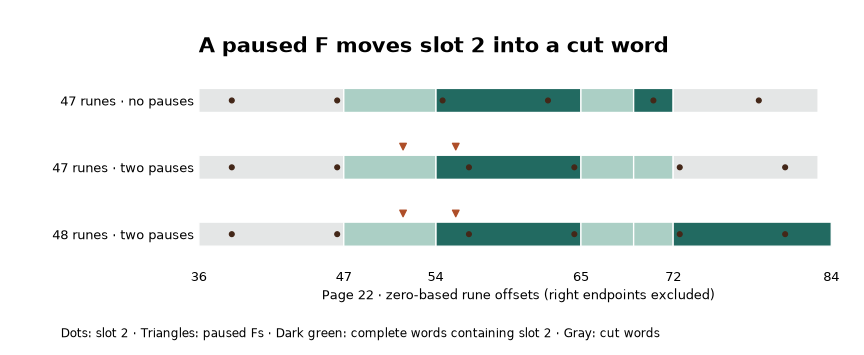
One implementation stepped through each possible pause mask in each window. Another assigned clock slots across a page for each mask and counted the window starts containing each complete word. The independent method reproduced 1,680 page/length/period/budget counts at the reported boundaries. The no-pause bounds also reproduce Session 164. These exact numbers assume the stated transcription, word boundaries, additive clock and pause budget; they do not demonstrate that the unsolved pages use them.
Ten-run decision. A search rebuilt from 72 runes recovered all three old misses on later endings and 17/17 fresh short-key endings. Two-slot repair gained one over one-slot repair; it needed two to meet the preset requirement. The rebuilt search met its gain criterion, both historical keys read their whole next pages with supplied pauses, and 12/17 genuine short predictions earned confirmation. But three deliberately wrong panels also earned confirmation across the two 17-record groups. The preset false-support limit was missed in both. The exploratory joint historical replay decoded two known texts with their keys and F maps withheld. No unknown-page plaintext was recovered or proposed.
Next test: hide the pause locations on fresh positive and negative controls. Compare a search carrying several possible clock positions with the family that assumes every rune advances. Require the first-page key and boundary state to predict a separate stretch, and count false endorsements when no offered key is correct. Use the 48/50-rune bounds for the two-pause layout check. This tests whether the historical success transfers before trying to interpret an unknown page.
Reproduce: protocol and labeled follow-ups · candidate search · all case records · summary · independent finalist verifier · joint historical replay and results. The search takes case and summary output names; the historical replay takes its result filename. Python 3, NumPy, SciPy and the linked notebook helpers and pinned inputs are required.
Layout evidence: runner · C++17 enumerator · counts and counterexamples · independent verifier · figure source. The runner compiles the enumerator in a temporary directory; pass the published result filename and run the separate verifier beside it.