For a continuously advancing eight-slot key, 39 consecutive runes guarantee that every slot touches at least two complete printed words anywhere a window fits in the unsolved text. With thirteen slots, the minimum is 48. Each bound is sharp: a particular window one rune shorter fails. This is a finding about where a key can be tested. It does not establish either period or any new plaintext.
We mapped the printed word boundaries of numbered LP2 pages 0–55: 12,956 transcribed runes, 2,864 word occurrences wholly contained on one page, and 32 crossing a page boundary. Page 50 has no transcribed runes; 55 pages contribute windows. Every possible within-page start was counted, with no edge fragments counted as words. Only positions and printed boundaries entered the audit, not candidate letters. “Two words” means two complete occurrences; they might have identical spellings or meanings.
| Hypothetical key period | Minimum runes for every slot to touch one complete word | Two words | Three words |
|---|---|---|---|
| 3 | 23 | 33 | 39 |
| 4 | 23 | 33 | 39 |
| 5 | 25 | 33 | 42 |
| 6 | 25 | 34 | 45 |
| 7 | 29 | 38 | 51 |
| 8 | 30 | 39 | 50 |
| 13 | 33 | 48 | 62 |
Why one more rune matters. On page 2, starting at offset 126, a 38-rune window puts slot 7 twice in the same complete word, at offsets 141 and 149. Another occurrence at 157 lies in a word still cut by the window’s right edge. Rune 39 completes that word. On page 22, starting at offset 36, a 47-rune window likewise leaves slot 10 in just one complete word. Rune 48 finishes a second word containing that slot. Page numbers, starting offsets and slots here are zero-based.
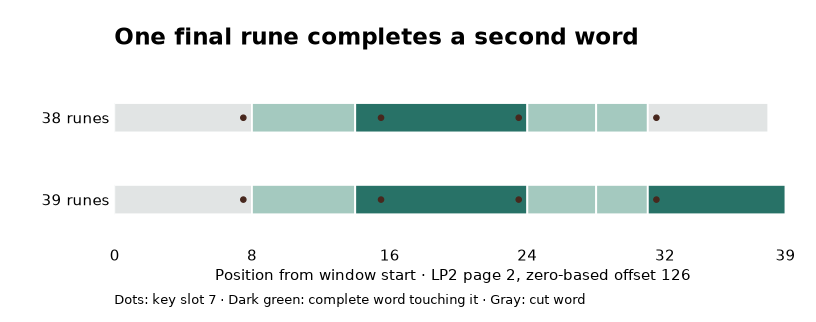
How often did the shorter windows suffice? In the original fixed-length audit at period eight, all slots touched two complete words at 9,527 of 11,691 24-rune starts and 11,148 of 11,251 32-rune starts. At period thirteen, none of the 24-rune starts could cover all slots twice; even without boundaries that would require at least 26 runes. At 48 runes all 10,371 eligible starts passed at both periods. The exact minima above came from a labeled follow-up: record when each slot’s first, second and third complete word ends at every start, then find the longest failing window. This independent calculation also reproduced the primary counts for all 56 pages, four fixed lengths and seven periods.
The limits depend on the notebook’s transcription and lexical marks, complete words within a single page, and a clock that advances on every rune. A skipped F or a reset changes the mapping. These lengths guarantee an opportunity to gather evidence. They do not say whether the words favor a proposed reading.
Ten-run decision. Word scoring recognized all 54 ordinary keys but so did the flat trigram. Both selected 30 of 31 harder pairs correctly and reached 17 of 20 exact hidden-key endings. Word scoring retained both historical keys and improved some historical panel counts. Against pairs with no correct choice, even the strongest corroboration rule accepted 8/54, above the preset 5% ceiling. The criteria for relying on this selector were not met, and the layout audit tried no key on unsolved text.
Next test: give the hidden search a chance to nominate a second changed key position when neither finalist has independent support. Freeze those alternatives, judge them on windows long enough for the proposed period, and score later runes blind. Keep two-wrong-key controls in the trial; otherwise a larger candidate list can reward a more convincing mistake.
Reproduce the batch: fixed protocol and follow-up · key-pair experiment · raw cases · model results · independent case verifier. The main script takes the case-archive filename and summary filename as arguments. The verifier independently fits the four models and checks both blind grades for every pair. These Python 3 scripts use NumPy, SciPy, the prior notebook helpers and their pinned inputs.
Layout evidence: page-by-page counts, CSV · fixed-length results and examples · exact minima and witnesses · layout audit · independent minimum-length calculation · illustration source. Run the layout script with its CSV and JSON output names, then the minimum-length script with its JSON output name.