Of the 56 ordinary breaks on LP2 pages 27–32, the next rune was too wide at 48. Eight remain borderline. Session 126 established the first 44. Here we revisited only the other 12, searching the rest of the book for the exact two signs that would have touched across each break. The new comparisons rule out four more early breaks. No break clearly leaves room, and no plaintext follows from these measurements.
The tree page: could line 5 have held the F?
On LP2 page 32, archive scan 49, line 5 ends in T (ᛏ) and line 6 opens with F (ᚠ). The same ordered pair occurs inside ordinary lines on ten other scans. Every time, the blank gap is just 3–4 pixels. Put the F after the T on line 5 and its ink would end at x = 1797–1798. Ordinary text elsewhere reaches 1798. An early break is therefore plausible here, but the page does not tell us whether the typesetter would have allowed it.
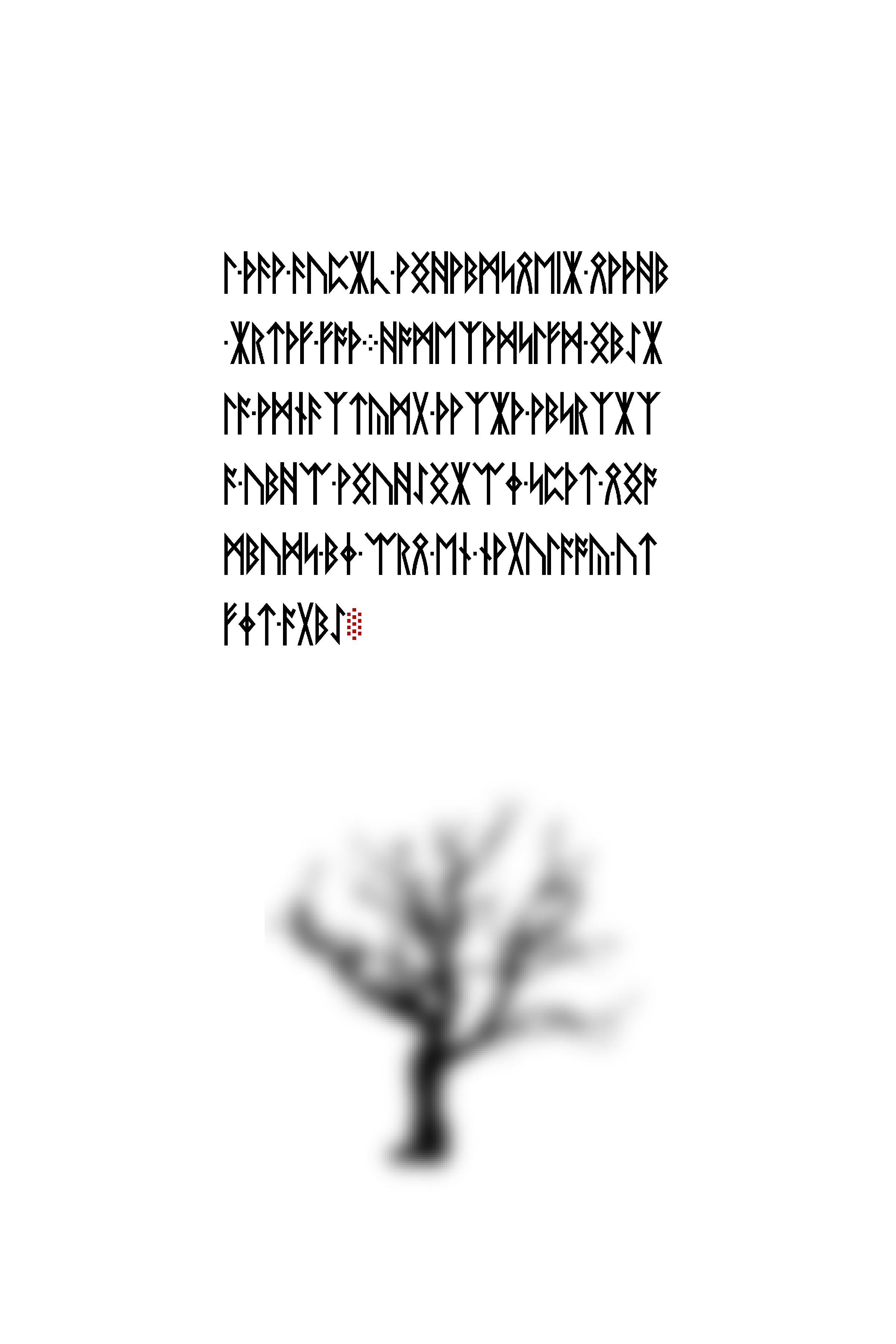
Line 3 is less promising. Its X–A (ᛉᚪ) pair occurs on seven other scans. The predicted end is 1805–1806, past the 1798 edge seen in our ordinary comparison lines. It still overlaps the generous boundary set before this test. Both breaks keep their borderline grade. These letter labels identify the printed runes; they are not a proposed reading.
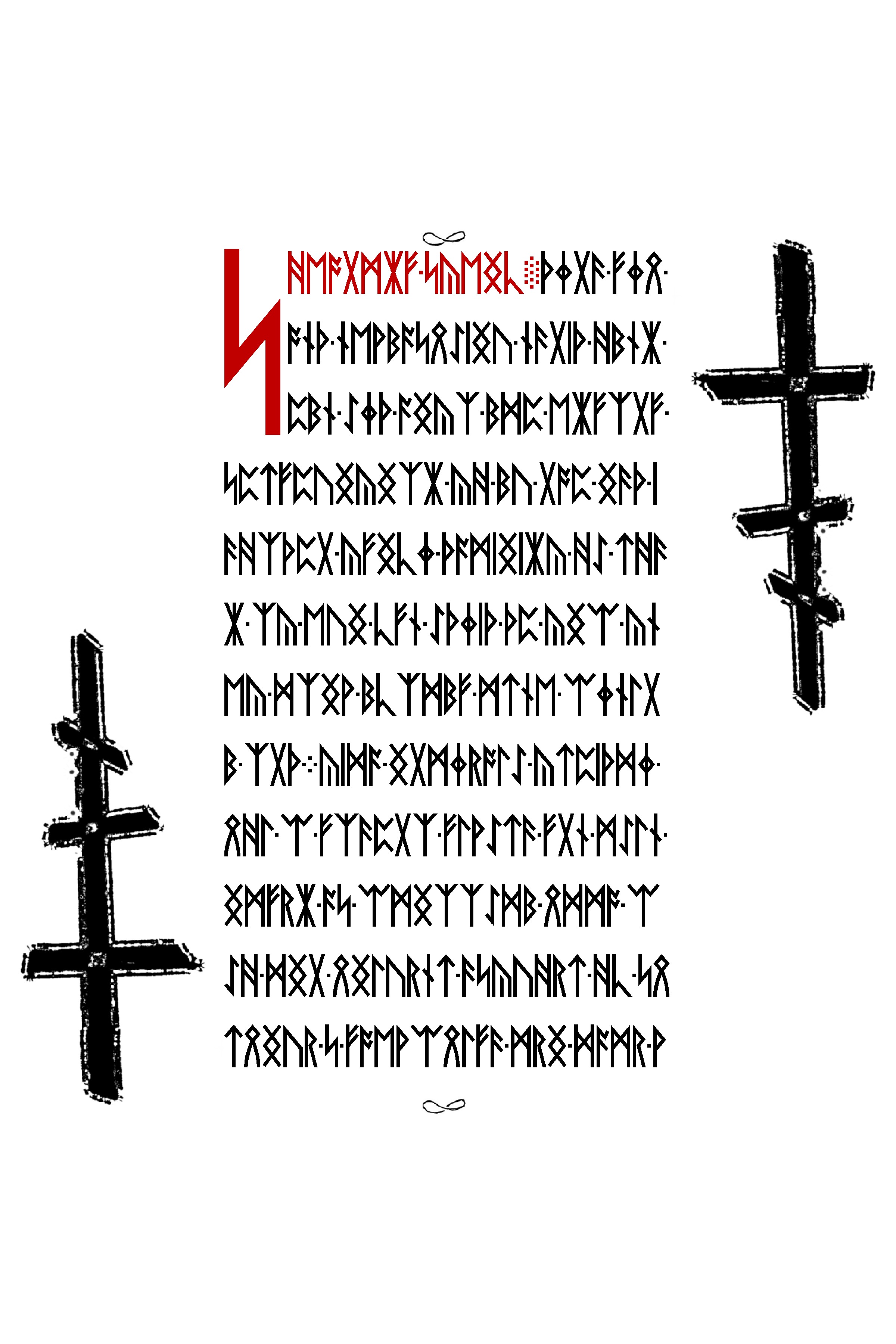
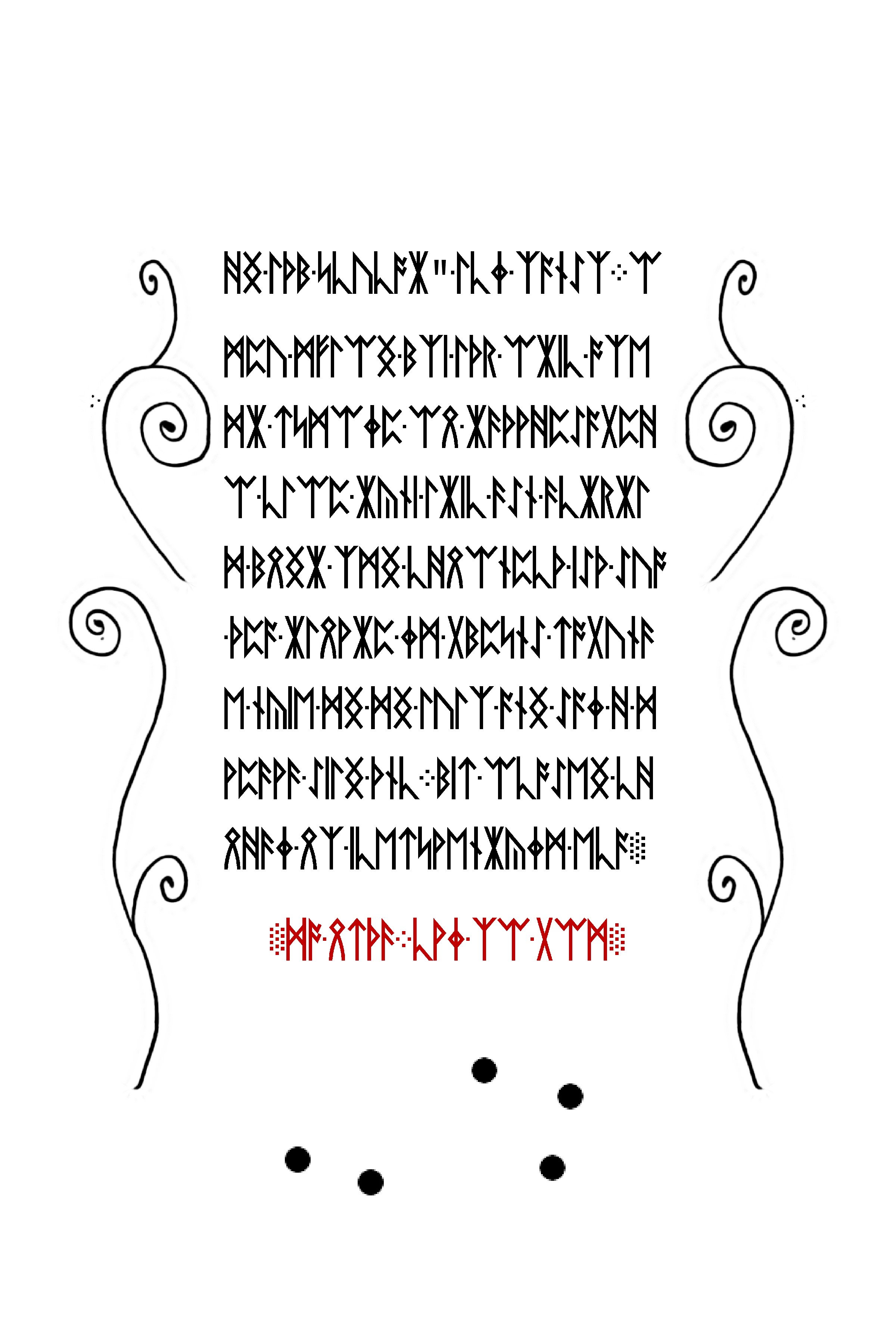
All twelve comparisons
“Dot” is the printed word separator already at the end of the line. Each predicted end includes both the measured gap and the width of the incoming sign. Coordinates are pixels in the original 2,400-pixel-wide JPEG; an end is the first column after the ink.
| LP2 page | Line | Last → next | Examples / scans | Predicted end | Grade |
|---|---|---|---|---|---|
| 27 | 5 | dot → EA | 81 / 39 | 1803–1805 | Borderline |
| 27 | 6 | dot → I | 69 / 39 | 1801–1802 | Borderline |
| 27 | 9 | dot → AE | 69 / 36 | 1811–1813 | Too wide |
| 28 | 2 | I → AE | 13 / 9 | 1808 | Too wide |
| 28 | 6 | dot → A | 63 / 34 | 1798–1799 | Borderline |
| 28 | 7 | J → B | 6 / 6 | 1808–1810 | Too wide |
| 29 | 10 | J → H | 3 / 3 | 1805–1806 | Borderline |
| 30 | 5 | E → TH | 3 / 3 | 1800 | Borderline |
| 31 | 6 | G → R | 8 / 7 | 1800 | Borderline |
| 31 | 7 | U → ING | 12 / 11 | 1810–1811 | Too wide |
| 32 | 3 | X → A | 7 / 7 | 1805–1806 | Borderline |
| 32 | 5 | T → F | 10 / 10 | 1797–1798 | Borderline |
How well does a pair predict spacing?
We excluded all six target scans from the reference set. A reference line had to match one complete transcribed row uniquely by position in that scan’s transcription and by glyph dimensions. We also checked the line origin, text height and ink color. This selects ordinary black body text; it does not independently verify the transcription.
At the primary pixel-darkness threshold (100), 419 lines across 54 scans supplied 10,835 adjacent sign pairs. For each comparison we set the whole observed scan aside and required at least three other examples across two scans. All 10,711 eligible observations fell within the predicted interval padded by two pixels. Thresholds 80 and 140 also covered all eligible observations (10,711 and 10,568). All twelve target intervals and grades stayed unchanged. The repeated typeface makes spacing reproducible; it does not reveal why a line ended.
We kept the earlier decision rule: a clear fit must end at or before 1793 even after adding two pixels; a “too wide” call must exceed 1805 even after subtracting two. All other supported outcomes are borderline.
Why 1798 is not a decoding rule
Can a single cutoff in visible ink explain the ordinary wraps? Among 136 consecutive reference-line transitions on 24 even-numbered scans, printed ink reaches 1798. Yet at least one wrap would need the cutoff at 1797 or less to explain why the next sign moved to a new line, even using the generous end of its predicted interval plus the two-pixel allowance. The 154 transitions on 24 odd-numbered scans independently give the same incompatible limits. This one-pixel inconsistency is enough to rule out that exact cutoff model under our assumptions. The groups share the same reference typeface and spacing procedure.
A font can reserve blank space to the right of its visible strokes. The next test is to estimate that reserved width from the positions of successive runes, then predict ordinary breaks on pages set aside in advance. Only if that predicts those breaks accurately should we use it to judge line 5 of the tree page.
Comparison rules · Measurement script · All endpoints, reference examples and control results (gzipped JSON) · Source-image hashes · Earlier margin measurements