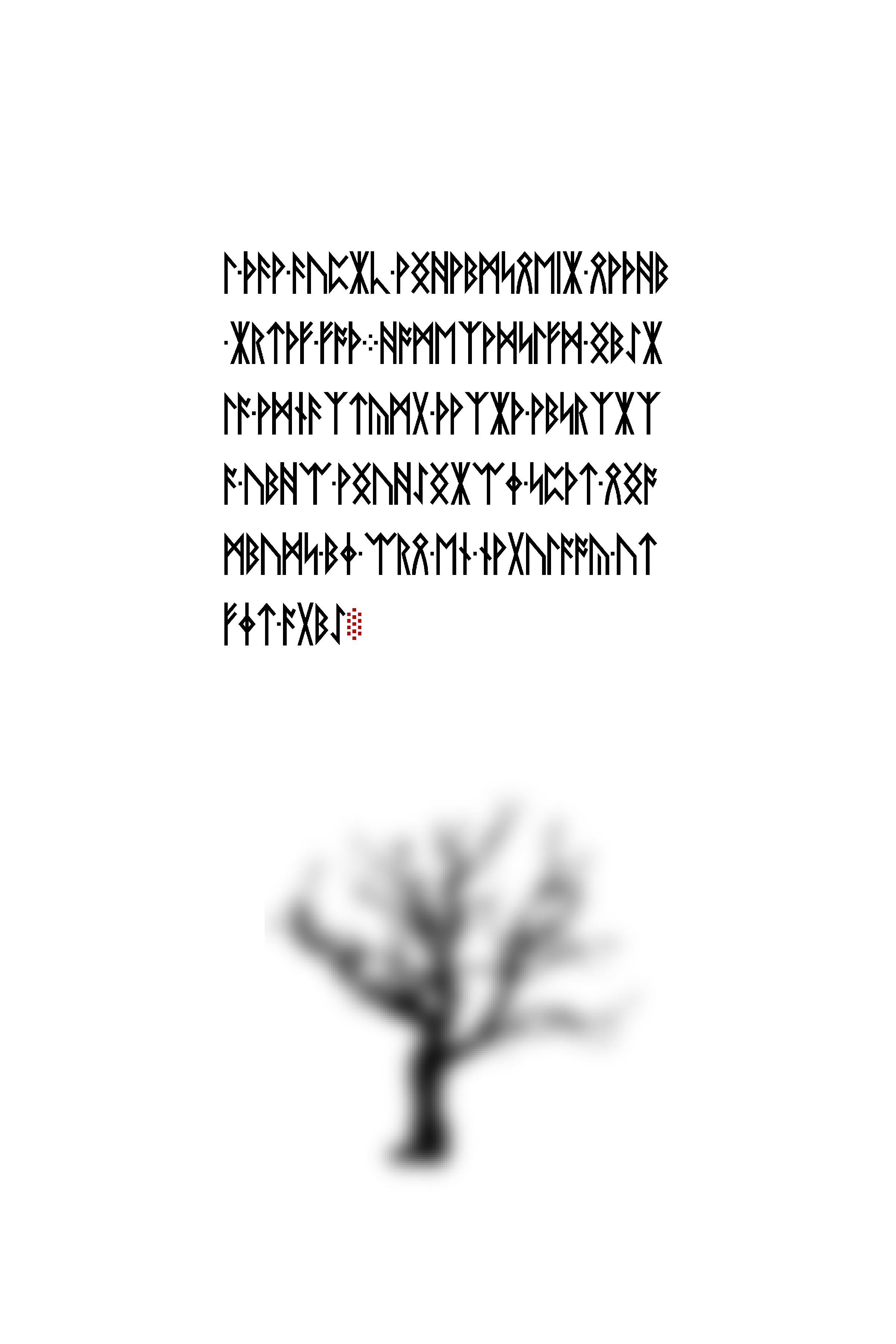
None of the 56 measured line breaks on LP2 pages 27–32 clearly left room for the next rune. At 44 breaks the next rune was too wide even under a generous margin; the other 12 are borderline. On the page with the tree itself (LP2 page 32, archive image 49), three of five breaks were too tight and two were borderline. This gives us no line ending to use as a cipher clue yet.
The line that looked most promising
On page 27, line 5, the ink ends at horizontal coordinate 1711. The furthest edge measured on comparable solved lines was 1793, which leaves 82 pixels. But the next rune is EA, a single wide glyph: its actual image on line 6 is 86 pixels wide, even before adding a gap. If we allow a wider margin, it becomes borderline. The unusually short-looking line has an ordinary explanation.
What counted as room?
We used the pinned JPEGs at their original 2,400 × 3,600 resolution. We measured only ordinary black text continuing onto the next line on the same page. We excluded headings, drop-cap rows, illustrations and final rows of text blocks. The six tree-passage pages supplied 56 eligible breaks. Four solved comparison images (05, 14, 15 and 74) supplied 14. This is a selected group with comparable open margins, not a random sample of the book.
For each break we measured the last visible ink, then the width of the actual next rune from the next row. If the next row starts with a word-separator dot, we included the dot and its space. A separator already at the end of the current row was already in its measured width. We checked the incoming glyph widths against the earlier solved glyph measurements; we did not need to recognize or decrypt the surrounding text.
In the solved controls, 194 gaps between adjacent printed signs spanned 1–18 pixels at the main ink threshold. We required the next rune to fit even with the largest such gap and two pixels to spare before x=1793. To call it too wide, even the smallest gap had to put its end more than two pixels past x=1805, a generous allowance around the nominal x=1800 edge. The interval between these decisions is intentionally left unresolved. Repeating the measurement at three darkness thresholds changed no real line's classification.
| LP2 page | Breaks checked | Clearly fits | Borderline | Too wide |
|---|---|---|---|---|
| 27 | 7 | 0 | 3 | 4 |
| 28 | 11 | 0 | 3 | 8 |
| 29 | 11 | 0 | 1 | 10 |
| 30 | 11 | 0 | 1 | 10 |
| 31 | 11 | 0 | 2 | 9 |
| 32, with the tree | 5 | 0 | 2 | 3 |
| Tree passage | 56 | 0 | 12 | 44 |
| Solved comparison pages | 14 | 0 | 4 | 10 |
Could this test detect a break placed one rune early?
We moved the break back by one rune on each eligible line with a clearly measurable ending, carrying the preceding single separator with it where applicable. The rune had actually fitted on the original line, so this gave a positive control without inventing a glyph. The conservative rule detected 23 of 39 planted early breaks in the tree passage and 5 of 11 on solved pages. It classified all the rest as borderline. A failure to flag a break cannot establish that it was mechanically wrapped.
On the tree page, the two borderline cases are lines 3 and 5, before A and F respectively. On line 5 the F is 34 pixels wide; with the observed gap range it would end between x=1795 and 1812. That straddles the plausible margin. A useful next test is to look for the same neighboring signs elsewhere in the same typeface and measure their particular spacing. That could resolve some of the 12 borderline cases without guessing a plaintext or assigning meaning to the tree.
Replay script · all row measurements, planted breaks and threshold checks · original page and delimiter map. Run the script beside the listed JPEGs, image manifest, glyph measurements and master transcription with Python, NumPy and Pillow. The results are gzipped JSON.