The title fits the space, but the evidence argues against the proposed reading. One spelling of beginning fits the eight red runes. It requires two adjacent runes that never occur together in our solved reference text. Keys inferred from that title do not read the next printed line, either.
What is actually on the page?
This detail uses the archived page image, LP2 page 54 (image 71 in the combined collection). The oversized red initial, red word, dot cluster and start of the black body text are visible together.
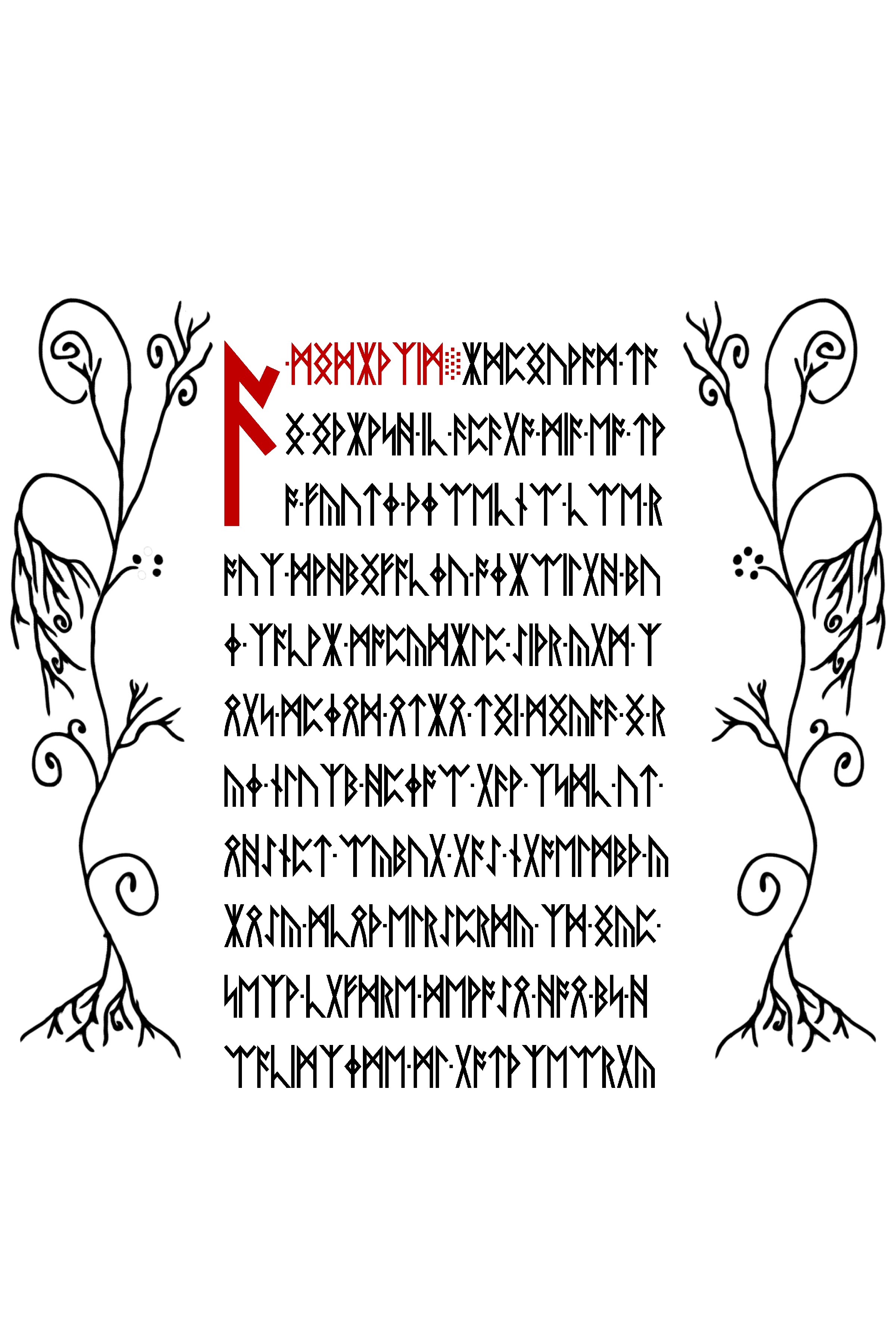
Our reading of the red ciphertext agrees with the master transcription: ᚪ · ᛗᛝᛞᛡᚦᛉᛁᛗ. The second word starts and ends with the same rune, ᛗ. For beginning to fit, that rune would have to mean B at the start and NG at the end. This rules out even a fixed decoding table where different runes can share a letter: the same rune still has to give the same output. A key that changes by position can do it.
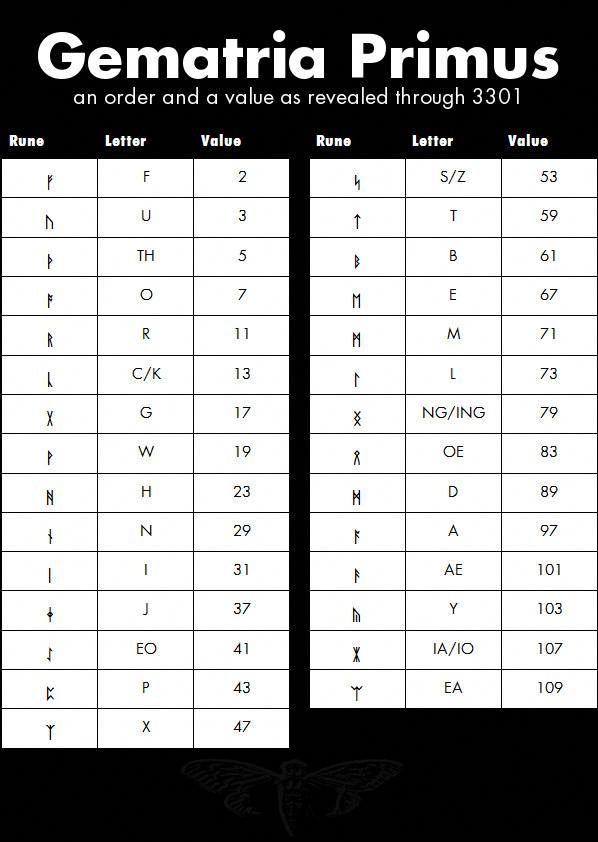
The Gematria chart gives ᛝ both NG and ING. That lets us settle the 2014 disagreement without dropping a letter:
| Spelling of the second word | Number of runes | Fits eight? |
|---|---|---|
| B E G I N N I N G | 9 | No |
| B E G I N N I NG | 8 | Yes |
| B E G I N N ING | 7 | No |
The distinction matters in practice. Across 2,977 solved runes in nine reference groups there are 31 occurrences of ᛝ, including 23 at word endings; zero are immediately preceded by the I rune. The known title A Warning ends in a single ING rune. We also tried begining, with one N omitted, as a separate sensitivity check. Its eight-rune version ends in three separate runes I, N, G; none of the 739 reference word tokens ends that way. These are observations about the recovered text, not rules for every unsolved page.
Did the title predict anything in black ink?
For each fitting spelling, subtracting the proposed plaintext from the red ciphertext fixes all shifts modulo 29. We repeated that exact key in the printed direction, advancing once per rune. We either included the oversized initial (nine shifts, the first zero) or treated it as unkeyed (eight shifts). Neither set of shifts admits a shorter repeating period. None matches the page 56 prime-minus-one rule at any of its first 3,301 starts in either treatment. A known nine-rune sample from page 56 identifies its actual prime start uniquely in the same search.
We left the black text out of key selection. The key first crosses the ten black runes on line 1. The first independent score uses the 21 runes on line 2; the second uses the remaining 192 runes on lines 3–11. On each window, we compared the proposed spelling with all 180 distinct ways to order the same six interior runes, keeping B and the final rune fixed. Rank 1 is best. Scores use rune pairs learned only from solved LP1 pages; rotation or fitting on black text was not allowed.
| Title spelling | Repeated key | Next printed line, rank / 180 | Remaining nine lines, rank / 180 |
|---|---|---|---|
| Beginning | 9 | 144 | 89 |
| Beginning | 8 | 135 | 12 |
| Begining | 9 | 9 | 124 |
| Begining | 8 | 148 | 9 |
One misspelling variant scores well on the short window, another on the long one. No single spelling and key length scores in the top nine on both or yields readable text. A short-window rank alone is weak: on constructed samples made from the solved Welcome and Second Koan, correct keys ranked between 1st and 13th on the short line, but first on the long window in all eight checks, recovering all 223 body runes each time. Those controls use the same four models and only two independent plaintext passages.
An independent check that does not need an English guess
Session 32 verified the same six ciphertext runes on pages 27 and 55. Suppose their plaintext is also the same and the same key restarts at the red openings on pages 27 and 54. The two copies start at offsets 28 and 302 from those openings, a difference of 274. With every rune consuming a shift, all four title-derived keys disagree at all six positions.
If selected F runes consume no shift, there is one possible F before the earlier copy and six before the later copy. We tried every possible pair of skip counts. An eight-slot key agrees across the two phrases only when the later passage skips two more Fs; a nine-slot key requires four more. This identifies a condition, not which Fs to skip, and identical ciphertext need not carry identical plaintext. Also, there is no F anywhere in the first 31 black runes on page 54. Changing F handling cannot repair what these keys predict on line 2.
We are setting this title aside as a key. The next useful question is whether a rule for skipping F, chosen on solved pages before looking at either copy, predicts their relative alignment. The 274-rune spacing gives such a rule an exact test without choosing another English title.
Reproduce: Python replay, all spellings, shifts, ranks and skip counts, known plaintext rune streams. Run the script beside the reference streams, master transcription and page image linked above. The archive is a retained copy, not a new authentication of the historical image.